“Sign the contract before I decide you’re not worth paying at all,” Victor Harlan snapped, thrusting the papers toward Sarah Whitmore’s face. Behind him, a massive drilling rig waited beside the narrow ribbon of green grass crossing her otherwise pale Kansas field, its engine rumbling as though the land already belonged to him. Sarah stood between the machine and the rocky depression, wearing a dusty-mauve farm dress, a neatly tied ivory apron, a cream headscarf, and simple black flats that were already gathering dust. She knocked the contract away with the weathered field journal in her hand and said, “Start drilling, Victor, and the federal water investigators will arrest you before your crew reaches ten feet.”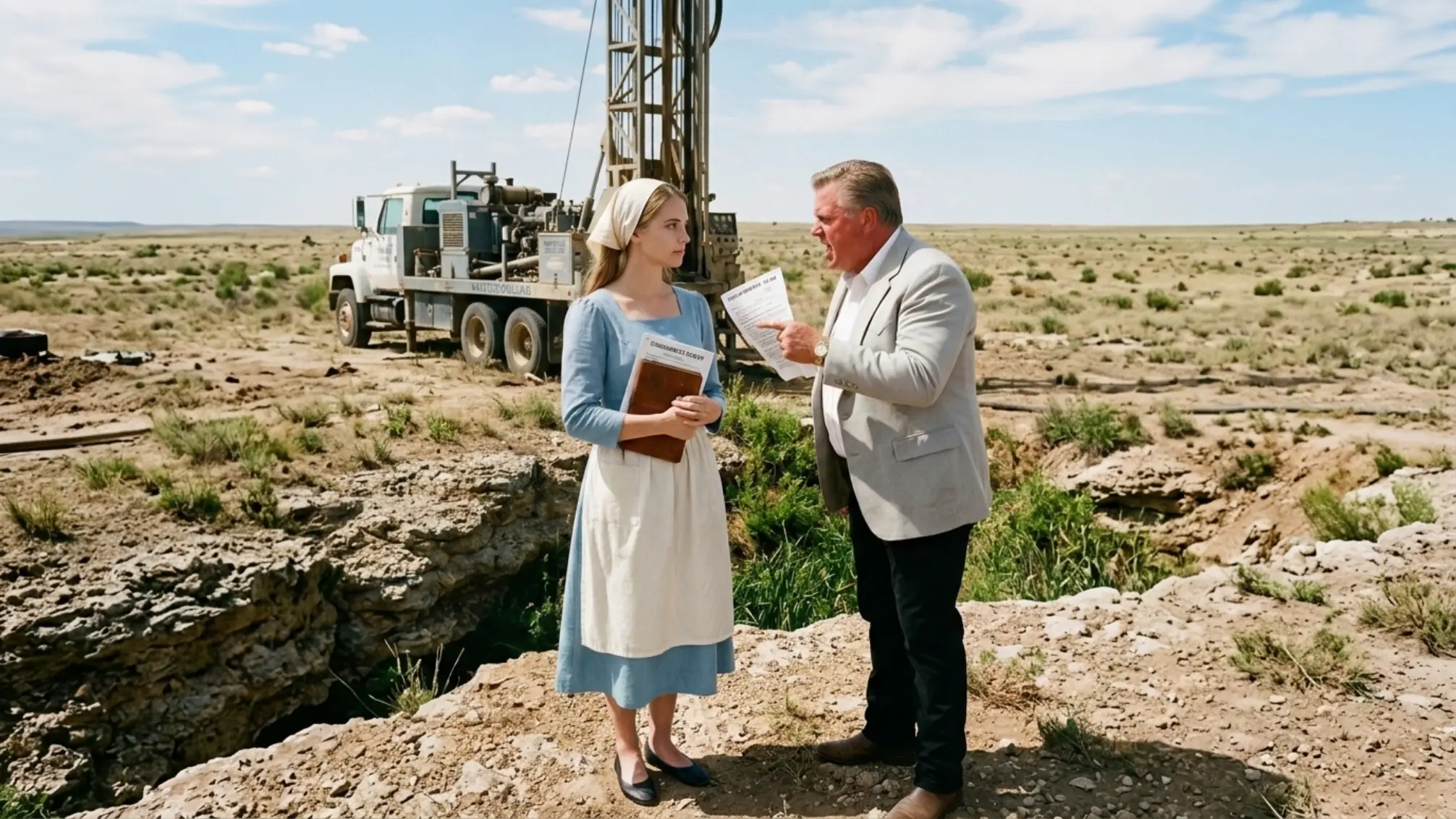
Victor’s face tightened, but Sarah saw the hesitation in his eyes. He had expected a frightened young woman who could be bullied into selling the most valuable part of her property for almost nothing. He had not expected survey stakes, hidden cameras, or the official groundwater protection notice folded inside her journal. As two dark government vehicles appeared beyond the hill, Sarah looked toward the place where the impossible spring had risen from the earth and remembered the cold April morning when everyone had believed she was buying nothing but failure.
Sixteen months earlier, Sarah had walked into the county office carrying a cashier’s check for $5,500. The amount was so small that the clerk examined it twice, as though a zero must have been missing. Across the table sat Raymond Carter, a sixty-seven-year-old farmer whose hands were broad, scarred, and permanently bent from decades of work. He signed the deed without asking Sarah whether she understood what she was purchasing.
The Carter farm had been considered useless for nearly forty years. Wheat shoots yellowed before reaching six inches, shallow wells dried by August, and the alkaline soil cracked into white-edged plates beneath the summer heat. Raymond’s father had borrowed money against the property, Raymond had refinanced it twice, and both men had spent their lives believing that one more season might finally turn the land around. Instead, every hopeful year had been followed by another drought, another failed crop, and another piece of equipment sold to satisfy a lender.
“You can still change your mind,” Raymond said after Sarah finished signing. “Nobody here will blame you.”
Sarah looked through the office window toward the distant western edge of the property. A narrow curve of greener grass crossed one hillside, barely visible among the exhausted fields. She had noticed it when she arrived, and the sight had left a quiet pressure inside her chest. “I’m not changing my mind,” she said.
Raymond studied her for a long moment. “I loved that place, but it never loved me back.”
“Maybe it did,” Sarah replied. “Maybe nobody understood what it was trying to say.”
The clerk lowered her eyes to hide a smile. By the time Sarah returned to her dusty pickup, two men standing outside the feed store were already discussing the foolish young woman who had paid real money for the Carter place. One said she would leave before winter. The other guessed she would last until the first repair bill arrived. Sarah heard them, placed the deed beside her on the truck seat, and drove away without answering.
She was twenty-seven years old, but farming had shaped nearly every year of her life. Her grandparents had raised cattle and winter wheat two counties east, where Sarah learned to recognize an approaching storm by the smell of the air and judge soil moisture by rubbing dirt between her fingers. After college, she worked for six years as a soil-conservation technician. She walked failing farms, measured erosion, mapped drainage, and wrote recommendations that desperate landowners often could not afford to follow.
The old Carter farmhouse had peeling white paint, warped floorboards, and a kitchen faucet that coughed rust before producing water. Sarah moved in with two suitcases, a narrow bed, and several boxes of field notebooks. On her first evening, she sat beneath a single hanging lamp and opened a fresh brown journal. At the top of the first page, she wrote, “What is this land trying to tell me?”
For four months, Sarah planted nothing. She walked the property before sunrise, again at midday, and often once more before darkness. She marked the driest areas, the places where wind gathered loose soil, and the shallow channels created by decades of erosion. Most importantly, she recorded every location where the farm behaved differently from what its reputation suggested.
The ribbon of green grass on the western hillside never disappeared. Even when June brought three weeks without rain, the narrow strip remained softer and brighter than the land around it. A cluster of old cottonwood trees grew near a rocky depression farther down the slope, although cottonwoods usually needed reliable water. On the hottest afternoons, the soil beneath those trees felt cool against Sarah’s palm.
She began noticing birds gathering near the depression shortly after sunrise. Meadowlarks landed there repeatedly, and insects hovered above several patches of wildflowers that continued blooming after flowers elsewhere had wilted. None of those observations proved the existence of water. But Sarah knew that isolated clues became meaningful when they formed a consistent pattern.
Her nearest neighbor, Henry Collins, watched her cross the fields with a notebook and measuring stick. Henry was sixty-three, broad-shouldered, and deeply suspicious of any farming method that required more paper than machinery. One evening, he leaned across the boundary fence while Sarah marked another patch of cool soil. “You’re chasing ghosts,” he told her. “Three generations drilled that farm, and all three came up dry.”
“They drilled where the old well maps told them to drill,” Sarah answered.
“Because that’s where water should have been.”
Sarah closed her notebook. “Land doesn’t care where we think water should be.”
Henry laughed, though not cruelly. “You’ve got courage, girl. I’ll give you that.”
“Courage is cheaper than a new well,” she said. “For now, I’m using what I can afford.”
By July, Sarah believed an underground water system passed beneath the western slope. She hired a local drilling crew using nearly all the money she had left after purchasing the farm. The first test well produced damp limestone and barely enough water to fill a bucket. The foreman removed his hat, glanced toward Sarah, and gently advised her not to spend more money.
She marked a second location one hundred yards north. That well was worse. The bit struck dense rock, and the crew found no useful water at all. When the trucks left that afternoon, Sarah stood beside the empty borehole until dust from their tires vanished beyond the gate.
Henry arrived carrying two bottles of water. He offered one without mentioning the failed well. Sarah accepted it and stared at the white soil around her shoes. “You can say it,” she murmured.
“I’ve been wrong before.”
“You don’t sound convinced you’re wrong now.”
“No,” Henry admitted. “But I don’t enjoy watching a good person lose money.”
Sarah spent that night at her kitchen table with both failed drilling reports spread beside her journal. Doubt entered quietly, not as a sudden surrender but as a hundred reasonable questions. Perhaps the green grass came from trapped surface moisture. Perhaps the cottonwoods had roots stretching farther than she understood. Perhaps she had mistaken persistence for proof because she desperately wanted the farm to contain something everyone else had missed.
The following morning, Dr. Melissa Grant from the county extension office examined Sarah’s notes. Melissa had studied groundwater systems for nearly three decades and had listened to countless landowners describe hidden rivers, forgotten wells, and family legends about springs. She turned several pages, paused over Sarah’s wildlife records, and raised an eyebrow. “Cottonwoods and birds are observations,” she said. “They are not evidence of a usable aquifer.”
“I know.”
“You have already drilled twice.”
“I know that too.”
Melissa closed the journal. “Then what exactly are you asking me to do?”
Sarah looked toward the western hillside. “I’m asking you to tell me why all these unrelated things keep happening in the same narrow line.”
Melissa did not agree to a survey, but she also did not dismiss Sarah completely. Before leaving, she suggested checking historical aerial photographs and old drainage records. Sarah drove to the county archives that afternoon and spent hours opening boxes that smelled of dust and aging paper. She found agricultural maps, handwritten well reports, and black-and-white photographs dating back to the early 1960s.
Near midnight, she arranged several photographs across her kitchen table. In the oldest image, a faint seasonal drainage line crossed the farm in a curved path. In later photographs, erosion, plowing, and new fence lines slowly erased it from view. By the late 1970s, the channel had disappeared almost completely.
Sarah placed her hand-drawn map over the photograph. The line matched the greener grass, the cottonwoods, the cool soil, and the wildflowers. Her failed wells had not been evidence that no water existed. They had simply been drilled outside the ancient channel.
She telephoned Melissa shortly after sunrise. The hydrologist arrived expecting another theory, but her expression changed when Sarah laid out the historical photographs. Melissa aligned the maps herself, checked the dates, and studied the slope through the farmhouse window. “This could indicate fractured limestone beneath the old drainage path,” she said carefully.
“Can we test it?”
“A proper test will cost more than another shallow well.”
“I’ll find a way.”
Sarah sold her grandmother’s unused horse trailer, postponed repairs to the farmhouse roof, and applied for a small conservation research grant. Melissa persuaded a university team to bring ground-penetrating radar equipment at reduced cost. For three days, they moved slowly across the western slope, sending signals into the earth and recording the shapes of buried rock.
The results revealed a fractured limestone layer beneath the old drainage route. Rainfall from higher land several miles away entered the limestone and traveled through a natural network of underground channels. Near Sarah’s farm, the water encountered a dense rock barrier that forced it upward. A shallow, pressurized pocket had formed beneath the exact area where the grass remained green.
Melissa stood beside the monitor and stared at the readings. “You have a perched aquifer,” she said. “Possibly a natural spring system.”
Sarah swallowed. “How long has it been there?”
“Long before the Carter family owned this farm.”
The third test well was drilled forty yards east of the cottonwoods. At thirty-two feet, the bit entered fractured limestone. At thirty-eight feet, water began rising inside the casing. By the time the crew reached forty-five feet, clear water spilled over the top and ran across the dust in a shining stream.
No one spoke for several seconds. The drilling foreman removed his hat. Melissa crouched and allowed the water to run across her fingers. Sarah stood perfectly still, afraid that moving might somehow break the moment.
Raymond Carter returned two days later. He walked beside Sarah toward the new well, carrying his hat against his chest. When he saw water flowing into a temporary holding tank, his face crumpled. “Forty years,” he whispered. “I walked past this place ten thousand times.”
Sarah placed a hand on his arm. “You weren’t careless, Raymond. The visible channel disappeared before you took over.”
“I thought the land had failed me.”
“It didn’t fail you,” she said. “It was hiding its answer in a place nobody checked.”
News spread through the county before the water tests were complete. Local farmers drove slowly past Sarah’s gate, hoping to glimpse the spring. Agricultural reporters called the discovery remarkable, while land brokers began estimating the property’s new value. A farm purchased for $5,500 was suddenly being discussed in numbers Sarah had never expected to hear.
The most aggressive offer came from Harlan Agricultural Development. Its owner, Victor Harlan, controlled irrigation projects across three states and had a reputation for purchasing distressed land before desperate families understood what they owned. He arrived in a spotless black truck wearing polished boots, a pale-gray jacket, and a gold watch that cost more than Sarah’s farmhouse. His first offer was $300,000.
Sarah thanked him and declined.
Victor smiled as if she had misunderstood. “You bought this place for less than the price of my truck tires.”
“That doesn’t mean I have to sell it.”
“You found water, Sarah. You didn’t create it.”
“Neither did you.”
His smile disappeared. He increased the offer to $600,000 and explained that his company could install commercial pumps, pipelines, and holding reservoirs. Sarah asked how much water he intended to withdraw each year. Victor answered with financial projections instead of a number.
Melissa’s testing showed that the spring was substantial but vulnerable. It could support Sarah’s farm, restore nearby wetlands, and provide limited drought relief to neighboring properties. Industrial extraction, however, could lower the underground pressure and collapse the system within several years. Protecting the recharge zone was essential because contamination miles away could poison the entire aquifer.
Sarah rejected Victor’s second offer. Soon afterward, surveyors wearing Harlan company jackets appeared near the northern boundary without permission. Sarah photographed their vehicles and ordered them to leave. A week later, she received a letter claiming that historical water rights allowed Victor’s company to investigate the spring.
The document looked official, but Sarah noticed the legal description referred to an abandoned drainage district that had never included the Carter property. She brought the letter to the county water office. Investigators confirmed that no such right existed and warned Victor in writing to stay off her land.
He responded by approaching Sarah’s neighbors. He told them her conservation plan would prevent anyone else from using the spring. He claimed she intended to charge desperate farmers extreme prices during droughts. Henry heard the rumors at the feed store and drove directly to Sarah’s farmhouse.
“People are listening to him,” Henry said.
“Because they’re frightened.”
“He says he can guarantee water for twenty years.”
Sarah placed Melissa’s recharge calculations on the table. “Not at the volume he wants to pump. He’ll drain the spring in five.”
Henry studied the report. “Then show everyone.”
Sarah invited neighboring farmers to the old barn. Melissa explained the aquifer, the recharge zone, and the withdrawal limits in plain language. Sarah proposed a cooperative system in which surrounding farms could receive emergency water during severe droughts. No one would become wealthy quickly, but the spring could remain productive for generations.
Most farmers supported her after seeing the evidence. Victor, however, had already negotiated secret option agreements with two landowners above the recharge zone. Those agreements would allow him to drill industrial wells just outside Sarah’s boundary. Legally, he could claim he was pumping from a different underground source unless Sarah proved the water systems were connected.
For the next three months, Sarah and Melissa gathered samples from shallow wells across the region. They compared mineral signatures, temperature, pressure, and seasonal flow. The results showed that Victor’s proposed wells would draw from the same fractured limestone feeding Sarah’s spring. Sarah submitted an application to designate the recharge area as a protected groundwater zone.
Victor filed an objection and hired lawyers from Wichita. They portrayed Sarah as an inexperienced farm owner attempting to control water beneath property she did not own. Anonymous complaints accused her of operating an illegal irrigation system. Someone cut a section of fence near the spring, and twice Sarah found tire tracks crossing her fields during the night.
She installed trail cameras around the western slope. One recorded a Harlan supervisor measuring the spring outlet after midnight. Another showed workers placing small colored stakes inside Sarah’s property. The most important camera captured Victor himself studying a map beside the rocky depression while pointing toward the exact location of the pressurized water pocket.
Sarah delivered the recordings to county investigators. They opened a formal inquiry but warned her that trespassing charges alone might not stop Victor. He had enough money to delay hearings and enough influence to pressure landowners. Sarah needed the protected-zone designation before his drilling permits were approved.
The final public hearing was scheduled for a Monday morning. On the Friday before it, Sarah drove to town to collect additional copies of Melissa’s report. When she returned, she heard machinery beyond the western hill. A drilling rig was entering her field through the section of fence that had been cut again.
Victor stood beside it holding a contract. He claimed one of the neighboring landowners had granted him temporary access across Sarah’s farm. Sarah knew the document was worthless because no neighbor could authorize entry onto her property. Still, Victor behaved as though the arrival of the machine had already settled the dispute.
Sarah walked toward him in the beautiful dusty-mauve dress and cream headscarf she had worn for a county heritage event that morning. Her ivory apron remained tied around her waist, though she had exchanged the basket of apples she carried at the event for her field journal and evidence folder. Victor looked at her clothes and laughed. “Did I interrupt a costume parade?”
“You interrupted your last chance to leave voluntarily.”
He pushed the purchase contract toward her. “You paid $5,500 for dead dirt. I’m offering you more money than anyone in your family has probably seen. Sign before I decide you’re not worth paying.”
Sarah struck the papers aside with her journal. “Bring that rig another foot onto my land, and it becomes evidence.”
Victor stepped close enough that she could smell coffee on his breath. “I have drilling permits, lawyers, and agreements with every landowner who matters.”
“You don’t have permission from me.”
“I won’t need it after Monday.”
Sarah glanced at the rig operator. “Has he told you the aquifer is under an active protection review?”
The operator looked toward Victor. Victor’s jaw hardened. “Start the engine.”
The machine rumbled louder, but it did not move. Sarah raised her phone and activated a live video connection. Melissa appeared on the screen beside two officials from the state water authority. Sarah had contacted them the moment she heard the machinery.
Victor reached toward the phone. “Turn that off.”
Sarah stepped back. “Touch me, and they add assault to the recording.”
“You’re bluffing.”
“Then start drilling.”
The first government vehicle appeared beyond the hill, followed by another. Victor turned toward the road, and Sarah watched confidence drain from his expression. Investigators had obtained emails showing that his company knew the proposed wells were connected to the spring. One message instructed an employee to begin drilling before the protection order could be approved, because “once the equipment is in the ground, the girl will have to negotiate.”
The hearing still took place on Monday, but Victor did not attend as an objecting investor. He appeared with attorneys while investigators reviewed allegations of permit fraud, attempted illegal extraction, trespassing, and falsified access agreements. His own maps showed plans to pump nearly four times the aquifer’s sustainable yield.
The groundwater protection designation passed unanimously. Victor’s drilling permits were revoked, and Harlan Agricultural Development was ordered to restore damaged fencing and pay for environmental monitoring. Several landowners canceled their option agreements after learning that Victor intended to leave them responsible if the wells failed. Within a year, additional financial investigations forced him to sell the company.
Sarah did not use the victory to punish the community members who had doubted her. She established a cooperative water plan, protected the recharge zone, restored native grasses, and installed gravity-fed irrigation that required no expensive pumps. During the severe drought two summers later, the spring supplied emergency water to Henry’s farm and three other properties.
Standing in a field of living wheat, Henry shook his head as water moved through the irrigation channel. “I told you that you were chasing ghosts.”
Sarah smiled. “You were right.”
Henry frowned. “How do you figure?”
“The spring was the ghost of an old river,” she said. “I just followed where it used to walk.”
Raymond continued visiting the farm on quiet evenings. Sometimes he sat near the restored wetland and listened to water moving between the grasses. He no longer spoke about the years he believed the land had betrayed him. Instead, he told young agricultural students that failure sometimes meant people had asked the wrong question for too long.
Sarah’s farm became a demonstration site for sustainable groundwater management. Students studied the fractured limestone, farmers learned to recognize natural indicators, and conservation teams used her records to locate other forgotten drainage systems. The weathered journal she had carried from the first day remained on her kitchen table, its pages softened by dust, rain, and constant use.
Near the front, beneath maps and measurements, one sentence remained written in dark pencil: “What is this land trying to tell me?” Sarah never crossed it out. Finding the spring had not ended the question. It had taught her how important it was to keep asking.
The farm had never been dead. The water had never vanished. Beneath forty years of failed harvests, debt, doubt, and disappointment, it had continued moving patiently through the limestone.
It had simply been waiting for someone who would listen longer than everyone else.