“You’d rather trust filthy beavers than pay a real man to save this ranch?”
Wade Harper stood above the creek bank in a spotless white work shirt, his polished boots planted carefully beyond the mud. His silver watch reflected the brutal Oregon sunlight as he pointed toward the tangled wall of sticks, reeds, and wet clay blocking the narrow channel. Behind him, Clare Bennett rested both hands on the handle of her shovel, her red-and-cream plaid shirt dusty beneath faded denim overalls.
“A real man wouldn’t need my drought to make his money,” she said.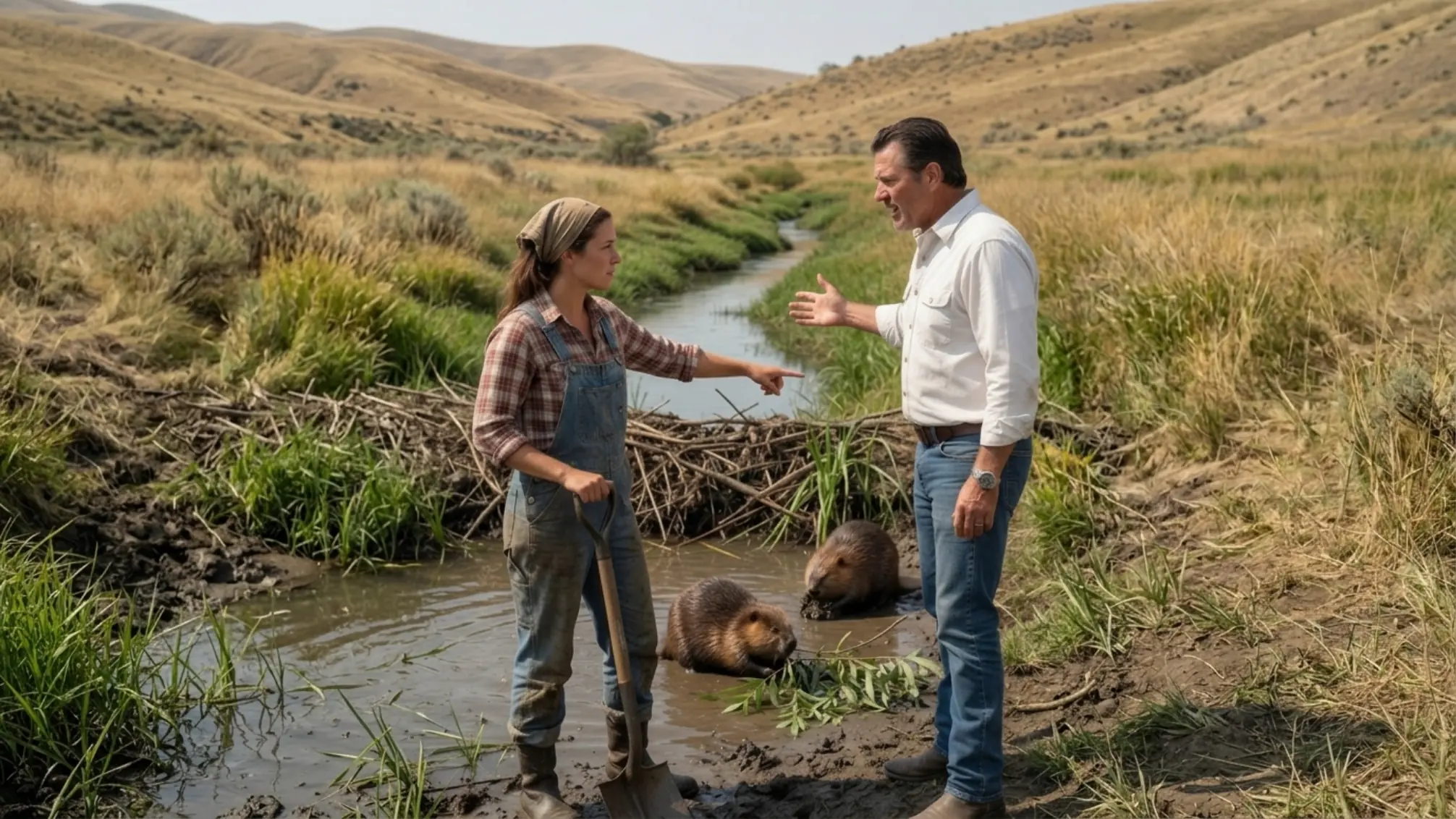
Wade’s smile disappeared. A few yards behind Clare, one large beaver dragged a willow branch through the shallow pond while its mate pressed mud into the dam with quick, deliberate movements. The water now stretched across ground that had been cracked and gray only weeks earlier.
“One complaint from me,” Wade said, stepping closer, “and this whole mess gets ripped out by sundown.”
Clare looked from his polished boots to the widening water behind her. “Do it, and explain why your experts failed where two beavers didn’t.”
Six months earlier, Bennett Creek Ranch had been dying one dry acre at a time. The ranch had belonged to Clare’s family for three generations, but history could not make water rise from an empty well. Her grandfather had once swum in the creek as a boy, and her father remembered trout hiding beneath the cottonwood roots.
By the time Clare inherited the place, the creek had become a shallow brown scar through the pasture. Spring runoff arrived fast, carved the channel deeper, and disappeared before the grass could use it. The hayfield that once produced two cuttings barely produced one, and the cattle crowded around a weakening stock tank by July.
Clare had already sold twenty head to cover feed costs. Only eleven cows remained, along with two calves too young to separate from their mothers. If the drought lasted another year, she would have to sell them too.
Without cattle, Bennett Creek would still be land.
It would no longer be a ranch.
Clare tried everything she could afford. She repaired old irrigation ditches, hauled water in tanks, spread grass seed across bare banks, and planted young willows near the creek. Most of the willows died before their roots reached reliable moisture.
Then the well pump began taking longer to recover.
That was when she called Harper Waterworks.
Wade arrived in a bright blue truck with clean tires and a company logo large enough to be seen from the county road. He walked the property with a tablet in one hand, occasionally stopping to push his sunglasses higher on his nose. His company drilled wells, cleared channels, installed pumps, and promised desperate landowners control over water that no longer behaved predictably.
“You need a deeper well,” he told her. “New casing, a high-capacity pump, and mechanical channel work along the creek.”
“How much?”
“About sixty thousand dollars.”
Clare nearly laughed. “I asked for water, not a second mortgage.”
Wade smiled as though he had heard the objection many times. “Nature had its chance. Now you need engineering.”
He offered financing backed by the ranch itself. The monthly payment would have consumed nearly everything the remaining cattle earned, and one bad season could have placed the property in his lender’s hands. Clare declined.
Wade left his business card anyway.
“You can’t afford to be wrong,” he said before driving away.
Two weeks later, a conservation specialist named Dr. Hannah Ortiz called Clare. Hannah worked with a regional watershed group helping ranchers restore damaged creeks. She had seen satellite images of Bennett Creek and wanted permission to inspect the property.
Clare expected a woman carrying theories and expensive recommendations.
Hannah arrived in muddy boots with a clipboard scarred by rain.
They walked the creek from the northern fence to the lower pasture. Hannah pointed toward the deep, narrow channel carved into the earth. During storms, water rushed through it instead of spreading across the floodplain and soaking into the ground.
“The creek is draining your ranch,” Hannah explained. “Every heavy rain becomes a delivery system taking water away.”
Clare folded her arms. “And you think beavers can stop it?”
“They can help slow it.”
“Beavers chew trees, flood roads, and plug culverts.”
“They also build structures that hold water without concrete, fuel, or loan payments.”
Hannah explained that properly managed beaver dams could create ponds, raise nearby groundwater, reduce erosion, and keep water on the land longer. The animals were not magic and could not simply be released anywhere. Trees needed protection, fences had to keep cattle away from sensitive banks, and water levels required monitoring.
Clare looked toward the dying pasture.
“So my choices are a sixty-thousand-dollar well or two beavers with construction habits.”
Hannah smiled. “That is one way to describe it.”
The beavers were a bonded pair removed from a drainage canal where their dam threatened a county road. The wildlife group already held relocation authorization, and Hannah’s survey showed that Bennett Creek offered enough food, space, and safe habitat.
When the wildlife truck arrived, Clare’s neighbor Roy stood against his fence watching the wooden transport crates.
“Please tell me those aren’t what I think they are,” he called.
“That depends on what you think they are.”
Something scratched inside one crate. A flat tail struck the wood with a heavy slap.
Roy stared at her. “You’re saving the ranch with giant river rats?”
Clare looked toward her last cows standing beneath a nearly leafless cottonwood. “I’ll take help from anybody with teeth and a work ethic.”
Roy laughed until he had to hold the fence.
The first beaver stayed inside its crate for several minutes after the door opened. The second waddled toward the creek, entered the deepest remaining pool, and disappeared beneath the brown surface. Its mate eventually followed.
Nothing about the release looked heroic.
Clare watched two animals swim inside a dying creek and wondered whether Wade had been right.
During the first week, the beavers destroyed three young willows she had planted by hand. One dragged fence stakes from beside the barn, while the other attempted to build in a shallow bend that could not hold water. Clare spent her mornings wrapping valuable cottonwoods in wire and redirecting branches toward safer sections.
People in town heard about the experiment quickly.
Someone photographed Clare standing knee-deep in mud while fastening wire around a tree. One beaver floated behind her like an impatient supervisor. The image appeared online beneath the caption: BEAVER SWAMP RANCH NOW OPEN FOR BUSINESS.
At the feed store, two men slapped their palms against the counter whenever she entered. A woman at the diner asked whether Clare planned to sell beaver milk. Roy continued calling the animals her “new ranch hands.”
Clare smiled when possible and ignored them when necessary.
Then she noticed the first change.
A shallow pool behind the rough dam remained full overnight. After a brief thunderstorm, water that usually vanished within hours stayed trapped among the sticks. It spread slowly beyond the channel, darkening soil that had been pale and cracked.
Clare crouched beside the pond and touched the surface.
“No way,” she whispered.
Within another week, damp ground appeared several yards from the creek. Thin green shoots emerged among the dead grass, and small birds began gathering near the bank. The cattle stopped crowding the stock tank and watched the changing creek from behind the temporary fence.
The beavers continued working every evening.
They brought willow, cottonwood branches, reeds, and mud. Their dam looked disorganized to Clare, but each new piece strengthened the wall. Water deepened behind it, covering areas that had not remained wet since her father was alive.
Clare filmed a short video with her phone.
“This bend was dry three weeks ago,” she told the camera. “The water is staying, the bank is wet, and the grass is returning. I know half the county thinks I’ve lost my mind, but my weird little engineers may know what they’re doing.”
She posted the video that evening.
By morning, it had several hundred views. A regional farming page shared it, and questions began replacing jokes. A cattle rancher thirty miles away asked to visit, while a schoolteacher wanted to bring students in the fall.
Clare slept through the night for the first time in months.
Then Wade returned.
He drove through the ranch gate without calling and found Clare repairing fencing near the creek. His truck looked freshly washed despite the dusty county roads. He stepped out wearing pressed jeans and the same polished boots.
“Heard you’ve got yourself a science project,” he said.
Clare continued tightening wire. “Morning, Wade.”
He looked toward the pond. “I’ve seen desperate people try strange things, but trusting wild animals with water management is new.”
“They’re helping.”
“Until they flood the lower field or chew through every tree.”
“They’re part of a managed plan.”
Wade laughed quietly. “A plan? Clare, I build water systems. You’re creating a swamp because you can’t afford a proper well.”
The word swamp began appearing online two days later.
Anonymous accounts claimed the ponds were contaminated, filled with insects, and dangerous to cattle. Someone wrote that the beavers would flood neighboring ranches and damage downstream irrigation.
Another account said Bennett Creek beef might be unsafe.
The rumors affected business immediately. A small restaurant purchasing Clare’s beef suspended its order. Two ranchers canceled scheduled visits, and the county water office sent a notice requesting an inspection.
Clare sat at her kitchen table with bills, the notice, and coffee that had gone cold. For the first time since the water returned, she wondered whether saving the creek might still cost her the ranch.
Her best friend Marcy entered without knocking.
“You look terrible.”
“Good to see you too.”
Marcy picked up the county notice. “Is this because of the rumors?”
“The rumors, the inspection, the cattle, and the possibility that I invited two semiaquatic criminals onto my property.”
“The creek looks better.”
“It does.”
“Then show people.”
Clare looked up.
“Measurements,” Marcy continued. “Water tests. Before-and-after photographs. Invite the county, the neighbors, and anyone else talking nonsense.”
Clare laughed tiredly. “You want me to defeat gossip with charts?”
“Make the truth boring enough that nobody can twist it.”
They organized an open creek day. Hannah brought water-testing equipment, measuring rods, and printed information about beaver-assisted restoration. Clare marked walking paths, reinforced the cattle fence, and displayed photographs showing the creek before and after the dams.
More than forty people arrived.
The beavers behaved as if someone had warned them about the inspection. One swam across the pond carrying a branch while the second climbed onto the bank and returned to work. Children filmed them openly, while skeptical adults pretended to be interested only in the water measurements.
Hannah demonstrated that the pond water contained no dangerous contamination. She showed how sediment settled behind the dam instead of being washed downstream. She pointed to new grasses, sedges, and willow shoots growing along the moist bank.
Clare explained every management decision.
She had protected mature trees with wire, fenced cattle away from unstable ground, and created a separate watering access point. She checked water levels each morning and documented changes with photographs.
Even Roy remained quiet.
A local reporter posted a video that evening titled BEAVERS BRINGING WATER BACK TO BENNETT CREEK. The restaurant restored its order, and several ranchers asked Hannah to evaluate their properties.
Two days later, Clare received notice that the county inspection would proceed.
She believed the worst had passed.
The night before the inspector arrived, someone destroyed the dam.
Clare discovered it before sunrise. The temporary gate stood open, cattle had entered the wet area, and their hooves had churned the recovering bank into deep mud. Water poured through a wide gap where branches had been deliberately removed.
A young willow lay snapped beside the creek.
Clare ran into the pasture, shouting until the cattle moved back through the gate. By the time Hannah and Marcy arrived, the pond level had fallen nearly eighteen inches.
The county inspector reached the ranch at nine.
He examined the cloudy water, damaged bank, and broken fence. “I’m not saying this was your fault, but I cannot approve the site today.”
Clare nodded because speaking would have released tears in front of everyone.
After he left, she crouched in the mud beside the broken dam. Her old cattle dog pressed its gray muzzle against her shoulder while silent tears ran down Clare’s face.
She had endured jokes, debt, drought, and fear.
Seeing the water escape felt like watching her father’s ranch die a second time.
Wade arrived less than an hour later.
“I heard there was trouble,” he said.
Clare stood slowly. “How?”
“Small county. People talk.”
He surveyed the broken dam and shook his head with rehearsed disappointment. “This is exactly what I warned you about. You cannot build a water system from sticks and hope.”
“You drove here to tell me that?”
“I came to help. I can have a crew here tomorrow, clear this mess, cut a proper channel, and start drilling the well.”
“For sixty thousand dollars.”
“Before things get worse.”
The sadness inside Clare hardened.
“This dam didn’t break naturally.”
Wade’s sympathetic expression tightened. “Stress makes people imagine things.”
He turned toward his truck.
That was when Clare noticed narrow tire tracks near the service road. They did not belong to her pickup, Hannah’s vehicle, or any machinery used on the ranch. The tracks came from an all-terrain vehicle and disappeared toward the cottonwood grove.
Clare said nothing.
Months earlier, Marcy had helped her install two trail cameras after coyotes approached the calving pen. One camera watched the barn. The other faced the creek.
That afternoon, the three women opened the memory card on Clare’s laptop.
For several minutes, the footage showed only darkness and dry grass moving beneath the wind. A raccoon passed close to the lens, its eyes shining white.
At 2:17 a.m., headlights appeared.
An ATV entered the frame.
The rider stopped near the temporary gate, climbed down, and opened it. He carried a long metal rake to the dam and began removing branches one section at a time.
He was not destroying it in anger.
He was carefully creating a failure.
After opening the dam, he scattered livestock feed near the wet bank. The cattle appeared ten minutes later.
When the rider returned toward the ATV, he turned toward the camera.
Wade Harper’s face filled the screen.
Marcy whispered, “Oh my God.”
Clare leaned back and began laughing. The sound was not amusement. It was relief sharpened into rage.
“You absolute idiot,” she said.
The sheriff received the footage before noon. The county inspector reviewed it that afternoon, and the reporter published an update before sunset.
BENNETT CREEK BEAVERS WERE FRAMED.
The story spread faster than the original rumors.
Several anonymous accounts attacking Clare were traced to employees of Harper Waterworks. A former worker admitted Wade had joked about teaching farmers a lesson before everyone began choosing wildlife instead of drilling crews.
Wade denied everything until investigators showed him the clear footage.
Then he claimed he was protecting neighboring land.
The opened gate, scattered feed, and deliberately damaged dam made that explanation impossible.
He was charged with trespassing, property damage, tampering with livestock fencing, and interfering with a permitted restoration project. His company lost two county contracts within the month.
The dam was repaired by volunteers.
Roy brought posts. Marcy delivered food. Hannah organized the work, while ranchers who once mocked Clare arrived carrying gloves and quiet apologies.
The beavers repaired more than the humans did.
Within three nights, they rebuilt the broken section with new branches and fresh mud. The pond began filling again, and the cloudy water settled.
Two weeks later, the inspector returned.
Grass was growing across the damaged bank. The water was clear, the cattle remained behind secure fencing, and insects moved among the new plants.
“I’ll be honest,” the inspector said. “I did not expect this to work.”
Clare smiled. “Neither did half the county.”
He signed the approval.
By September, the creek held water longer than it had in years. The pasture near the banks remained green after the surrounding hills turned brown. Frogs returned, willow shoots spread, and birds gathered each morning.
Clare’s remaining cattle gained weight.
The ranch was not permanently saved. One wet season could not erase years of drought, and the beavers required management. Yet the creek now gave Bennett Creek Ranch something it had nearly lost.
A chance.
Farmers began arriving from three counties. Clare warned them that beavers were not simple solutions. They chewed valuable trees, built in inconvenient locations, and required planning, fencing, and monitoring.
“But when the land is right,” she explained, “they slow the water down long enough for the ranch to use it.”
Roy stood near the back during one visit.
He raised his hand.
Clare narrowed her eyes. “Yes, Roy?”
“Where do I sign up for the giant river-rat program?”
Everyone laughed.
This time, Clare laughed with them.
One evening, she walked alone beside the first dam. The setting sun turned the pond gold while both beavers worked in the fading light. One dragged a willow branch through the water, and the other pressed mud into a gap.
Clare remembered her father’s words.
Water is the first crop. Everything else comes after.
She finally understood.
Her greatest mistake had been believing she needed to force the ranch to behave like a machine. Wade offered control through debt, steel, fuel, and equipment. The beavers offered something slower: a partnership with the land’s natural movement.
They were muddy, stubborn, destructive, and inconvenient.
So was ranching.
Months later, Bennett Creek Ranch had a waiting list for educational tours. The restaurant placed Clare’s beef on its menu with a note about water-conscious ranching. A regional farm magazine requested an interview, and Roy asked Hannah to inspect the creek on his own property.
Clare made him ask twice.
On the first cold morning of autumn, she stood beside the ranch gate wearing her faded overalls, plaid shirt, and work scarf. The hills remained dry, and the future remained uncertain because no farmer receives permanent safety.
Below her, Bennett Creek moved slowly through the pasture.
It entered the pond, spread across the banks, and remained where the land needed it. One beaver crossed the water carrying a branch while the second followed.
The county had laughed when a broke farm girl placed her faith in two animals they considered pests.
Wade Harper had laughed because he believed desperation would eventually force her into his sixty-thousand-dollar contract.
Instead, the beavers restored the creek, and his own trail-camera image destroyed the reputation he had built.
Clare had not defeated drought forever.
She had done something more realistic.
She had listened, adapted, survived, and proved that the most expensive solution was not always the smartest one.
Sometimes the difference between a dying ranch and a living creek was not a deeper well.
Sometimes it was two stubborn beavers—and a farm woman brave enough to let them work.