The laughter began before Marlene Voss had finished signing the auction receipt. It was April 1967, and the liquidation sale outside Millhaven, Wisconsin, had attracted farmers, mechanics, scrap dealers, and machinery salesmen from across Adams County. In the center of the muddy lot stood a faded red 1952 Farmall Super M with its hood raised and nothing beneath it except empty frame rails, dead wiring, and a clear view through to the transmission housing. A rough wooden sign leaning against the front tire announced what everyone could already see: NO ENGINE.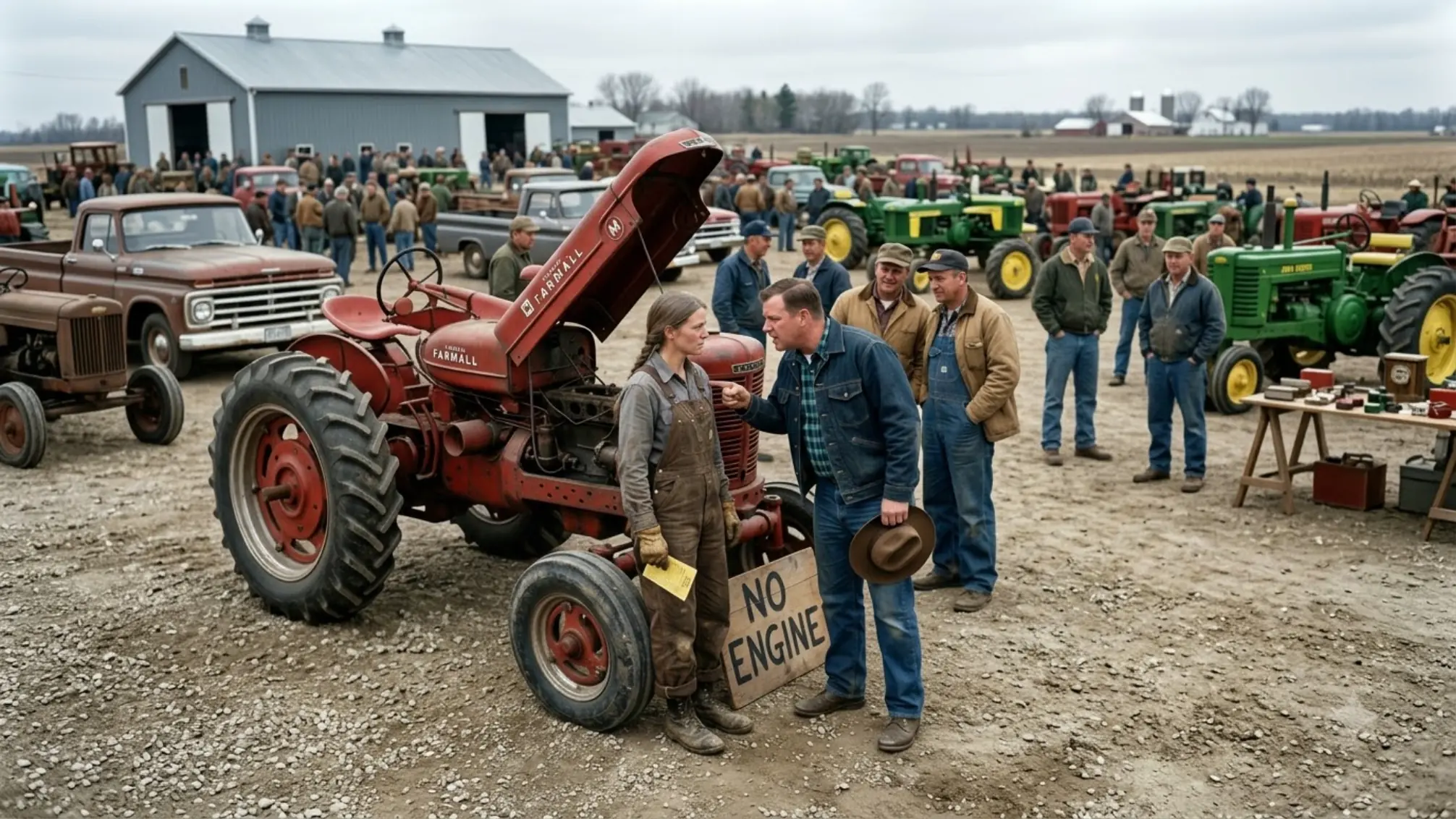
Marlene had paid thirty-five dollars for it. The auctioneer had expected twenty from a scrap dealer, and even that seemed optimistic for a machine missing its starter, generator, carburetor, radiator, fuel system, and the single component that made a tractor more useful than a wagon. When Marlene raised the bid, several men turned toward her in disbelief. When she raised it again, the scrap dealer shrugged and walked away.
Douglas Rymer laughed the loudest.
He owned the John Deere franchise near the Millhaven cooperative and had spent fifteen years convincing farmers that reliability came painted green and financed through his office. At forty-one, Douglas had the thick shoulders, polished work boots, and easy confidence of a man accustomed to being treated as an authority whenever machinery was discussed. He walked over after the bidding ended, removed his felt hat, and circled the empty Farmall as though inspecting the remains of a dead animal.
“You understand there’s no motor in it?” he asked.
Marlene folded the receipt and tucked it into her overall pocket. “I noticed.”
“No motor means no tractor.”
“No,” she said. “It means no motor.”
The men near the parts wagon laughed again. Douglas slammed the empty hood hard enough to rattle the rusted sheet metal, then told her she had bought garbage. Marlene stepped forward until only a few inches remained between them, and the laughter thinned into an uneasy silence.
She warned him not to touch her machine again.
Douglas reached for the receipt, apparently believing he could embarrass her into surrendering the purchase. Marlene caught his wrist, turned it away, and told him to come back in spring if he wanted to see which machine survived. For a second, the tractor dealer stared at her with open anger.
Then he pulled free and smiled.
“You can’t threaten horsepower into an empty frame.”
Marlene lowered the hood. “Good thing I know how to build it.”
By sunset, the engineless Farmall was chained to her flatbed. Without the heavy gasoline motor, two men could push it up the ramps with little effort. Marlene tightened every binder herself, checked the wheels, and drove south toward the 140-acre farm her father had left her two years earlier.
She passed Douglas’s dealership on the way home.
He stood in the doorway with several employees and pointed at the red shell as it rolled by. By evening, the story had reached the grain elevator, the diner, and the tavern near County Road H. By the end of the week, farmers who had not attended the auction were repeating the joke as though they had witnessed it themselves.
Marlene Voss had bought a tractor with no engine.
Some said grief had finally made her foolish. Others said a woman had no business trying to operate a farm alone and that the purchase proved it. Douglas told customers that Marlene was building a collection of scrap because she could not accept that her father’s way of farming had died with him.
Marlene answered none of them.
She had been born on that farm in 1938, the only child of Ernst Voss, a German-born machinist who had immigrated to Wisconsin before the Depression. Ernst purchased land other farmers rejected because its sandy soil produced modest yields and demanded constant attention. He never became wealthy, but no machine on his property stayed broken for long.
His workshop was better equipped than many commercial repair shops.
A rebuilt lathe stood against one wall. A vertical mill salvaged from a Milwaukee factory occupied the center floor, while welding tanks, a coal forge, precision gauges, hardened cutters, and drawers of handmade fixtures filled every available corner. Farmers traveled twenty miles to have Ernst reproduce parts dealers claimed were obsolete.
Marlene grew up beneath the sparks.
At twelve, she could face a shaft on the lathe. At fifteen, she could weld a broken hitch without warping it. By eighteen, she understood tolerances, alignment, balance, and heat treatment better than most mechanics who dismissed her as the machinist’s daughter.
Ernst never taught her to view machinery as sacred.
“A factory builds what it can sell,” he often told her. “A machinist builds what she needs.”
He showed her how a tractor was not one machine but a collection of systems: frame, power source, clutch, transmission, cooling, fuel, and control. Each system could be replaced, altered, or improved if the builder understood how forces moved through it. Brand names impressed customers, but measurements determined whether metal survived.
Ernst died in 1965 with a wrench still in his hand.
Marlene found him beside the workbench after returning from the north field. The doctor called it a heart attack. For months afterward, she could not enter the shop without expecting to hear his boots scrape across the floor.
She inherited the land, tools, debt-free buildings, and every unfinished drawing he had left behind.
One drawing mattered more than the others.
In the corner of a yellowed notebook, Ernst had sketched a diesel engine connected to an older Farmall transmission. Beneath the drawing, he had written three lines about low-speed torque, cheaper fuel, and the excessive safety margin of military generator engines. The idea was unfinished but not forgotten.
Six months before the auction, Marlene attended a surplus sale at Fort Dalton. The army was disposing of decommissioned generators, trucks, compressors, and engines that no longer fit current equipment standards. Most farmers searched for tools or canvas, but Marlene walked between the rows reading engine identification plates.
She found a Continental CD-193 diesel sitting on an olive-drab frame.
The four-cylinder engine had powered a generator until the army replaced the entire unit. A metal tag identified it as serviceable, and the crankshaft turned freely when Marlene tested it. The military rated the engine at forty-eight horsepower, though Ernst had once examined the same model and believed it could safely deliver closer to sixty.
Marlene paid eighty-five dollars.
She transported it home, drained the old fluids, checked the bearings, tested the injectors, and started it on a temporary stand. The engine fired after several rotations and settled into a heavy, even idle. It was more power than her existing tractors could produce and required a frame strong enough to accept it.
Then the empty Farmall appeared at auction.
The Super M had originally carried a 264-cubic-inch gasoline engine. Its transmission was heavy, its rear end nearly indestructible, and its wheelbase stable enough for hard field work. Other bidders saw a missing engine.
Marlene saw a waiting frame.
The tractor entered Ernst’s workshop before the first week of May ended. Marlene removed the hood, fuel tank, damaged wiring, and every bracket left from the original gasoline system. She pressure-washed twenty years of grease from the transmission housing and placed the Continental beside the frame.
Nothing aligned.
The engine mounts sat at different heights. The crankshaft flange did not match the Farmall flywheel. The bell-housing bolt patterns looked as though they belonged to machines from different countries because, in practical terms, they did.
Douglas heard about the problem and sent one of his salesmen to “check on her progress.”
The salesman returned laughing.
“He says the engine won’t even bolt up.”
Douglas leaned back in his chair. “Of course it won’t.”
“He says she has both pieces sitting on blocks.”
“By harvest, she’ll sell them for scrap.”
But Marlene had never expected the parts to match.
She began with the adapter plate, the most important component in the entire conversion. A one-inch steel plate would connect the Continental engine to the Farmall transmission while holding the crankshaft and input shaft on a perfectly shared centerline. If the alignment missed by even a few thousandths of an inch, vibration would destroy the clutch, bearings, or transmission.
Marlene measured for three nights before making the first cut.
She created paper patterns, transferred the bolt locations, checked them against both housings, and then repeated the process. She mounted the plate on Ernst’s mill and bored the pilot opening slowly. After every pass, she stopped the machine, cleaned the surface, and measured again.
The work took three weeks.
Next came the flywheel adapter. The Continental crankshaft flange was smaller than the Farmall flywheel center, requiring a stepped steel collar with two different bolt patterns. Marlene turned the collar on the lathe, drilled the holes on the mill, and balanced the completed assembly using a fixture Ernst had built from an old wheel balancer.
One ounce in the wrong place could ruin the engine.
She balanced it until the dial indicator barely moved.
During the summer, neighbors occasionally stopped near the workshop. Some came out of curiosity, others hoping to see proof that Marlene had failed. She allowed no one inside unless they had a reason to be there.
Douglas arrived one afternoon in July.
He stood at the open door and watched her machining an engine bracket. “Still trying?”
Marlene shut down the mill. “Still waiting for spring?”
He looked at the Continental suspended from the chain hoist. “That engine weighs too much.”
“Not for the frame.”
“It’ll twist your mounts.”
“Not these mounts.”
“You think because your father could machine a few parts, you can redesign an International Harvester tractor?”
Marlene wiped metal chips from the table. “I’m not thinking. I’m doing it.”
Douglas stepped inside without permission.
He examined the adapter plate and ran a thumb across the machined pilot bore. The surface was smoother than he expected, and the bolt pattern had been indexed with professional precision. His expression tightened.
“You didn’t make this.”
Marlene faced him. “Get out.”
“Who machined it?”
“I did.”
“Where?”
She pointed at the mill standing between them.
Douglas laughed again, but the sound lacked confidence. “Even if it bolts together, the cooling system won’t handle it.”
“I know.”
“The starter won’t fit.”
“I know.”
“The fuel system is wrong.”
“I know.”
He stared at her.
Marlene picked up her gloves. “You finished listing problems I solved last month?”
Douglas left without answering.
By autumn, the Continental sat inside the Farmall frame. Marlene fabricated new engine mounts from half-inch steel plate and added rubber isolation blocks to control diesel vibration. She modified the hood for the taller air cleaner and rebuilt the front support to accept a larger truck radiator.
The original fuel tank had held gasoline.
Marlene cleaned it, installed a diesel return line, mounted filters, and fitted a mechanical lift pump. She built new throttle linkages, relocated the battery, added glow-plug controls, and wired a heavy-duty starter. Every bracket was shaped, fitted, removed, improved, and installed again.
The work continued through the Wisconsin winter.
Temperatures fell below zero, and frost formed on the workshop windows. Marlene completed her farm chores before sunrise, repaired equipment for neighbors during the afternoon, and worked on the Super M after supper. Some nights she stayed until two in the morning.
Ernst’s voice remained inside the room.
Measure twice. Think three times. Cut once.
By February 1968, only the exhaust remained unfinished. Marlene built a new manifold connection and mounted a vertical stack beside the hood. The tractor no longer looked empty.
It looked dangerous.
She filled the cooling system, bled the diesel lines, checked the oil pressure circuit, and rotated the engine by hand. The clutch engaged cleanly. The transmission turned without binding.
On March 9, she rolled open the workshop doors.
Snow remained along the fence lines, but the yard itself had thawed into dark mud. Marlene climbed onto the seat, switched on the glow plugs, waited, and pressed the starter. The Continental turned once, twice, and then fired.
The sound shook dust from the rafters.
It did not have the sharp rhythm of a gasoline Farmall. The diesel produced a low, steady growl, deeper than anything that red hood had ever contained. Marlene watched the gauges while the engine warmed.
Oil pressure held.
Temperature remained stable.
No vibration appeared in the clutch housing.
She pushed the throttle forward.
The exhaust darkened for a second, then cleared as the engine gained speed. Marlene engaged first gear, released the clutch, and drove the tractor from the workshop under its own power.
A neighbor heard it from half a mile away.
By noon, three trucks had stopped along the road. Men stood near the fence watching the engineless joke circle Marlene’s yard with a military diesel roaring beneath its modified hood. Nobody laughed.
Marlene drove to the south field.
She hitched a four-bottom plow behind the tractor, one more bottom than the original Super M commonly handled in her sandy ground. Several observers followed at a distance, expecting the engine to stall or the transmission to break.
Marlene lowered the plow.
The blades entered the soil.
The Continental’s exhaust deepened, but the engine did not slow. The tractor pulled all four bottoms through the field, turning clean rows while its rear tires held steady. It moved with a kind of effortless force the original gasoline engine had never possessed.
News reached Douglas before evening.
Five customers entered his dealership telling the same story. Marlene’s military-powered Farmall was pulling four bottoms without struggling. One man claimed it sounded like a tank.
Douglas drove to the Voss farm on Saturday.
He found Marlene changing the oil beside the workshop. The tractor stood with its hood raised, revealing the dark green Continental engine mounted inside the red frame. Douglas walked around it slowly.
This time, he did not laugh.
He crouched beside the adapter plate, inspected the engine mounts, followed the fuel lines, and examined the radiator supports. His eyes lingered on the machined surfaces and balanced flywheel assembly. He spent fifteen minutes beneath the tractor before standing.
“This is professional work,” he said.
Marlene continued tightening the filter adapter.
“Better than professional,” he added. “The factory wouldn’t spend this much time aligning one machine.”
“My father would.”
“How much power?”
“About fifty-eight at the drawbar.”
“The original made forty-four.”
“I know.”
Douglas removed his hat. “What did the build cost?”
“Thirty-five for the tractor. Eighty-five for the diesel. Around forty for steel, hoses, gaskets, and hardware.”
“One hundred sixty dollars?”
“That’s right.”
The cheapest new tractor on Douglas’s lot cost more than seven thousand.
He looked toward the Super M and then toward Marlene. “I’m not going to sell you a John Deere, am I?”
“Probably not.”
For the first time, Douglas smiled without mocking her. “No. Probably not.”
The county called it the Frankenstein Farmall, but the name became admiration rather than ridicule. Marlene used it for plowing, planting, hauling, and belt work. The Continental burned less fuel than the tractors around it and produced stronger low-speed torque.
It started during brutal January mornings when gasoline machines refused to turn.
By 1975, it had logged more than four thousand hours without a major repair. Marlene changed filters, adjusted valves, and maintained the cooling system, but the adapter plate remained perfectly aligned. The transmission never failed.
Farmers began bringing her empty frames of their own.
She installed a Perkins diesel in an old Farmall H for a neighbor who could not afford financing. She fitted a turbocharged Continental into a Farmall 560 and converted another tractor using a surplus Navy generator engine. Each machine required unique mounts, custom plates, modified cooling, and patient alignment.
Every one ran.
Douglas watched potential customers drive past his dealership toward Marlene’s workshop. At first, he disliked it. Then he understood that the farmers seeking her help could not afford his new equipment anyway.
In 1976, he began sending them himself.
“If you need a tractor under three thousand,” he told them, “there’s a woman south of Millhaven who can build one for a quarter of that.”
The arrangement surprised everyone except Marlene.
Douglas sold polished factory machines. She built practical ones from what other people discarded. Both served farmers, but only one required them to sign years of payments.
Marlene’s own costs remained almost nonexistent.
Her land was paid for. The tractor had no loan. The shop belonged to her, and the diesel burned less fuel than neighboring machines. The sandy soil never produced spectacular yields, but every modest profit stayed hers.
Through the 1970s, she saved quietly.
By 1982, the farm crisis had reached Adams County. Interest rates climbed, crop prices fell, and farmers carrying large equipment loans began losing land. New tractors that once symbolized progress became evidence of debt.
Marlene tightened expenses and continued farming.
Her Super M required oil, filters, and fuel.
Nothing more.
In 1984, the 180-acre Brecke farm adjoining her eastern boundary entered foreclosure auction. Douglas attended because dealers always attended farm auctions during bad years, partly to observe and partly to count which customers would never return.
The bidding began at two hundred dollars per acre.
Marlene stood near the back in the same worn work coat she had used for years. A Milwaukee speculator challenged her, raising the price several times. At three hundred ten dollars per acre, he stopped.
The total was fifty-five thousand eight hundred dollars.
The auctioneer asked how she intended to finance the purchase.
“Cash,” Marlene said.
The crowd turned silent.
Men who had laughed when she spent thirty-five dollars on an empty tractor now watched her write a check for an entire farm. Douglas approached after the sale.
He looked older than he had in 1967.
“I sold people horsepower,” he said. “You built what you needed and saved the difference.”
Marlene folded the receipt. “They bought on credit.”
“And you built from scrap.”
“That matters.”
Douglas removed his hat. “I owe you an apology.”
“For what?”
“For calling that Farmall a tin can. For telling half the county you were crazy.”
Marlene looked across the field she had just purchased. “Took you seventeen years.”
“I’m a slow learner.”
She shook his hand.
The Diesel Super M continued working until Marlene retired in 1994. By then, the Continental had logged thousands more hours, and the red tractor had outlived machinery purchased decades after its conversion. Marlene transferred the combined 320-acre operation to her daughter Clara, who had learned the lathe and mill inside the same workshop.
The knowledge passed again.
In 1998, the Adams County Historical Society invited Marlene to display the tractor at the county fair. She agreed under one condition: the sign beside it had to list the cost.
The display read:
1952 FARMALL SUPER M FRAME — $35
CONTINENTAL CD-193 MILITARY DIESEL — $85
STEEL, MOUNTS, HOSES, AND HARDWARE — $40
TOTAL COST — $160
Below the numbers appeared another line:
BUILT BY MARLENE VOSS IN THE WORKSHOP OF ERNST VOSS, MASTER MACHINIST.
Douglas visited the display with a cane.
He stood before the sign for several minutes, reading the numbers as though seeing them for the first time. The tractor’s paint remained scarred, and the modified hood still revealed evidence of Marlene’s handwork.
“One hundred sixty dollars,” he said.
Marlene stood beside him. “Still running.”
“I sold machines for forty-five thousand that didn’t last this long.”
“They were fine machines.”
“People didn’t always need them.”
“No.”
Douglas looked toward the crowd gathered around the tractor. “What did your father say about factories?”
Marlene smiled.
“A factory builds what it can sell. A machinist builds what she needs.”
Douglas nodded. “He was right.”
At the auction in 1967, everyone had looked through the empty hood and seen nothing. The scrap dealer saw iron by the pound. Douglas saw a joke, and the other farmers saw proof that a quiet woman had finally attempted something beyond her ability.
Marlene saw space.
She saw a strong frame, a surplus diesel, her father’s tools, and a problem that could be solved through knowledge. She understood that the missing engine was not the end of the tractor.
It was freedom from the engine the factory had chosen.
They laughed because the machine was empty.
By spring, Marlene filled that emptiness with fifty-eight horsepower, five months of disciplined work, and everything her father had taught her. The tractor cost one hundred sixty dollars, pulled harder than machines worth sixty times more, and helped her buy the land of farmers who had laughed at it.
Douglas had promised to crush the shell before she turned one bolt.
Instead, the woman he mocked built a machine that outworked his dealership, survived an agricultural crisis, and remained in service long after the laughter disappeared.