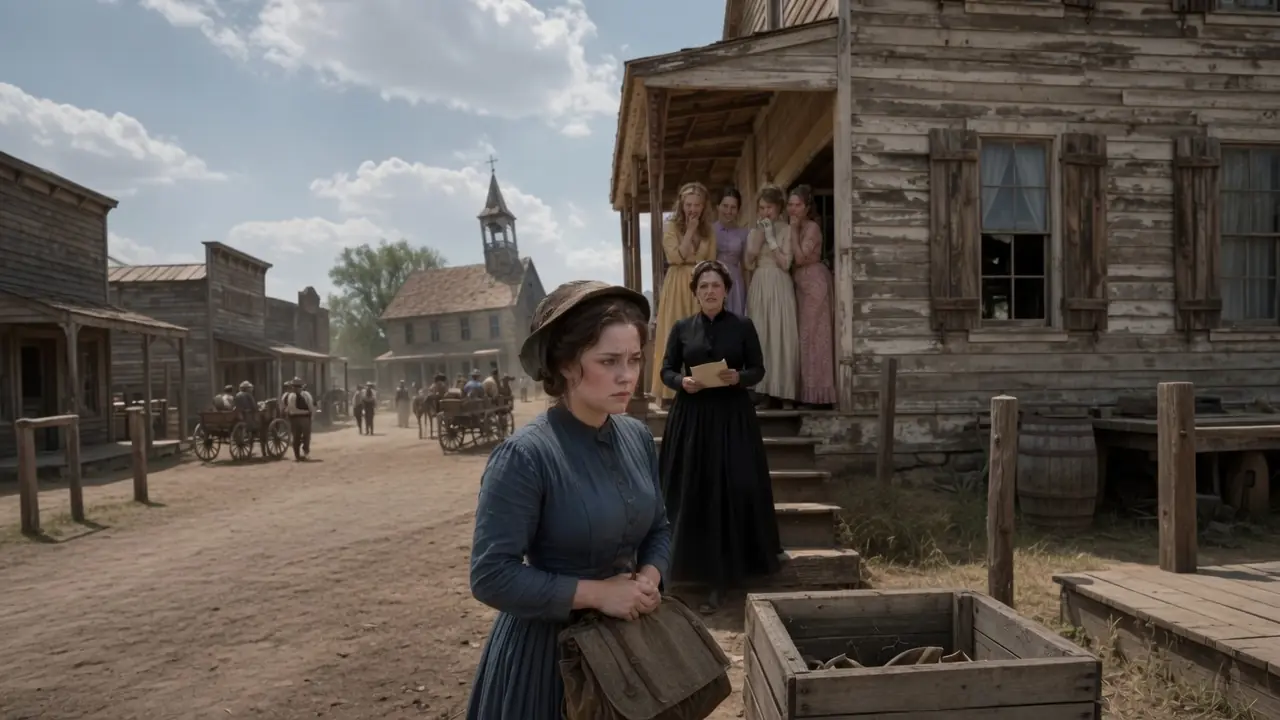
Mara Ellison reached the gate of Broken Spur Ranch with dust on her hem, sweat beneath her bonnet, and shame pressing against her ribs like a second heart. The folded paper from Mrs. Pruitt had gone damp in her hand, the ink blurring where her fingers had gripped it too tightly. Behind her lay five miles of road and every laugh the boardinghouse girls had thrown after her. Ahead stood Gideon Ash, the most feared rancher outside Dry Hollow, holding a sledgehammer like judgment itself.
He was taller up close than he had looked from town, with a black hat shading eyes that seemed to miss nothing. His shirt was rolled at the sleeves, his forearms marked by work, and dust clung to him like it belonged there. He looked once at Mara, then at the paper, then back at her face. “Who sent you?” he asked.
“Mrs. Pruitt,” Mara said, forcing the words out. “From the boardinghouse.” She held up the paper because she did not trust her voice to survive much more. Gideon took it, read only the first line, and his mouth hardened. Then, without asking permission, he tore the paper cleanly in half.
Mara flinched as if he had struck her, but Gideon’s voice was low and controlled. “I asked for honest hands,” he said, dropping the torn paper into the dust, “not a woman sent here to be mocked.” Mara stared at the pieces at his boots, unable to understand why he was angry for her instead of at her. She had grown used to cruelty coming first, kindness coming never, and silence filling the space between.
“If this was a joke, Mr. Ash,” she whispered, “I’ve already walked far enough for it.” Gideon looked toward the road behind her, then toward the distant church bell of Dry Hollow leaning in the sun. “Then listen well, Mara,” he said. “The joke ends at my gate, and the first person who laughs at you answers to me.” He said it so plainly that it sounded less like comfort and more like law.
Mara did not know what to do with a man who did not laugh. Her hands tightened around the carpetbag until her fingers ached, and she looked down because being seen with respect felt almost more frightening than being mocked. Gideon stepped aside and opened the gate wider. “There’s work if you want it,” he said. “There’s supper if you earn it, and water whether you do or not.”
The offer was plain, almost rough, but it held no pity. That made Mara lift her head. “What work?” she asked. Gideon pointed toward the stable, where a nervous bay mare stamped near the back stall. “My stable boy ran off three days ago. I need stalls cleaned, feed measured, tack repaired, and someone calm enough not to frighten a horse already near breaking.”
Mara looked at the mare and felt something inside her recognize the animal’s restless fear. The horse’s ears flicked back and forth, her eyes wide, her body carrying the trembling alertness of a creature expecting pain from every hand. Mara knew that feeling well. “What’s her name?” she asked.
Gideon stayed back, studying Mara with the same hard silence he had given the storm clouds. Mara did not reach for the mare. She only stood near the stall door and hummed softly, the way her mother used to hum while kneading bread before illness stole the strength from her hands. Juniper’s ears shifted forward by the smallest measure.
“That song,” Gideon said after a moment. “Where’d you learn it?” Mara kept her eyes on the mare. “My mother,” she said. “She said frightened things need something steady to hear.” The words left her before she could hide them, and she felt heat rise in her face.
Gideon did not mock her. “Your mother was right,” he said. That simple sentence lodged somewhere in Mara’s chest and made her throat tighten. Nobody in Dry Hollow spoke of her mother unless they were mentioning unpaid debts, charity baskets, or how beauty skipped some daughters. Gideon Ash had spoken of her as if wisdom could come from a poor dead woman.
The first day nearly broke Mara’s body, but not her spirit. She cleaned stalls, carried water, measured oats, scrubbed buckets, and swept the stable until her palms burned. Gideon worked nearby, repairing fence rails and lifting feed sacks without making a show of strength. He corrected her only when needed, and when he did, he used her name, never the cruel one the boardinghouse girls had tossed after her.
By sundown, Mara’s dress was streaked with dust, her back ached, and her stomach twisted with hunger. She expected Gideon to hand her a crust outside the kitchen door, the way Mrs. Pruitt did on nights when boarders finished first. Instead, he set two plates at the table in the ranch house and pointed to the chair across from him. “Sit before you fall over,” he said.
Mara hesitated. “At the table?” Gideon gave her a look. “You worked like a hired hand. You eat like one.” She sat carefully, afraid the chair might vanish beneath her if she trusted it too much. The meal was beans, cornbread, and salted beef, but to Mara it tasted like dignity.
For the next week, she returned every morning. At first, she walked back to Pruitt House each night, enduring the girls’ laughter as they asked whether Gideon had saddled her yet or made her sleep in the barn. Mrs. Pruitt smiled over her ledger and counted Mara’s wages before Mara even received them. “Board doesn’t pay itself,” she said, holding out her hand.
On the eighth morning, Mara arrived with a split lip. It was not deep, but Gideon saw it before she could turn her face away. His eyes went cold in a way that made the stable seem suddenly smaller. “Who did that?” he asked.
“Nobody,” Mara said, reaching for the feed scoop. Gideon stepped in front of her, not touching her, only blocking her escape into work. “Nobody has a name in Dry Hollow most times.” Mara swallowed hard. “Lottie pushed the attic door open while I was carrying a basin. I fell against the latch.”
Gideon looked toward town. “And Mrs. Pruitt?” Mara gave a bitter little smile. “Said clumsy girls cost more in repairs than they earn.” Gideon’s hands curled once at his sides, then opened again. “You can sleep in the small room off the kitchen,” he said.
Mara stared at him. “No.” The answer came too quickly, fueled by fear of gossip, fear of owing, fear of kindness changing shape once the door closed. Gideon nodded once, as if he had expected the refusal and respected it. “Then you can sleep in the tack room with the bolt on your side, and Mrs. Keller from the next ranch can come by tomorrow to judge whether it’s proper enough for town mouths.”
Mara blinked at him. “Why would you do that?” Gideon looked back at Juniper’s stall, where the mare now allowed Mara to brush her neck. “Because a woman should not have to return nightly to a house that feeds on her shame.” His voice had rough edges, but the meaning inside it was clean. Mara looked down before tears could betray her.
Mrs. Keller came the next day, a stern widow with a shotgun voice and a heart she kept hidden behind practical words. She inspected the tack room, the kitchen room, the windows, the locks, and Gideon himself with equal suspicion. Then she took Mara aside and said, “If he troubles you, you come to my place. If town talks, let it choke on its own dust.” By nightfall, Mara had moved her carpetbag from Pruitt House to Broken Spur.
Mrs. Pruitt did not accept the loss quietly. Three days later, she arrived at the ranch in a black dress, holding her ledger like scripture. Behind her came Lottie, Pearl, Ruthie, and Nell, dressed as if they had come to watch a hanging. Mara saw them from the stable doorway and felt the old terror rise in her body before she could stop it.
Gideon was shoeing a horse near the corral when they arrived. He looked at Mrs. Pruitt once and did not stand immediately. That bothered her. Women like Mrs. Pruitt built their power on making others rise first.
“Mr. Ash,” Mrs. Pruitt called, voice sweet and sharp, “I’ve come for what Mara Ellison owes.” Mara’s face burned as the girls hid smiles behind gloved hands. Gideon finished setting the horse’s hoof down before he turned. “What does she owe?”
“Board, linens, meals, moral supervision, and damages.” Mrs. Pruitt opened the ledger with a flourish. “A girl does not leave a respectable house in the night and expect debts to vanish.” Mara stepped forward, shaking but determined. “I left in daylight, and I paid what you asked every week.”
Mrs. Pruitt looked at her as if she were a dog speaking at church. “You paid what little you could. Charity covered the rest.” Lottie giggled softly. Mara’s hands clenched in her apron, and for one second she was back on the porch, the crushed bonnet in her hands, laughter falling on her like hot ash.
Gideon walked to the fence and rested both hands on the top rail. “Read the first entry,” he said. Mrs. Pruitt frowned. “Excuse me?” “If there’s a debt, read it from the start.” His voice was calm enough to be dangerous. Mrs. Pruitt hesitated, then looked down at the ledger.
The first entry was from the day Mara’s mother died. Funeral washing, attic cot, two meals, black ribbon, church transport. Mrs. Pruitt read faster as Gideon’s face darkened. By the third line, even Pearl had stopped smiling.
Gideon looked at Mara. “Did you ask for black ribbon?” Mara shook her head. “No.” “Did you ride in church transport?” “No. I walked.” “Did you get two meals?” Mara’s voice barely held. “No. I gave mine to a child staying there.”
Gideon turned back to Mrs. Pruitt. “So your ledger begins with lies.” Mrs. Pruitt’s face flushed. “You have no right to question how I run my boardinghouse.” Gideon stepped through the gate, and the girls moved back without meaning to. “I have the right to question any woman who fattens her purse by starving a girl’s spirit.”
Mrs. Pruitt snapped the ledger shut. “Mara is ungrateful, unstable, and foolish. She will embarrass any household that keeps her.” Mara felt the words strike old bruises inside her, but this time Gideon answered before they could settle. “No,” he said. “She will strengthen any place wise enough to value her.”
The silence that followed seemed to stun the air itself. Mara looked at him, unable to breathe. No one had ever said she strengthened anything. She had been useful, tolerated, hidden, corrected, and fed only after others finished, but never valued aloud.
Mrs. Pruitt lifted her chin. “If you choose to make yourself ridiculous over that girl, Mr. Ash, the town will remember.” Gideon’s eyes did not move from her face. “Good. I’ve been hoping Dry Hollow would learn something worth remembering.” Then he reached into his vest and pulled out money.
He counted bills slowly and placed them on the fence rail. “This covers every honest cent she might owe. Since your ledger has trouble recognizing honesty, take it as payment to keep your lies off my land.” Mrs. Pruitt stared at the money, then at the witnesses she had brought herself. Her victory had turned to smoke in her hands.
Lottie tried one last laugh, small and brittle. “Well, Mara finally found someone big enough to shelter her.” Mara flinched, but Gideon’s voice cracked across the yard. “Say another word about her body, Miss Price, and I’ll send your father a bill for the manners he failed to raise.”
Lottie went white. Pearl looked at the ground. Mrs. Pruitt swept the money from the rail and turned away, but Gideon stopped her with one final sentence. “If Mara’s name becomes gossip in town, I will know which porch it started from.” Mrs. Pruitt did not answer. She only walked back to the wagon with the stiff posture of a woman who had discovered fear late in life.
After they left, Mara stood in the stable doorway with tears on her cheeks. Gideon did not mention them. He only picked up the feed scoop and handed it to her as if work could gently return her to herself. “Juniper’s waiting,” he said.
Mara took the scoop, but her voice came out broken. “Why did you defend me?” Gideon looked toward the road where the wagon dust still hung. “Because they were wrong.” “People are wrong every day,” Mara whispered. “Most men let them be.”
Gideon was quiet for a long moment. “My mother was mocked until she forgot how to lift her head,” he said. “I was too young to stop it then.” Mara looked at him and saw, for the first time, that the feared rancher carried ghosts of his own. “I am not young anymore,” he added.
Summer stretched across Broken Spur Ranch, and Mara changed with it. Her hands toughened, her shoulders straightened, and her laughter returned first in small slips, then in sudden bursts that startled even her. Juniper became her shadow, following her along the fence line and lowering her head whenever Mara hummed. The ranch hands Gideon hired for cattle season learned quickly that jokes at Mara’s expense died before leaving their mouths.
Dry Hollow did not become kind overnight. Towns rarely repent in a hurry. Women still whispered when Mara came to the mercantile with Gideon’s supply list, but they whispered softer when Mrs. Keller walked beside her. Men still looked twice, but they no longer laughed loudly.
The real turning point came at the Harvest Social, held outside the church with bunting on the porch and pies lined beneath cloth covers. Mara did not want to go. Gideon did not force her, but he asked once, carefully. “Do you want them to keep the church steps too?” he said.
So she went. She wore a deep blue dress Mrs. Keller had altered from one of her own, and her hair was pinned neatly beneath a clean bonnet. When she stepped from Gideon’s wagon, the same four girls who had once laughed at Pruitt House fell silent near the lemonade table. Mrs. Pruitt stood beside them, stiff as a fence post.
Mara’s heart pounded, but Gideon offered his arm. She looked at it, then at him. “People will talk,” she said. Gideon’s mouth twitched. “They already do. Might as well give them the truth to choke on.” Mara took his arm.
Inside the church yard, Robert Hale, the town banker, approached Gideon with a smile that did not reach his eyes. “Ash,” he said, then glanced at Mara. “Didn’t know you were bringing help to socials now.” The insult was clean enough to pretend innocence, but everyone nearby heard it.
Gideon’s hand tightened once under Mara’s fingers. Before he could speak, Mara lifted her chin. “Mr. Hale, if you need help distinguishing guests from servants, perhaps your spectacles need replacing.” Mrs. Keller coughed into her glove to hide a laugh. Gideon looked down at Mara with something like pride brightening his eyes.
Hale flushed and walked away. A murmur moved through the church yard, but this time it carried surprise instead of mockery. Mara felt her own breath return. For the first time, she had defended herself before Gideon could defend her, and the world had not ended.
Later that evening, Mrs. Pruitt approached with a tight smile. “Mara,” she said, “you look improved.” Mara turned slowly. “I was never damaged, Mrs. Pruitt. Only tired.” The older woman’s lips thinned. “You have grown bold.”
Mara looked toward Gideon, who stood a few steps away, close enough to help but far enough to let the moment belong to her. Then she looked back at Mrs. Pruitt. “No,” Mara said. “I have grown unwilling.” The words were quiet, but they struck deeper than shouting.
Mrs. Pruitt had no reply. The girls behind her looked uncertain now, as if cruelty had lost its familiar map. Mara walked past them without lowering her eyes. She could feel Gideon beside her, steady as the fence line, but for the first time she knew she would have kept walking even alone.
By autumn, Broken Spur became known not only for hard cattle and clean horses, but for the woman who could gentle animals no one else could touch. Ranchers brought frightened mares, stubborn mules, and half-starved colts to Mara, not Gideon. She worked slowly, with patience learned from pain, and animals answered her because she never mistook fear for disobedience.
One evening, Gideon found her by Juniper’s stall after the mare had safely foaled a strong little colt with a white star on its forehead. Mara leaned against the wood, exhausted and glowing with relief. Gideon stood beside her, looking at the foal wobbling near its mother. “You saved them both,” he said.
Mara shook her head. “Juniper did the hard part.” Gideon’s eyes softened. “You made her believe hands could help.” Mara looked at him then, and the quiet between them changed. It was not sudden, not like lightning. It was more like a lantern being turned up slowly in a dark room.
“I thought you would send me away that first day,” she said. Gideon rested his arms on the stall door. “I thought you might run.” “I almost did.” “Why didn’t you?” Mara smiled faintly, touching the wood rail. “Because you tore the paper.”
Gideon looked down, the memory passing through his face. “That paper deserved worse.” Mara laughed softly, and he looked at her as if the sound mattered. Then his voice lowered. “Dry Hollow sent you here as a joke, Mara. I’m glad they were foolish enough to do it.”
Her eyes filled, but she did not look away. “So am I.”
Winter came with pale mornings and hard frost on the troughs. Mara stayed at Broken Spur, no longer as a frightened girl with a carpetbag, but as the person everyone looked for when trouble entered the stable. Gideon paid her fair wages, then higher wages, then added her name to a small share of the horse operation despite her protests. “You built half its worth,” he said. “Paper ought to learn the truth.”
When spring returned, Gideon took Mara into town to file the partnership papers. Mrs. Pruitt saw them leaving the county office and went still on the boardwalk. Mara wore a clean gray dress, her hair pinned beneath a proper hat, and her signature still drying on a document that made her part owner of the Broken Spur horse trade. Lottie, now married and less bright than before, stared from the mercantile window.
Mrs. Pruitt tried to recover herself. “Well,” she said, “fortune is strange.” Mara stopped in front of her. For a moment, the old attic cot, the crushed bonnet, and the laughter returned like dust from a road. Then Mara felt Gideon beside her, not speaking, not needing to.
“No,” Mara said. “Fortune had little to do with it.” Mrs. Pruitt looked confused. Mara smiled, not cruelly, but freely. “I worked. Someone finally noticed.”
She walked on before Mrs. Pruitt could answer.
Years later, people in Dry Hollow told the story differently. They said Gideon Ash had rescued Mara Ellison from a cruel boardinghouse, which was true but not complete. They said he made her untouchable, which was true only for a while. What mattered more was that he gave her a place to stand until she remembered how to stand without him.
Mara herself never forgot the gate. She never forgot the torn paper falling into the dust, or Gideon’s voice saying the joke ended there. On hard days, when old shame tried to crawl back into her bones, she would walk to that same gate and place one hand on the latch. The land beyond it had not made her smaller, softer, or acceptable to cruel eyes.
It had made her visible.
And in time, Mara learned that being seen by one honest person could become the beginning of seeing herself.