Wes did not step forward to welcome her.
He stood in the ranch-house doorway with his hat twisting slowly between his hands while the wagon rolled to a stop beside the corral. The driver remained in his seat, offering no help as the passenger carefully climbed over the wheel. She lowered herself into the dust with one worn carpetbag in her right hand and the fingers of a small girl held tightly in her left.
The woman placed the bag on the ground with great care, as though everything she still owned in the world was packed inside it. Then she straightened and looked across the yard. Her gaze passed over the weathered house, the leaning porch, the bunkhouse, and the men gathered beside the fence before settling on Wesley.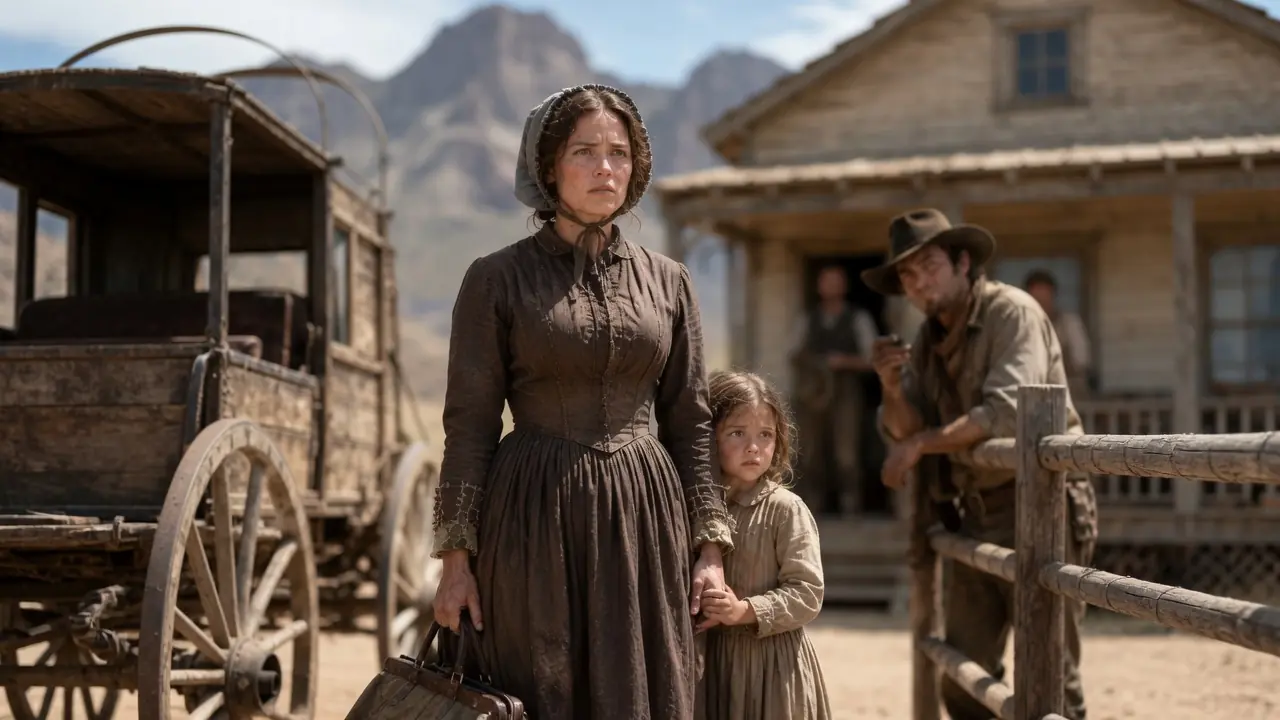
She did not smile.
She did not lower her eyes.
That made Wesley feel more ashamed than tears would have.
He had imagined someone different when he answered the advertisement in the Missouri paper. He could not have explained exactly what he expected, only that it had not been this tired woman standing beneath the hard Wyoming sun. Perhaps he had pictured someone younger, someone untouched by grief, someone who would step from the wagon smiling as though the journey west had carried her toward a dream.
The woman before him looked thirty-two but carried the weariness of someone older. Her brown hair was pinned beneath a bonnet faded almost gray around the brim, and her dark traveling dress had been repaired at both cuffs with tiny, careful stitches. Dust marked the hem, but the fabric was clean.
The little girl beside her appeared seven or eight. She was thin, silent, and watchful, with both hands now wrapped around her mother’s wrist. Her eyes moved from one ranch hand to the next as if strangers had taught her that a child’s future could be decided by men she had never met.
Cap Reeves leaned against the upper rail of the corral with an unlit cigarette between two fingers. He was forty-six, narrow-faced, and permanently bent at the shoulders from years in the saddle. He had managed the Tate spread since before Wesley inherited it and behaved as though that history made every opinion his right.
Cap looked the woman over from bonnet to boots.
“That the wife?” he called loudly. “Thought you sent off for a cook, Wes—not somebody’s tired aunt.”
Two younger hands laughed before understanding the cruelty of the moment. One of them stopped quickly when he noticed Wesley was not laughing. The other looked down at his boots.
The woman heard every word.
Her face remained composed, but the child’s fingers tightened.
Wes stepped from the porch at last.
“You’re Mrs. Halloran?”
“I am.”
Her voice was quiet and stronger than he expected.
“And this is my daughter, Ruth.”
The girl gave the smallest possible nod.
Wes glanced toward the bunkhouse. Fifteen hungry men worked the Tate spread during branding season, and every one of them could empty a plate faster than the last cook could fill it. The previous cook had lasted twenty-three days before throwing a skillet at the wall and declaring that no amount of money was worth feeding men who complained about scorched coffee while leaving every pan for someone else to clean.
Wes had written east asking for a practical wife who could manage a ranch kitchen. He had not asked for beauty. Yet as his men watched him examine Cora like an animal delivered for purchase, he hated himself for the disappointment he had felt.
Cap flicked the dead cigarette into the dust.
“Well, Wes?” he said. “You planning to marry her, or send her back before she scares the cattle?”
Silence spread through the yard.
Cora’s face did not change, but Wesley saw humiliation burning beneath her calm. She had traveled hundreds of miles with a child and one bag only to be judged before anyone offered water.
He cleared his throat.
“Can you cook for a whole outfit?”
The question sounded harsher than he intended.
Cora looked past him toward the open bunkhouse door. Inside stood a blackened stove, stacks of dirty pans, and shelves that appeared strangely bare for a ranch preparing to brand hundreds of cattle. Near the threshold lay a line of pale dust.
Flour.
Cora followed it with her eyes.
The trail crossed the porch, disappeared beneath a bench, then continued toward the small room Cap used beside the tack shed. Fresh white powder marked the edge of his right boot.
She removed her bonnet and placed it carefully on the carpetbag.
“I can feed the whole outfit,” she said. “But first tell me why half the winter supplies are missing.”
Cap’s posture changed.
“Watch your mouth, woman. You just arrived.”
Cora turned toward him.
“Then explain why the stolen flour leads straight to your room.”
No one moved.
Little Ruth stepped from behind her mother’s skirt and pointed toward the bunkhouse floor.
“There are mouse holes under the boards,” she whispered. “But mice don’t wear boots.”
One ranch hand coughed to hide a laugh. Another stared openly at Cap’s powder-covered heel. Wesley looked from the flour trail to the foreman who had spent three months complaining that the ranch hands ate too much.
Cap pushed away from the fence.
“You calling me a thief in my own yard?”
Cora’s eyes sharpened.
“I am asking what the evidence already answered.”
“This is not your yard.”
“No,” she replied. “But the missing food was supposed to feed the men working in it.”
Wesley should have spoken immediately.
Instead, he hesitated.
Cap noticed.
The foreman stepped closer to Cora, using his size as he had likely done with others many times before.
“A widow walks in with a child and one torn bag, and now she thinks she can question me?”
Cora did not move.
“I buried my husband beside a railroad grade with frozen earth under my knees,” she said. “You will need more than a loud voice to frighten me.”
The words ended the laughter completely.
Wes finally moved between them.
“That’s enough, Cap.”
The foreman looked at him with disbelief.
“You taking her word over mine?”
“I’m taking a look at the floor.”
Wes called for Amos Bell, the oldest hand on the ranch. Amos had spent twenty-one years keeping inventory before Cap gradually took the task from him. He came from the barn wiping his hands on his trousers.
Wes asked how much flour should have remained.
“Six full sacks,” Amos answered. “Maybe five if the last cook wasted more than I saw.”
Wes entered the bunkhouse.
Only one half-empty sack stood beside the stove.
He checked the storage room next. The shelves held three jars of beans, a little salt pork, dried onions, coffee, and nearly nothing else. According to Cap’s ledger, the ranch had purchased enough food in March to last through June.
It was only the middle of May.
Wes returned carrying the ledger.
“Where are the supplies?”
Cap shrugged.
“The men eat.”
Amos stepped forward.
“Not that much.”
Cap pointed at the bunkhouse.
“You’ve seen how they fill their plates.”
“We’ve been eating watery beans for two weeks,” a young hand named Caleb said. “There hasn’t been flour for biscuits since Sunday.”
Wes opened the ledger.
The entries appeared orderly at first. Flour, sugar, coffee, beans, salt pork, and canned fruit had all been recorded. Yet Cora noticed that the same ink was used across dates separated by weeks.
She reached toward the book but stopped before touching it.
“May I?”
Wes handed it to her.
Cora examined the pages.
“My husband kept supply records for the railroad camps,” she said. “Different deliveries should show different hands, different dust, different ink.”
Cap laughed too quickly.
“You’re a cook now, not a bookkeeper.”
“I was both when my husband became ill.”
She pointed to a line.
“This says twelve sacks of flour arrived on April third.”
Amos nodded.
“They did.”
“This says six remained yesterday.”
Wes looked toward the nearly empty storage room.
Cap’s mouth tightened.
Cora turned another page.
“The coffee shipment was written in before the store invoice number existed. Someone filled this ledger after the fact.”
Cap reached for the book.
Wes pulled it away.
“Open your room.”
The foreman’s expression hardened.
“You’re embarrassing yourself.”
“Open it.”
“I’ve managed this spread since your father was alive.”
“And now I’m asking for the key.”
Cap stared at him for several seconds before reaching into his vest. He threw the key into the dust near Wesley’s boots.
“Search everything.”
Wes picked it up.
Inside Cap’s room, they found no flour.
At first.
The bed was neatly made, the shelves held only clothing and ammunition, and the small trunk contained nothing beyond shaving tools and two bottles of whiskey. Cap stood outside the doorway with a faint smile returning to his face.
Then Ruth crouched beside the wall.
She pointed toward a board beneath the bed.
“That one is clean.”
Every other floorboard was gray with dust.
Wes moved the bed aside and lifted the board with a knife. Beneath it lay folded receipts, three bags of coffee, two tins of peaches, and money wrapped inside a cloth.
More papers led them to the tack shed.
Behind stacked saddles were flour sacks marked with the Tate brand. Six crates of canned fruit had been covered by old harnesses. In the loft, Amos discovered salt pork packed for transport.
The ranch hands gathered silently.
Wes unfolded one receipt.
Cap had been selling the supplies to a trading post two towns south. The owner’s signature appeared beneath every transaction. In total, the stolen goods represented nearly three months of food.
Wes looked at the foreman.
“How long?”
Cap crossed his arms.
“You paid me less than I was worth.”
“So you stole from me?”
“I took what your father would have given me.”
“My father would have shot you for starving his men.”
Cap smiled without humor.
“Your father understood this ranch. You inherited it.”
The insult struck where Cap intended. Wesley had spent six years feeling like a boy standing inside another man’s boots. His father had built the Tate spread from nothing and died before teaching Wesley half of what he believed a rancher should know.
Cap had used that uncertainty carefully.
He advised every purchase, hired every hand, and questioned every decision until Wesley relied on him. Each time Wesley challenged him, Cap reminded him that experience could not be inherited with land.
Cora watched Wesley’s face and understood the trap.
“Mr. Tate,” she said quietly, “a man does not become loyal by staying a long time.”
Cap turned toward her.
“You stay out of this.”
She met his eyes.
“You brought hunger into it.”
Wes closed the ledger.
“Cap Reeves, you’re finished here.”
Several ranch hands shifted uneasily.
Cap laughed.
“You won’t last one season without me.”
“Then I’ll fail without being robbed.”
“You think she’ll save this ranch?”
Wes looked at Cora.
“No. I think she noticed in ten minutes what I refused to see for a year.”
Cap’s face went pale with rage.
He stepped toward Wesley, but Amos and Caleb moved between them. For a moment, everyone expected violence.
Cap stopped.
“You’ll regret choosing a stranger over the man who built this place.”
“My father built it,” Wesley replied. “You stole from it.”
Cap was given his horse, wages through that day, and one hour to leave. Wesley sent Amos with him to ensure nothing else disappeared. He also ordered Caleb to ride to town and contact Sheriff Lowell with copies of the receipts.
Cap left without looking at Cora.
Ruth watched until his horse vanished into the dust.
Only then did her small hand release her mother’s dress.
The yard remained quiet.
Wes turned toward Cora.
“I owe you an apology.”
“Yes,” she said.
The direct answer surprised him.
“For Cap?”
“For letting him speak while you decided whether I deserved defending.”
Wes felt the truth of it more sharply than accusation.
“You’re right.”
Cora looked toward Ruth.
“My daughter heard every word.”
“I know.”
“No, Mr. Tate. You saw her standing there. That is not the same as knowing what she heard.”
He lowered his eyes.
“I’m sorry, Ruth.”
The child studied him.
“Will that man come back?”
“I don’t know,” Wesley answered honestly. “But he will not live here again.”
Ruth looked at her mother before nodding.
Wes glanced toward the nearly empty shelves.
“We have food for maybe three days.”
Cora rolled up her mended sleeves.
“Then standing in the yard will not improve it.”
She entered the bunkhouse kitchen.
The room was worse than it looked from outside. Grease coated the stove, flour paste hardened inside bowls, and a pot of beans had burned so badly that the bottom seemed permanently black. Fifteen men watched from the doorway as Cora tied on an apron found beneath a pile of rags.
“What do you need?” Wesley asked.
“Everyone out.”
The men looked offended.
Cora pointed toward the wash barrels.
“Every plate, cup, pan, and spoon goes outside. Boil water. Scrub until the metal stops feeling greasy.”
One hand muttered that the cook usually handled dishes.
Cora looked at him.
“The cook usually receives supplies that haven’t been stolen.”
He picked up two pots.
Within an hour, the yard looked like a military camp for kitchen tools. Men carried kettles, pumped water, split wood, and scraped char from the stove. Cora worked without wasting motion, sorting what remained and planning around shortages.
She found dried apples hidden in a jar, potatoes beginning to soften in a corner, and enough salt pork for one proper meal. Amos produced onions from his personal garden patch. Ruth gathered wild mustard greens along the creek.
By sunset, the smell coming from the bunkhouse changed the ranch.
Cora prepared a thick potato-and-pork stew, skillet bread made from the last flour, fried onions, and apple dumplings stretched with coarse meal. It was not a feast, but after weeks of weak beans, the men stared at their plates as though they had been served at a hotel.
No one complained.
The hand who had laughed first at Cap’s insult stood before Cora with his hat in both hands.
“Ma’am,” he said, “I’m sorry.”
Cora studied him.
“What is your name?”
“Henry Vale.”
“Then tomorrow, Henry Vale, you can apologize by peeling potatoes without cutting half of them away.”
“Yes, ma’am.”
The men laughed, but this time not at her.
Wes watched Cora move between the tables. She filled plates evenly, served Ruth first, and set aside food for the two hands riding night watch. Nobody had done that before.
Cap had always eaten before everyone else.
Cora ate last.
Wes noticed.
After dinner, he found her outside washing her hands beneath the pump. Ruth sat nearby wrapped in a blanket, already half asleep.
“You should have eaten with us,” Wesley said.
“I ate.”
“After everyone else.”
“There was enough.”
“That was not my question.”
Cora dried her hands.
“I am accustomed to knowing whether there is enough before I take my share.”
Wes understood that the habit came from harder years than she intended to describe.
“You came here expecting marriage,” he said.
“I came because your letters promised an honest arrangement.”
“And now?”
“Now I have found a dishonest foreman and a man unsure whether he wants the woman he invited.”
The words left him nowhere to hide.
Wes looked toward the dark pasture.
“I expected someone different.”
“So did I.”
He faced her.
Cora continued.
“I expected a man who knew his own mind.”
He almost laughed, but the shame remained too fresh.
“What would you have me do?”
“Do not ask me that tonight.”
“Why?”
“Because a woman who traveled this far should not be forced to decide her future before she has slept.”
Wes nodded.
“The spare room is yours and Ruth’s.”
“And where will you sleep?”
“The office.”
“You need not surrender your room.”
“I’m not. I’m giving you a door you can close.”
For the first time, Cora’s expression softened.
Only slightly.
The next morning, Caleb returned with Sheriff Lowell and a letter from the trading-post owner. Cap had sold supplies under the claim that Tate Ranch had ordered too much. The owner agreed to return what remained if Wesley declined prosecution.
Wes declined the offer.
He wanted the theft documented.
The sheriff found Cap at a boardinghouse before noon. Cap insisted that years of unpaid loyalty entitled him to the goods. The law disagreed.
He was charged and held for trial.
With the foreman gone, deeper problems surfaced. Cap had undercounted cattle, hidden debts, and sold several horses through intermediaries. He had also told local merchants that Wesley was nearly bankrupt, allowing him to purchase supplies cheaply in the ranch’s name and resell them elsewhere.
The Tate spread was not ruined.
But it was closer than Wesley knew.
Cora spent the following week feeding the outfit while helping Amos reconstruct the records. She wrote clean columns, compared invoices, and identified missing figures quickly. John Halloran had taught her arithmetic during their years beside the railroad, and necessity had taught her the rest.
Ruth became less silent.
She followed Wesley to the barn, asked questions about every horse, and learned to collect eggs without frightening the hens. The men stopped referring to her as “the girl” and began saving small things for her—a blue ribbon, a smooth stone, a wooden whistle.
Cora noticed every kindness.
She also noticed Wesley never demanded gratitude.
He repaired the latch on their bedroom door, brought a smaller chair for Ruth, and ordered fabric from town without asking Cora to explain the worn places in her dress. When she objected to the expense, he showed her the marriage advertisement he had written.
“I asked for a wife,” he said. “That includes providing properly.”
“We are not married yet.”
“Then call it payment for saving fifteen men from boiled leather.”
Cora looked at the cloth.
“Blue?”
“Ruth chose it.”
Her daughter nodded proudly.
Two weeks after Cora arrived, Wesley asked her to walk with him beyond the cottonwoods. The ranch stretched gold beneath the late-day sun, with cattle moving like dark shadows near the river.
He stopped beside a low stone wall.
“My mother is buried here,” he said.
Cora removed her bonnet.
Wes looked toward the grave.
“She ran this ranch beside my father. After she died, he acted as though the work had been his alone. I believed him.”
Cora waited.
“I thought asking for a wife meant finding someone to fill the space she left. Someone to cook, keep accounts, and make the house feel less empty.”
“And now?”
“Now I know that was not enough reason to ask a woman to cross half the country.”
Cora looked at him.
“What is enough reason?”
Wes took a breath.
“To offer a life where her work is respected, her child is safe, and her voice matters before disaster proves she was right.”
The answer did not erase what happened in the yard.
But it reached the part of Cora that had feared she and Ruth would always be tolerated rather than chosen.
“Do you still wish to marry me?” she asked.
“Yes.”
“Because I found the theft?”
“Because you told the truth when every man here preferred comfort.”
“That may make me difficult.”
“I have had enough of easy lies.”
Cora looked toward the ranch house.
“And Ruth?”
“She stays whether we marry or not.”
Her eyes returned to his face.
“Why?”
“Because no child should travel another mile wondering whether she is wanted.”
Cora’s composure broke for the first time.
She looked away before he could see the tears, but Wesley saw them anyway. He did not touch her.
That mattered.
They married three days later in the ranch yard beneath the cottonwoods. Sheriff Lowell performed the ceremony because the justice could not travel before Sunday. The ranch hands wore clean shirts, Ruth carried wildflowers, and Henry Vale burned the first batch of biscuits while trying to help.
No one laughed when Cora approached.
Wes met her halfway.
After the vows, he turned toward Ruth.
“I made your mother a promise,” he said. “I owe you one too.”
The girl looked up.
“This is your home as long as you want it.”
Ruth held out the wooden whistle one hand had carved for her.
“Then you can keep this until I’m not afraid anymore.”
Wes accepted it carefully.
Years later, Ruth would forget exactly when she asked for it back.
The ranch recovered slowly.
Wes appointed Amos foreman and required two signatures on every supply order. Cora managed the household accounts, but only after insisting that her name be placed legally beside Wesley’s on the ranch records.
He agreed without argument.
Under her system, the men ate well but wasted little. Each hand took one kitchen duty every week, and anyone who complained about food earned a turn stirring the pot.
The men learned quickly.
Cap Reeves was convicted of theft and fraud. Before sentencing, he asked to speak with Wesley and claimed Cora had turned the ranch against him. Wesley answered that Cora had only opened the door to a room Cap built himself.
The stolen money never fully returned.
The truth did.
One autumn evening, almost a year after the wagon arrived, Wesley stood in the same doorway where he once twisted his hat and failed to welcome her properly. Cora crossed the yard carrying a basket while Ruth ran beside her with two puppies following.
Wes remembered the first thing Cap had said.
That the wife?
At the time, the question had reduced Cora to an object delivered for inspection. Now it sounded almost absurd.
She was his wife.
She was also the ranch’s bookkeeper, kitchen master, sharpest judge of character, and the woman who had saved the Tate spread before she owned a single part of it.
Cora climbed the porch steps.
“You are staring,” she said.
“I was remembering.”
“Dangerous habit.”
“Sometimes.”
She handed him the basket.
Inside were biscuits, still warm.
“Can you feed a whole outfit?” he asked.
Cora raised one eyebrow.
“I can.”
Then she looked toward the bunkhouse, where fifteen men were waiting for supper.
“But only if nobody steals the flour.”