In the spring of 1987, nearly every farmer in Pottawattamie County planted corn the same way. They prepared the black Iowa soil, planted straight rows, applied synthetic nitrogen, controlled anything that looked like a weed, and trusted the methods their fathers had passed down. On the Halverson farm, eighteen-year-old Claire Halverson did something the county considered absurd: she scattered red clover seed between forty acres of young corn. The moment the local seed dealer saw what she had done, he laughed and called her a pretty girl with an empty head.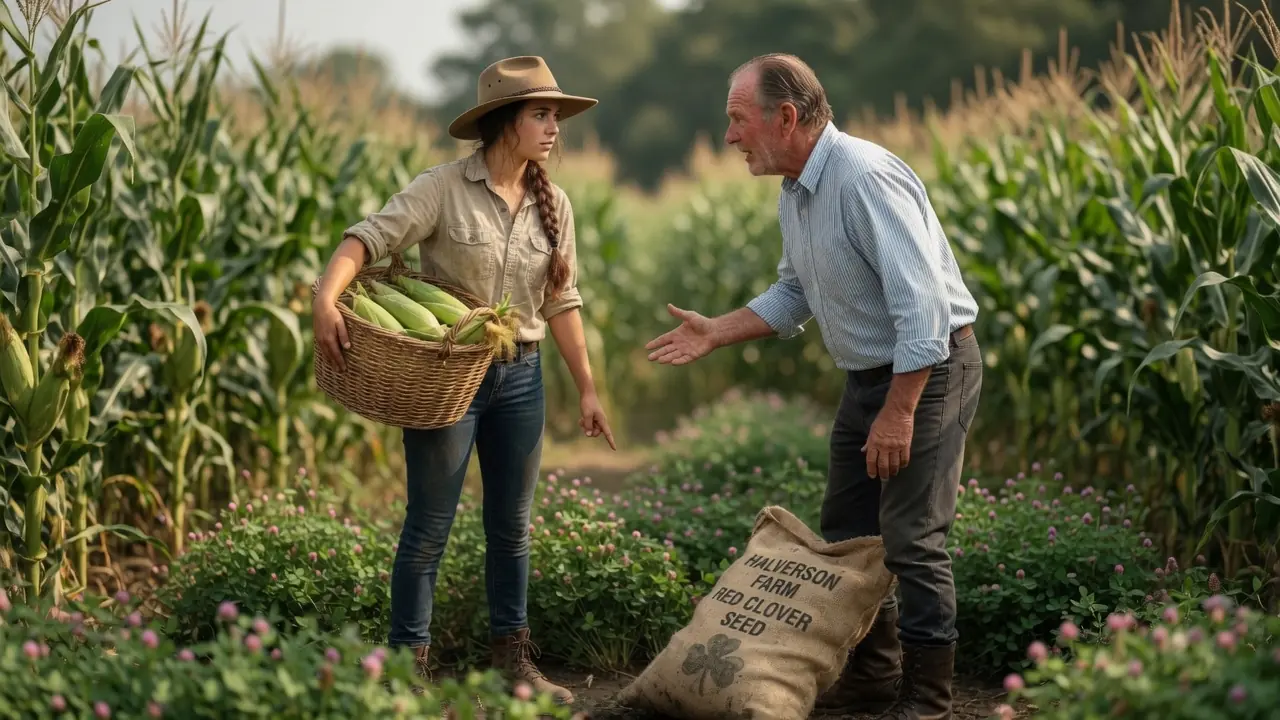
Claire did not look like the kind of farmer Gerald Stokes expected to challenge him. She had softly tanned skin, expressive brown eyes, and long dark-brown hair braided over one shoulder beneath a wide tan field hat. She usually worked in a rolled-sleeve beige shirt, dark-blue jeans, and dusty leather boots, carrying a spiral notebook wherever she went. People noticed her beauty first, then treated her ideas as though they were decorations attached to it.
Her father, Dale Halverson, had managed the family’s four hundred acres since 1962. He was a steady, careful farmer who could identify a failing bearing by sound and estimate a cornfield’s yield while driving past it at thirty miles an hour. He recorded every expense and harvest in a green ledger stored in the kitchen drawer. His methods were conventional, but they had kept the farm solvent for twenty-five years.
Claire had just completed her first year studying agronomy at Iowa State University. She returned home carrying lecture notes, soil reports, and a fourteen-dollar bag of red clover seed. Her professor, Dr. Raymond Voss, had taught her that productive soil was not merely dirt holding plant roots upright. It was a living system filled with organisms that stored water, cycled nutrients, and protected crops during difficult weather.
One Tuesday evening, Claire waited until her father finished dinner before placing her notebook beside his coffee cup.
“I want to try something on the back forty,” she said.
Dale opened the notebook and studied the diagrams. “What kind of something?”
“Red clover between the corn rows.”
His hand stopped on the page.
“You want to plant pasture seed in a cornfield?”
“It isn’t for pasture. It’s a cover crop.”
Claire explained that clover could fix nitrogen, protect exposed soil, and add organic matter after dying back. Its roots would hold the ground together while its leaves covered the surface beneath the corn canopy. If the research was correct, the field could retain more rainwater and require less purchased nitrogen the following year.
Dale listened without interrupting.
His wife, Ruth, washed dishes at the sink but occasionally glanced toward them. Claire showed him figures from university trials, notes on planting rates, and a plan to broadcast the clover only after the corn was established. The seed cost was small, but the social cost of failure would be much greater.
“If it competes with the corn, we lose yield,” Dale said.
“The timing prevents that.”
“And if it becomes a mess?”
“We don’t repeat it.”
Dale closed the notebook. “I’ll think about it.”
For three days, Claire continued with normal farm work and did not mention the proposal again. On the fourth morning, Dale found her repairing a fence near the back field. He leaned against the post and looked across the least productive forty acres on the farm.
“You can try it there,” he said. “Only there.”
Claire smiled. “That’s enough.”
“It had better be.”
The following Saturday, she drove to the county cooperative to collect replacement planter parts. The clover seed remained visible in the bed of her pickup. Gerald Stokes noticed it through the front window before Claire reached the counter.
Gerald was fifty-three, broad-shouldered, and always dressed more cleanly than the farmers buying from him. He had sold hybrid seed across western Iowa for sixteen years and had built his reputation by remembering every customer’s acreage, preferred variety, and harvest history. When Gerald gave advice, men listened because he usually sounded certain.
“What have you got in that truck?” he called.
“Red clover.”
Several farmers turned from the coffee machine.
Gerald stared at her. “For what?”
“The back forty.”
“You’re planting it in Dale’s corn?”
“Yes.”
The room became quiet for two seconds.
Then Gerald laughed.
It was not a joyful laugh. It was the dismissive sound of a man reacting to an idea before giving himself time to understand it. Two farmers joined him, while several others looked down into their coffee.
“Honey, this isn’t a pasture,” Gerald said. “This is corn country.”
“It’s a cover crop.”
“It’s a weed growing where your father needs corn.”
“It fixes nitrogen and builds organic matter.”
Gerald walked outside with the group following him. He reached into the pickup, lifted the seed bag, and let it fall hard against the truck bed.
“You planted weeds in your father’s corn,” he said. “Pretty face, empty head.”
Claire met his eyes. “Those weeds feed soil your chemicals keep starving.”
The farmers stopped smiling.
Gerald stepped closer. “When this crop fails, the county will remember you as Dale’s stupid mistake.”
“Come back after the drought,” Claire replied. “Your dead fields will introduce me properly.”
Gerald laughed again, but this time the room did not follow him.
Claire collected the planter parts, drove home, and began preparing the trial. She marked the field, calculated eight pounds of seed per acre, and waited until the corn reached the proper growth stage. Late in June, she mounted a broadcast seeder on an all-terrain vehicle and drove between the rows while clover seed scattered beneath the young plants.
Within ten days, tiny green leaves appeared across the soil.
From the road, the field looked ordinary. The corn rose taller and gradually concealed the clover beneath its canopy. Anyone walking between the rows could see a green carpet forming around the stalks, but passing drivers saw nothing unusual.
Gerald continued telling the story at the cooperative.
He described Claire as a college girl conducting an expensive science experiment with her father’s land. He joked that Iowa State had begun teaching students to turn cornfields into gardens. Every time someone repeated his words, the story became more insulting.
Dale heard the comments.
He never told Claire to stop, but he inspected the field more often than usual. He watched for yellow corn leaves, poor growth, or any evidence that the clover was stealing moisture. Claire noticed his concern and measured everything she could: plant height, soil temperature, weed pressure, and rainfall.
The corn remained healthy.
By August, the clover covered most of the ground but stayed low beneath the shade. It suppressed exposed weeds and reduced the hard crust that normally formed after summer rain. When Claire pushed her fingers into the soil, she found it softer than the neighboring ground.
Dale crouched beside her one evening.
“It feels different,” he admitted.
“The roots are opening the surface.”
“One season can’t change soil that much.”
“No. But it can begin.”
The autumn harvest produced 138 bushels per acre from the clover field. The previous year, the back forty had yielded only 122. Dale’s best ground produced more, but the improvement was significant enough to prevent him from dismissing the trial.
Gerald heard the number at the grain elevator.
“Good weather,” he said. “Not clover.”
Claire wrote the yield in her notebook without responding.
After the first hard frost, the clover died back and left a dense layer of plant material across the surface. Instead of exposing bare soil through winter, the back forty remained protected beneath the residue. Snow caught between the dead stems rather than blowing completely into the ditches.
The following spring, Claire arranged soil testing through the extension office. The back field showed higher organic matter than surrounding ground, though the difference remained modest. More importantly, the soil absorbed water much faster.
She demonstrated it to Dale using two metal cylinders.
Claire pressed one into the clover-treated field and another into a conventional section. She poured equal amounts of water into both. The back forty absorbed its water rapidly, while the conventional ground developed a shallow puddle.
Dale watched his daughter’s stopwatch.
“How much faster?”
“More than twice.”
He looked across the field. “What does that mean in a storm?”
“It means rain enters the soil instead of running toward the creek.”
“And in a dry summer?”
“It means we keep more of whatever rain falls.”
Dale studied the numbers in her notebook.
“You can plant the back eighty this year.”
Claire looked up. “Both sections?”
“Both.”
The expansion drew more attention.
Gerald began warning farmers that Dale was allowing his daughter to take control too quickly. He claimed clover would eventually reduce yield, attract pests, and interfere with harvest. None of those claims came from Claire’s field, but he delivered them with enough confidence that people repeated them.
Claire continued collecting evidence.
She reduced the nitrogen application on the clover-treated ground because the legume had already added nitrogen naturally. Dale considered the reduction risky, but he agreed after reviewing university recommendations. The treated field produced 141 bushels per acre, while conventionally managed sections averaged 136.
The corn grown with clover used less purchased nitrogen and still yielded more.
At the kitchen table, Dale calculated the difference in his green ledger. The reduced fertilizer saved nearly fifteen hundred dollars across eighty acres. He checked the figures twice, then turned toward Claire’s spiral notebook.
“You want to do the entire farm,” he said.
“Yes.”
“All four hundred acres?”
“Not exactly the same way everywhere. The low ground needs a different planting rate, and some fields may work better with another cover crop.”
Dale leaned back. “You’ve thought about this.”
“For two years.”
“I’ll think about it.”
This time, he needed only two days.
“You decide the rotation,” he told her. “Tell me what equipment and seed you need.”
Claire did not celebrate openly. She simply opened her notebook and began outlining the next stage.
Then the summer of 1988 arrived.
Rainfall across the Midwest fell far below normal. Weeks passed beneath clear skies while temperatures climbed. By June, corn leaves began curling during the hottest part of the afternoon, conserving moisture by reducing the area exposed to sunlight.
July brought worse conditions.
Fields that had been plowed deeply and left with little surface cover lost moisture rapidly. Rainfall, when it came, struck hard ground and ran into ditches rather than soaking into the root zone. The county’s dark soil began cracking.
Gerald drove from farm to farm delivering advice that no longer seemed sufficient. Farmers increased irrigation where possible, adjusted fertilizer plans, and hoped for storms that repeatedly disappeared before reaching western Iowa. Each day revealed more pale corn.
The county cooperative became quieter.
Men who once joked about Claire’s clover now discussed insurance coverage and emergency loans. Corn prices rose, but higher prices meant little to farmers watching their crops fail before pollination completed.
The Halverson back eighty suffered too.
Claire never pretended otherwise. The corn rolled its leaves in the afternoon and grew more slowly than it would have under normal rainfall. Yet the plants remained greener than neighboring fields, and their ears continued developing.
The clover residue protected the surface from direct sunlight.
Improved organic matter held moisture around the root zone. Fungal networks and healthier soil structure allowed the corn to reach water that nearby crops could not access as efficiently. The field was under stress, but it was still functioning.
Dale walked the property every evening.
On one side of the fence, the Henderson corn had turned pale and brittle. On the Halverson side, the back eighty remained visibly alive. The contrast became sharper with each rainless day.
“You expected a drought?” Dale asked.
“No.”
“You told Gerald to come back after one.”
“I knew one would come eventually.”
“How?”
“Because drought always comes eventually. The question is whether the soil is ready before it arrives.”
In early August, Gerald stopped his truck beside the Halverson field.
He did not enter.
He stood at the fence and watched the corn move under a hot wind. The lower leaves had yellowed, but the stalks remained upright. Between the rows, the soil was covered instead of bare.
Claire noticed him from the tractor.
She drove past without stopping.
Gerald removed his hat and looked toward fields farther down the road. Some had already failed. Their leaves hung like dry paper, and poorly pollinated ears contained little grain.
The Halverson harvest began in October.
Dale drove the combine while Claire recorded yield measurements from each field. The first conventionally managed sections produced disappointing numbers, though still slightly above some neighboring farms. Then they entered the back eighty.
The monitor climbed.
Ninety-four bushels.
Ninety-seven.
One hundred.
The final average settled at ninety-eight bushels per acre.
In an ordinary year, that number would have been disappointing. In 1988, when the county average fell near sixty-one, it was extraordinary. The back eighty produced thirty-seven more bushels per acre than the county average during the worst drought many farmers had ever experienced.
Claire calculated the financial difference.
At the elevated market price, the clover-treated eighty acres generated more than ten thousand dollars above what the same acreage would have earned at the county average. That difference protected loan payments, equipment repairs, and the following year’s planting budget.
Dale sat at the kitchen table with both record books open.
His green ledger contained decades of experience. Claire’s spiral notebook contained two years of experiments. For the first time, the books were no longer arguing with each other.
“You were right,” he said.
Claire looked up.
“I should have listened before giving you the worst forty acres like some consolation prize.”
“The back forty gave us the comparison.”
“That isn’t what I mean.”
“I know.”
Ruth stood in the doorway, smiling quietly.
News of the Halverson yield traveled quickly.
Farmers compared elevator receipts, insurance assessments, and bank statements. The number could not be dismissed as rumor because too many people had seen the field. Gerald’s customers began asking why the clover ground had survived when their fields had not.
For several weeks, he offered vague answers.
He suggested the Halverson property might contain naturally better subsoil moisture. He mentioned differences in seed genetics and planting dates. Each explanation weakened when farmers reminded him that the back forty had historically been the poorest land on the farm.
In November, Gerald finally drove into the Halverson yard.
Claire was inside the machinery shed checking the planter when his truck stopped outside. He entered without his usual audience and stood near the doorway with both hands in his coat pockets.
“You have a minute?” he asked.
Claire set down her wrench. “What do you need?”
“I’ve heard your back ground made ninety-eight.”
“That’s correct.”
“And the county average was sixty-one.”
“Yes.”
Gerald looked at the planter rather than at her. “Some customers are asking what they should change.”
“They should start by testing their soil.”
“I meant the clover.”
“The clover is part of it.”
“How much seed?”
“Eight pounds per acre in that trial.”
“When did you plant?”
“At the fourth leaf stage.”
Gerald nodded slowly. “Could you write this down?”
Claire folded her arms. “Do you remember what you said when you saw the seed in my truck?”
His shoulders stiffened.
“Yes.”
“You kicked the bag down and called me an empty-headed girl.”
“I remember.”
“You told the county I was my father’s stupid mistake.”
“I shouldn’t have said that.”
Claire waited.
Gerald finally met her eyes. “I was wrong.”
The apology sounded difficult because he had not practiced saying those words often. Claire believed him, but she did not release him from the lesson.
“The clover isn’t magic,” she said. “It did not create rain, and it did not make the drought harmless.”
“I understand.”
“No, Gerald. You understand the yield number. The larger lesson is that a farm depending on one crop, one fertilizer plan, and one management habit can be destroyed by one season it was not prepared for.”
He remained silent.
“You sell certainty,” Claire continued. “Farmers buy it because fear makes certainty comfortable. But soil is not a machine that accepts the same setting forever.”
“What should I tell them?”
“Tell them to observe first. Test organic matter. Measure infiltration. Understand where water goes. Then choose a cover crop that fits their land.”
“Will you show them?”
Claire thought about the laughter inside the cooperative.
“Yes. Bring them here in spring.”
Gerald nodded. “Thank you.”
As he turned to leave, Claire added one condition.
“When you introduce me, tell them what you said before the drought.”
Gerald paused.
“All of it?”
“All of it.”
He lowered his head. “Fair enough.”
The following April, eleven farmers gathered on the Halverson back forty. Gerald stood beside Claire while she pushed a soil probe into the ground. Before she began, he cleared his throat.
“Two years ago, I laughed when Claire planted clover here,” he said. “I called her foolish and told people this field would fail.”
Several men looked uncomfortable because they had laughed with him.
“I was wrong,” Gerald continued. “Her field produced thirty-seven bushels more per acre than the county average during the drought. She has agreed to explain why.”
Then he stepped aside.
Claire showed them roots, soil aggregates, and infiltration tests. She never claimed every farm should copy her exact system. Instead, she explained the principles beneath it and warned that cover cropping required careful timing, observation, and adjustment.
Four farmers tried small fields that year.
Nine joined the following season.
Within several years, dozens of local operations used red clover, rye, vetch, or other cover crops suited to their rotations. Not every trial succeeded. Some farmers planted too late, used the wrong rates, or abandoned the practice after one difficult season. Yet those who continued generally saw stronger soil structure, reduced input costs, and greater resilience during dry weather.
Claire completed her degree and returned to manage the Halverson farm.
She expanded the system gradually, matching different crops to different soil conditions. The farm’s organic matter increased, fertilizer purchases declined, and rainfall entered the soil instead of rushing toward Mosquito Creek.
In 1994, Claire was invited to speak before hundreds of farmers and agricultural advisers in Des Moines. She stood at the podium wearing a clean work shirt with her dark hair tied behind her shoulders. On the screen appeared seven years of yield records, soil tests, and water-infiltration measurements.
Dale sat in the third row.
Claire finished by showing two photographs from the drought. One showed a neighboring field of pale, failing corn. The other showed the Halverson back eighty still standing.
“A farm that grows only one thing and trusts only one method needs only one disaster to fail,” she said. “Healthy soil does not prevent bad weather. It gives the crop somewhere to stand when bad weather arrives.”
The room rose in applause.
Dale stood first.
He did not clap above his head or call attention to himself. He simply stood, his arms at his sides, looking at the daughter he had once allowed only forty acres.
Years later, Claire’s own daughter came to the kitchen table carrying an agricultural journal and a hand-drawn plan for integrating livestock into part of the crop rotation. The idea was more complicated than Claire’s first clover trial and carried risks of its own.
“I want to try something,” the girl said.
Claire looked at the diagrams.
She remembered the cooperative, Gerald’s laugh, and the seed bag striking the truck bed. She remembered her father’s cautious permission and the drought that made the invisible work beneath the soil impossible to ignore.
“How many acres do you need?” Claire asked.
The original spiral notebook remained in the kitchen drawer beside Dale’s green ledger. Both were full, their pages marked by different generations learning to understand the same land.
The county remembered Claire Halverson as the beautiful young farmer who planted clover in corn country.
At first, they remembered because they had laughed at her.
Then the drought came.
Their exposed soil hardened, their corn withered, and Gerald’s confident advice could not summon rain. On the Halverson farm, roots reached into living ground that had spent two years quietly preparing for the season no one wanted to imagine.
Claire never needed to answer the county with another insult.
When every neighboring field turned brown, her corn remained standing.
The soil answered for her.