"Sir, our equipment’s worth more than your farm.”
Derek Stone said it loudly enough for both of his crewmen to hear. He stood beside a mud-streaked recovery truck with his orange vest hanging open, looking from the weathered red tractor to the elderly man sitting behind its steering wheel.
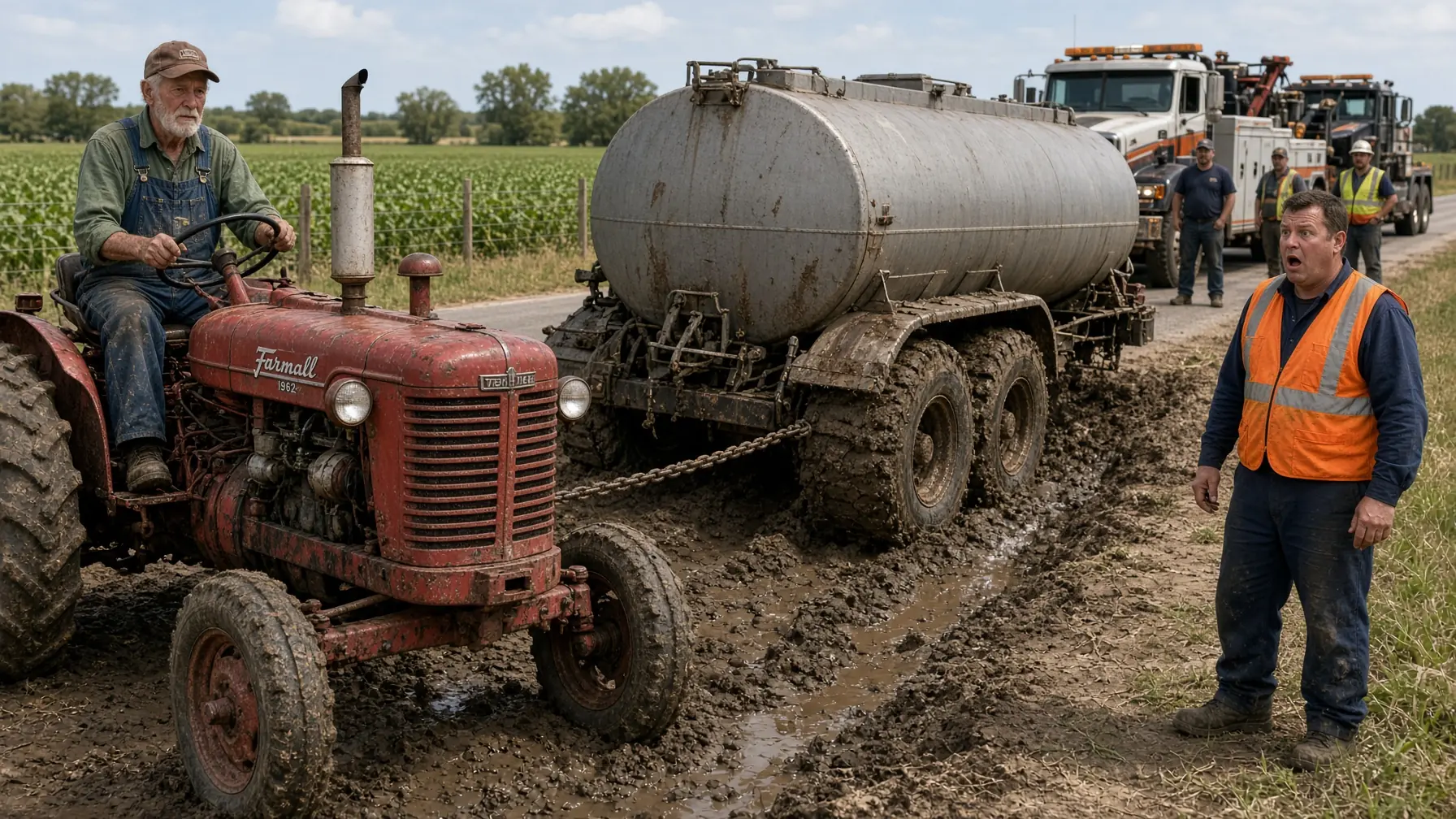
Harold Gaines didn’t smile. Beneath his brown baseball cap, his weathered face remained almost expressionless, and one broad hand rested on the tractor controls.
“I know,” he said. “Watch my chain.”
From firm ground beyond the work area, Seth held his phone steady. He had expected his grandfather to answer the insult with another one, or climb down and tell him they were going home.
Instead, Harold looked toward the tanker’s buried rear wheels.
A heavy recovery chain lay slack between the vehicles, disappearing into the shadow beneath the tanker. Three professional recovery trucks stood idle along County Road 7, their tires and equipment coated with the evidence of everything that had already failed.
Derek’s laughter faded.
“That’s not a standard attachment point.”
Harold turned forward and settled both hands around the steering wheel.
“No,” he said. “It’s the right one.”
Until that afternoon, Seth would have told anyone who asked that his grandfather’s greatest problem was knowing when to stop.
Harold was seventy-five. He still rose before daylight, still checked the weather by opening the kitchen door before checking it on his phone, and still believed a job done badly would take longer to forget than a job done slowly.
He wore the same denim overalls until the knees had been patched twice. His faded moss green work shirt had a pale rectangle where a chest pocket used to be, and his boots carried enough dried field mud to leave a trail across the back porch.
The family had been trying to persuade him to reduce his work.
Nobody called it retirement anymore.
The first time Seth’s father had used that word, Harold had set down his coffee and asked who intended to take over the chores he was supposedly retiring from. The conversation had ended with everybody looking at the table.
After that, they talked about shorter days.
They talked about getting help.
They talked about replacing old machinery before an ordinary breakdown became an expensive one.
The red Farmall appeared in nearly every one of those conversations.
It was a 1962 tractor with faded paint, mismatched patches of primer, and a seat Harold had repaired so many times that Seth couldn’t remember what the original covering looked like. Its engine had a particular roughness when first started, then settled into a familiar note that could be heard from the kitchen even with the windows closed.
Seth knew that sound before he knew the names of all his cousins.
As a child, he had ridden beside his grandfather through the fields, gripping whatever Harold told him to grip and asking questions until Harold finally said, “You planning to listen to any of the answers?”
At twenty, Seth still asked questions.
He simply asked different ones.
How much had the last repair cost? How many days could they afford to lose during planting? Why keep a tractor that needed attention when a newer one could do the same work without turning every week into a scavenger hunt for parts?
Harold never claimed the Farmall was better at everything.
That frustrated Seth more than a stubborn defense would have.
His grandfather would listen, nod at the sensible parts, and then say, “Depends on the work.”
It sounded evasive when Seth was impatient.
It sounded different later.
That morning, Seth had found Harold in the equipment shed, leaning over a workbench with a small tin of fasteners open beside him. The shed smelled of oil, warm dust, and the faint sweetness of grain left somewhere it shouldn’t have been.
Seth carried a printed listing for a used tractor.
He had circled the price before coming out.
“This one’s not that far away,” he said.
Harold glanced at the paper without taking it.
“Morning to you, too.”
“Morning. It’s got less wear than most of the others we’ve looked at.”
“We?”
“Dad and me.”
Harold selected a fastener and held it close to the shed doorway for a better look. Seth stood waiting while his grandfather turned it between thick fingers.
“We aren’t saying you have to buy it,” Seth added. “Just look.”
“I looked.”
“You glanced.”
Harold finally put down the fastener and accepted the paper.
He read it carefully. That was one thing Seth could never fairly accuse him of: Harold might disagree with an idea, but he usually gave it the dignity of understanding it first.
When he finished, he folded the listing along an existing crease.
“Good tractor, probably.”
“Then why won’t you go see it?”
“Because looking at something doesn’t make the money appear.”
Seth felt his prepared arguments lose their shape.
He knew the farm wasn’t failing. He also knew there wasn’t much space between an ordinary season and a difficult one, and that a major purchase could turn a repair problem into a payment problem.
Still, he looked past Harold toward the old Farmall.