The rain had been hammering Mill Haven, Tennessee, for nearly three hours when Ruth Calder heard the motorcycles. At seventy-one, Ruth had owned May’s Kitchen long enough to recognize almost every sound that crossed the old floorboards, from delivery trucks grinding into the gravel lot to the uneven engine of Sheriff Briggs’s aging cruiser. This sound was different. It began as a distant rumble beneath the storm, grew strong enough to tremble through the coffee cups, and finally became twenty-five motorcycles rolling slowly into her parking lot beneath sheets of October rain.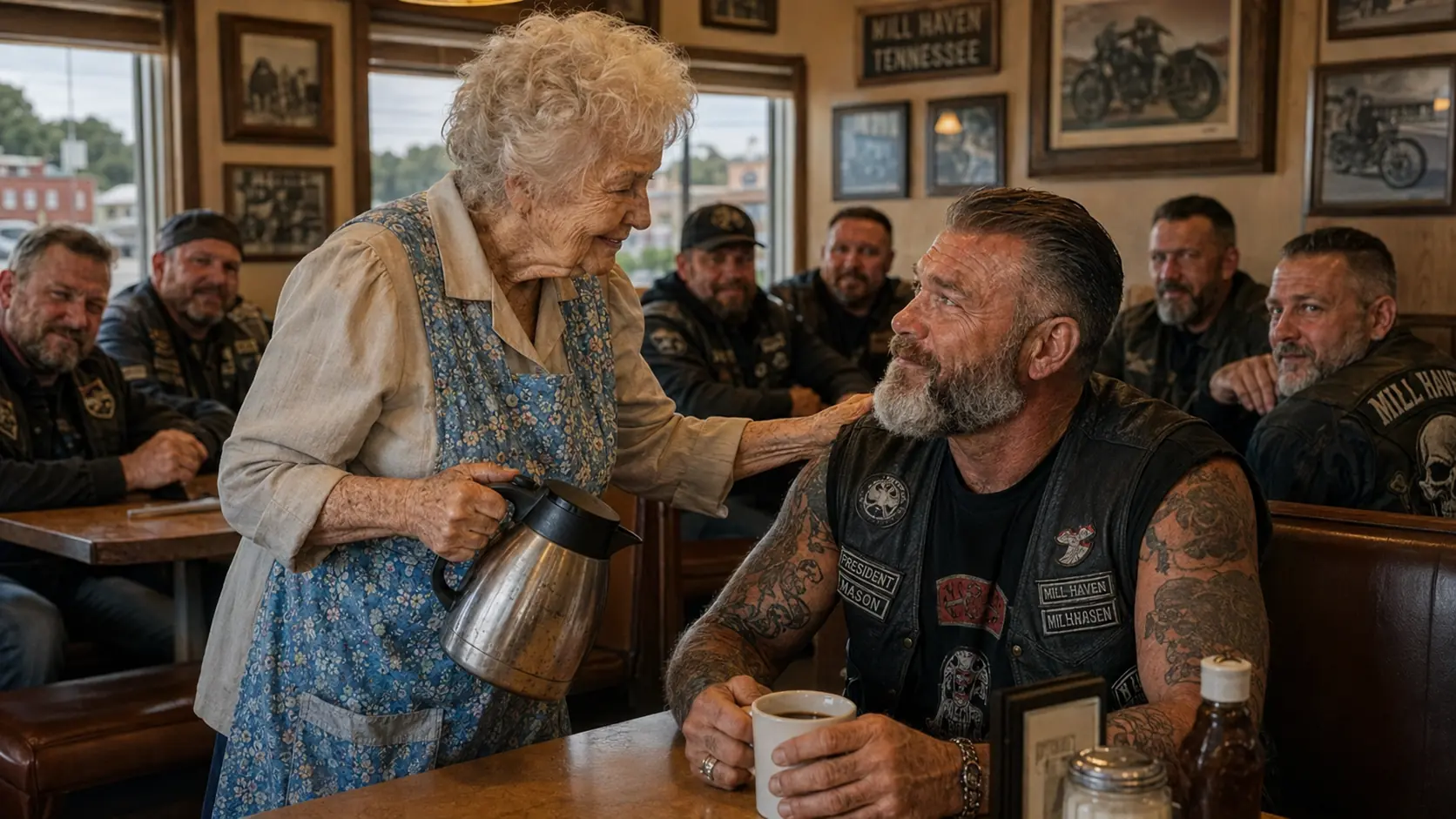
Ruth stood behind the counter wearing the faded blue floral apron she had owned for nearly a decade. Her gray-white curls were pinned loosely above her ears, her reading glasses hung from a chain around her neck, and an old stainless-steel coffee pot rested in her hand. Katie Mills, the twenty-three-year-old waitress working the evening shift, appeared beside the kitchen opening with nervous eyes. “Miss Ruth,” she whispered, “those men outside look serious.” Ruth glanced toward the windows and said, “So does the weather.”
The first biker through the door was Cole Mason, president of the Outlaw Riders’ East Tennessee chapter. He was a massive man in his late forties with tattooed arms, a thick salt-and-pepper beard, short dark hair, and the weathered face of someone who had spent more years riding highways than sitting behind desks. Water poured from his black leather vest onto Ruth’s tile floor. Behind him waited twenty-four riders, soaked through, cold, and exhausted, but nobody pushed inside until Cole removed his helmet and addressed Ruth respectfully.
“Ma’am, I know how this looks.”
Ruth raised one eyebrow. “How does it look?”
Cole glanced toward the riders behind him. “Like twenty-five people you probably weren’t expecting.”
“That part’s true.”
“We need somewhere dry for an hour or two. One of my men’s knee is giving out, and a couple of people are freezing. We’ll pay for whatever you’ve got and leave before closing.”
Ruth looked past him.
Two bikers were helping a younger man named Rick move carefully toward the porch. A woman wearing a red bandana held both hands around herself against the cold, her breathing already looking uncomfortable. Nobody appeared drunk. Nobody was shouting. Nobody was behaving the way frightened imaginations sometimes insisted bikers behaved.
Ruth opened the door wider.
“All of you, inside.”
Cole blinked.
“You sure?”
Ruth stared at him.
“Do I look confused?”
A faint smile moved beneath his beard.
“No, ma’am.”
“Then quit blocking my doorway.”
Within minutes, May’s Kitchen was full.
Leather jackets were stacked near the entrance instead of dripping across Ruth’s booths. Riders squeezed around tables meant for families of four. Men who looked intimidating enough to frighten half the county quietly asked permission before moving chairs. One enormous biker with tattoos covering both forearms grabbed napkins and began wiping water from the floor without being asked.
Katie watched everything with open disbelief.
Ruth handed her the empty coffee pot.
“Start another two.”
“Two pots?”
“Three if you can find enough grounds.”
“What are they going to eat?”
Ruth looked toward the chalkboard.
TODAY’S SPECIAL: BEEF STEW AND CORNBREAD.
The stew had technically run out two days earlier.
“Whatever Marcus can make.”
Katie looked toward the kitchen.
“For twenty-five people?”
Ruth nodded.
“People get hungrier when they’re cold.”
Inside the kitchen, Marcus Webb received the news without complaint. He had cooked for Ruth for nine years and learned early that arguing with her after she had decided to feed somebody was a waste of valuable oxygen. He opened the refrigerator, inventoried beef, vegetables, potatoes, onions, broth, leftover chicken, and enough flour for several trays of biscuits. “Thirty minutes,” he said. Ruth nodded. That was the entire discussion.
Ruth moved between the tables carrying coffee.
Rick sat in the corner booth with his injured knee elevated beneath the table.
“Old injury?” Ruth asked.
“ACL. Weather makes it angry.”
Ruth disappeared into the office and returned with the heating pad she used for her hip.
Rick looked at it.
“I can’t take that.”
“You aren’t taking it.”
She dropped it beside him.
“You’re borrowing it.”
Rick smiled.
“Yes, ma’am.”
At another table sat Donna Reyes, the biker wearing the red bandana. Ruth noticed the slight tightness in her breathing.
“You have asthma?”
Donna looked surprised.
“Yes.”
“Inhaler?”
“In my bag.”
“Good.”
Ruth poured coffee.
“Use it before you need someone yelling at you to.”
Donna laughed softly.
“You remind me of my grandmother.”
“She sounds like a sensible woman.”
“She terrified everybody.”
“Even better.”
For the first hour, everything remained peaceful.
The riders ate soup, biscuits, and anything Marcus could produce. Their voices stayed low. Someone fed quarters into the old jukebox but kept the volume reasonable. Cole sat at the center booth where he could see everyone, barely touching his food until Ruth noticed.
“You planning to stare at that bowl until it apologizes?”
Cole looked up.
“Just making sure everybody’s settled.”
“They’re settled.”
“They’re my responsibility.”
Ruth poured his coffee.
“You can be responsible while eating.”
Cole finally picked up his spoon.
That was when the front door slammed open.
Gary Hutton entered wearing an expensive rain jacket and the permanent expression of a man who believed his opinion constituted public policy. At fifty-eight, Gary owned the hardware store two blocks away and had served on the Mill Haven Town Council for eleven years. He stopped inside the doorway, stared at the biker jackets and patches, then looked at Ruth as if she had committed some obvious offense.
“Ruth.”
She continued filling a sugar dispenser.
“Gary.”
“What exactly is going on?”
“Dinner.”
Gary’s face reddened.
“You know what I mean.”
Ruth looked around.
“Apparently I don’t.”
Gary lowered his voice only slightly.
“These people shouldn’t be here.”
Every conversation stopped.
Cole remained seated.
Nobody threatened Gary.
Nobody even moved.
That silence somehow made his behavior look smaller.
Ruth set down the sugar dispenser.
“Why?”
Gary stared at her.
“Look at them.”
“I have.”
“They’re Outlaw Riders.”
“I can read jackets.”
“Do you understand what kind of reputation those people have?”
Ruth’s eyes hardened.
“I understand they arrived wet, cold, polite, and hungry.”
Gary looked around again.
Then came the sentence everyone would remember.
“You have thirty seconds to get every one of these animals out of this diner, or I’m calling Sheriff Briggs and every news station in three counties.”
Donna slowly lowered her coffee cup.
Rick looked up from his heating pad.
Cole’s jaw tightened, but he remained seated.
Ruth walked out from behind the counter.
She was barely five foot two.
Gary stood nearly a foot taller.
It did not matter.
“Then you better start dialing, honey.”
Gary’s mouth opened.
Ruth continued.
“Because nobody leaves my table hungry.”
The room remained silent.
Gary looked toward Cole, perhaps expecting intimidation he could later describe as justification.
Cole merely held his coffee.
Eventually Gary turned and walked out.
The bell above the door jingled behind him.
Ten seconds passed.
Then Rick said quietly, “Thank you, ma’am.”
Ruth picked up the coffee pot.
“Quit thanking me and eat before Marcus decides you insulted his soup.”
Laughter returned to the room.
Later, after everyone had eaten, Cole sat at the counter while Ruth finally poured herself coffee.
He watched her for several moments.
“What?”
Ruth asked.
“You really weren’t scared?”
“Of what?”
“Us.”
Ruth considered the question seriously.
“When I opened this diner thirty-one years ago, a homeless man came in during my first week. Sat in the corner for two hours. Didn’t order because he had no money. Customers complained because of how he looked.”
“What happened?”
“My husband wanted me to ask him to leave.”
“And?”
“I fed him.”
Cole smiled.
“He cause trouble?”
“Every Tuesday for eleven years.”
Cole laughed.
Ruth continued.
“His name was Walter Grimes. Came every week. Never had much money. Every spring he brought me one wildflower from the roadside.”
She looked down at her coffee.
“I learned a long time ago not to decide somebody’s character before they’ve given me evidence.”
Cole became quiet.
Ruth noticed something beneath the toughness.
He looked tired in a way rain alone could not explain.
“You going somewhere important?”
Cole stared at his cup.
“My father’s funeral.”
Ruth stopped.
“Tomorrow morning?”
He nodded.
“He died Sunday.”
“I’m sorry.”
Cole rubbed one hand across his beard.
“We weren’t close for a long time. He hated motorcycles. Thought the club ruined my life.”
“Did it?”
“No.”
“Then maybe he was wrong.”
Cole laughed faintly.
“Toward the end, he knew that.”
Ruth waited.
“He called me three weeks ago. Asked me to bring the bike by so he could finally see it.”
“Did you?”
“No.”
Cole’s voice changed.
“I kept thinking I had time.”
Ruth placed one weathered hand over his forearm.
Cole looked at it.
She did not offer some polished sentence about regret.
She simply said, “Then tomorrow you ride for him.”
Cole swallowed.
Ruth squeezed his arm once.
“And tonight you eat for him.”
That was when the biker president’s expression finally broke.
He looked down quickly.
Ruth pretended not to notice.
The storm worsened by eight.
The weather radio announced dangerous visibility across the plateau, and several routes toward Johnson City were temporarily unsafe for motorcycles. Cole gathered his riders and discussed alternatives, but Ruth could already see the answer in their faces.
Nobody was riding through that storm.
“Church has a fellowship hall four miles down Maple.”
Cole shook his head.
“Donna shouldn’t be back outside.”
Rick’s knee was worse too.
Ruth looked around her diner.
Then she sighed.
“There’s a storage room behind the kitchen.”
Cole stared.
“Ruth.”
“It’s dry.”
“Ruth.”
“Two people can sleep there. I have a house behind the diner. Three bedrooms.”
“No.”
“Excuse me?”
Cole stood.
“You already fed us.”
“And?”
“We’re not taking over your house.”
“You aren’t taking anything.”
Ruth crossed her arms.
“I’m offering.”
Cole shook his head.
“We can sleep here.”
“Fine. Some of you can. Booths, floor, storage room. Donna and Rick come to the house.”
Cole stared at her.
“You met us two hours ago.”
Ruth’s expression softened.
“The storm doesn’t care how long I’ve known you.”
He had no answer to that.
Near midnight, most riders were asleep.
Cole stepped outside and made a phone call from Ruth’s back steps.
He returned twenty minutes later.
Ruth was preparing biscuit dough.
“Who’d you call?”
Cole paused.
“How do you know I called someone?”
“You sat outside in thirty-eight-degree weather for twenty minutes and came back looking like you made a decision.”
Cole smiled.
“Some friends.”
“For what?”
“To tell them about you.”
Ruth frowned.
“You didn’t need to.”
“No.”
Cole looked toward the sleeping riders.
“I wanted to.”
The following morning, Ruth prepared breakfast for everyone.
Eggs.
Bacon.
Biscuits.
Coffee strong enough to wake the dead.
By eight, the weather had cleared.
Cole approached the register carrying three hundred dollars.
Ruth counted it and pushed a hundred back.
“Too much.”
“Keep it.”
“No.”
“Ruth, you fed us dinner, housed everybody, made breakfast.”
“Two hundred is fair.”
“You stood up to Gary.”
“That was free.”
Cole laughed.
Ruth pushed the money toward him.
“You want to respect me?”
“Yes.”
“Then don’t argue with what I charge.”
Cole took the money.
Before leaving, he shook her hand.
“Tomorrow.”
Ruth frowned.
“What tomorrow?”
“You might want extra coffee.”
“How many people?”
Cole smiled.
“More than twenty-five.”
He left before she could ask anything else.
By afternoon, Katie discovered that a photograph posted by one of the bikers had spread online.
It showed May’s Kitchen through the rain.
The caption described twenty-five riders being welcomed when nobody else would take them, and the elderly diner owner who refused to throw them back into the storm after Gary called them animals.
Thousands shared it.
Then tens of thousands.
A Nashville reporter called.
Then Knoxville television.
Then Ruth received a message from Cole.
Check your parking lot at ten tomorrow morning. Tell Mill Haven to make room.
Ruth stared at the phone.
Katie stared at Ruth.
“What does that mean?”
Ruth tied her apron tighter.
“It means call the church and ask for tables.”
The next morning at 8:47, Ruth heard the engines.
This time the sound did not shake only the diner.
It seemed to shake Mill Haven.
She walked outside.
Motorcycles appeared around the highway curve.
Ten.
Twenty.
Fifty.
One hundred.
They kept coming.
Katie stood beside Ruth with both hands over her mouth.
Reverend Hobbs stopped unfolding a church table.
Marcus came out of the kitchen.
By the time the last bike parked, there were 214 motorcycles filling Ruth’s lot, the church lot, and one side of the street.
Then the engines stopped.
The silence afterward was enormous.
Cole walked through the crowd.
Ruth stared at him.
“You said more than twenty-five.”
“I did.”
“This is not more than twenty-five. This is an invasion.”
Cole smiled.
“A peaceful one.”
“What are they doing here?”
He looked toward the riders.
“Making a statement.”
“To who?”
“To anybody who thinks people can be judged by a patch.”
Then he looked directly at her.
“And to the woman who opened the door.”
Ruth’s eyes grew wet.
She hated that.
Cole noticed.
He politely pretended he didn’t.
Ruth recovered, grabbed the nearest coffee pot, and marched toward the crowd.
“Well, standing around staring at me isn’t breakfast.”
The next four hours transformed Mill Haven.
Riders ate beside church volunteers.
Local families arrived.
People who had spent years avoiding bikers found themselves discussing motorcycles over biscuits.
Donna brought jars of honey from her Kentucky hives.
Rick helped serve coffee despite his knee.
Marcus and volunteers cooked until the kitchen seemed to operate on pure stubbornness.
Then Gary Hutton arrived.
The crowd went quiet.
He remained inside his truck for nearly two minutes before stepping out.
Cole moved beside Ruth.
“You want me here?”
“No.”
Gary walked through the bikers.
Nobody threatened him.
Nobody insulted him.
That somehow made the walk harder.
He stopped in front of Ruth.
“What I said Tuesday night was wrong.”
Ruth waited.
Gary swallowed.
“I called people animals when I didn’t know them. I embarrassed you in your own business.”
He glanced at Cole.
“I was scared of something before I bothered learning anything about it.”
Ruth looked at him for several seconds.
Then she said, “It took courage to come here.”
Gary nodded.
“Don’t waste it.”
That was all.
No dramatic forgiveness.
No punishment.
Just a door left open slightly.
Later, Donna found Ruth resting beside the building.
She handed her a jar of amber honey.
“For you.”
Ruth turned it beneath the sunlight.
“You make this?”
“My bees do most of the work.”
Ruth smiled.
“You sell wholesale?”
Donna blinked.
“What?”
“I buy honey every month.”
“You’re offering me business?”
“I’m asking whether your honey is good.”
Donna laughed.
“It’s very good.”
“Then leave me your card.”
Donna stared at her.
“You really cannot stop helping people, can you?”
Ruth looked offended.
“I’m buying honey, not adopting you.”
Donna laughed until tears appeared.
Around noon, Cole found Ruth inside the kitchen eating a biscuit while standing.
“Sit.”
“No.”
“Ruth.”
“I’ll sit when people stop needing food.”
“That could be never.”
“Exactly.”
Cole leaned against the counter.
For several seconds neither spoke.
Then he said, “My father would have loved you.”
Ruth looked toward him.
“What was his name?”
“Michael.”
“What did Michael eat for breakfast?”
Cole smiled.
“Everything.”
“Good man.”
“He loved biscuits.”
Ruth placed another biscuit on a plate.
Then poured coffee.
She set both at the empty place across from Cole.
He looked at them.
“For him?”
“For Michael.”
Cole lowered his head.
Nobody spoke for a while.
Then Ruth touched his shoulder.
Cole placed one huge hand gently over hers.
His voice came rough.
“Why are you treating us like family?”
Ruth smiled.
“Because tonight, honey, you needed one.”
Cole looked down.
“My father would’ve loved this place.”
“Then eat for him.”
She squeezed his shoulder.
“I’ll keep his boy warm.”
Cole laughed quietly through eyes that had become suspiciously bright.
Later, before leaving, he handed Ruth a round red-and-gold patch.
HONORARY ROAD FAMILY
Ruth traced the stitching with one finger.
“You people voted on this?”
“Unanimous.”
“What am I supposed to do with it?”
“Whatever you want.”
That evening, when the diner finally became quiet, Ruth stood beneath the photograph of her late husband Earl.
She had not moved that photograph in eleven years.
She pushed a thumbtack into the wall beside it.
Then another.
She hung the biker patch next to Earl’s military photograph.
Ruth stepped backward.
A young soldier.
A motorcycle-club patch.
Two pieces of completely different lives sharing the same wall.
It looked right.
Months later, May’s Kitchen remained busier than it had been in years.
But Ruth changed almost nothing.
Coffee was still inexpensive.
Biscuits still came from Marcus’s grandmother’s recipe.
Donna’s honey replaced the old Nashville supplier.
And every few weeks, a motorcycle or two appeared outside.
Sometimes twenty.
Cole returned often.
Never with two hundred riders again.
Ruth told him she would personally throw him out if he tried.
One cold December morning, Cole entered alone.
He sat in the same booth.
Ruth brought coffee without asking.
“You riding somewhere?”
“My father’s grave.”
Ruth nodded.
She returned with two biscuits.
“One for you.”
Cole looked at the second.
“And one for Michael?”
Ruth shrugged.
“Man liked biscuits.”
Cole smiled.
Outside, winter sunlight touched the motorcycles parked beside ordinary pickup trucks.
Inside, nobody stared at the biker anymore.
He was simply Cole.
A man drinking coffee at Ruth’s table.
Ruth walked toward another customer carrying the stainless-steel pot.
Cole watched her go.
He understood now why more than two hundred riders had crossed state lines to thank one elderly woman.
It was not because she had performed some extraordinary act of heroism.
She had simply opened a door.
She had looked at twenty-five soaked strangers and refused to calculate whether they deserved warmth before offering it.
Ruth Calder had spent thirty-one years believing that hunger made people equal.
Cole Mason had spent twenty-six years expecting strangers to fear him before knowing him.
One October storm brought those two beliefs to the same table.
And neither of them ever looked at strangers quite the same way again.