The two produce trucks stood side by side behind the old red barn, their beds raised toward the pale California sky. Thousands of rejected strawberries spilled onto the grass in rolling waves of red, forming two enormous piles beside the weathered farmhouse. Some berries were undersized, others were misshapen or bruised, but nearly all remained fresh enough for food processing. From the county road, several neighbors watched as though they had gathered to witness a public disaster.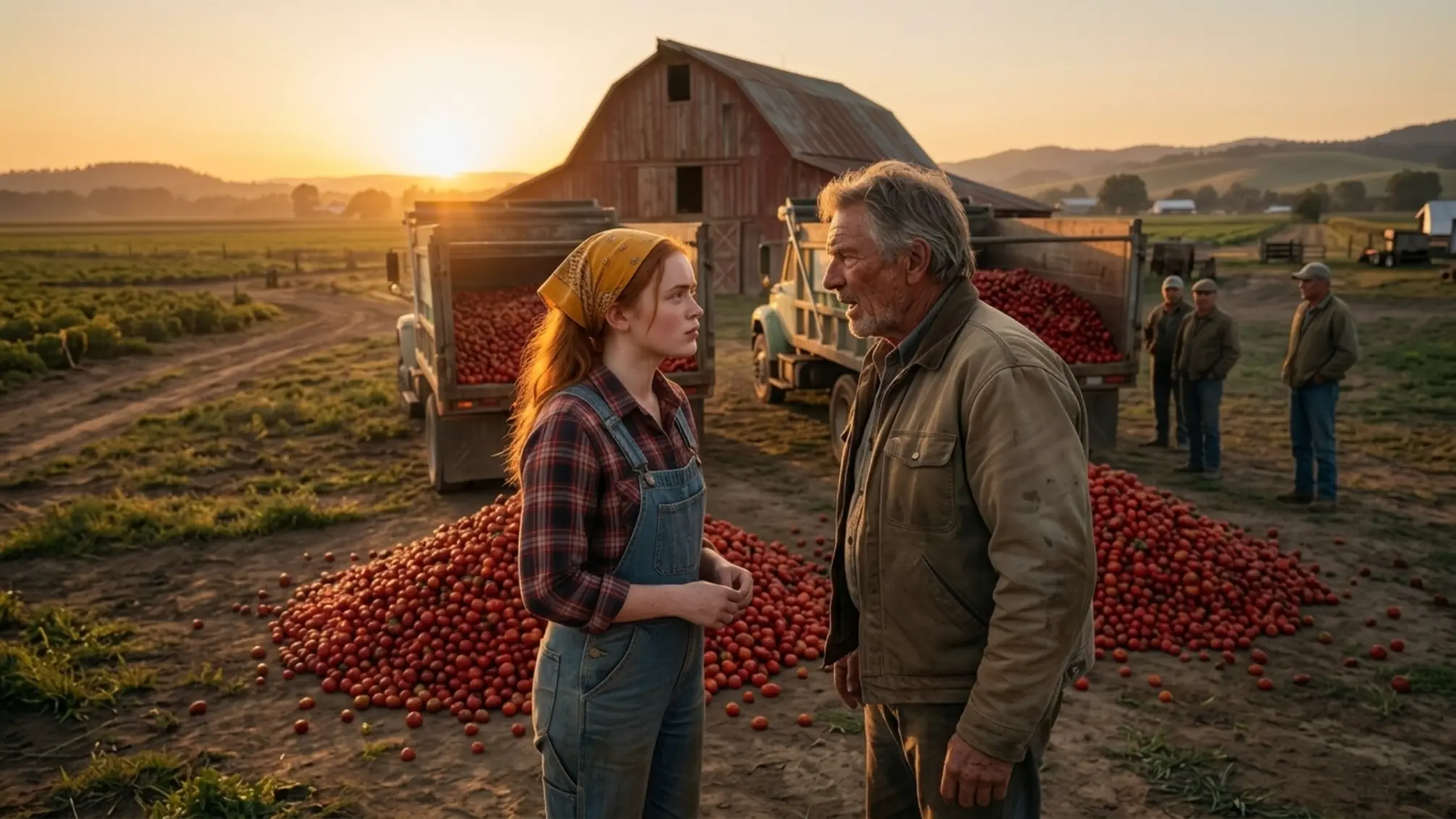
At the center of the field stood twenty-year-old Sophie Bennett, the young woman everyone had already decided was destroying her parents’ farm. Her freckled face was framed by copper-red hair tucked beneath a mustard-yellow headscarf, and faded denim overalls covered her red-and-black plaid work shirt. She looked smaller than the hostile fifty-six-year-old Farmer standing inches from her, but she did not step backward when he insulted her family. The moment his words touched the memory of her parents and the future of her younger siblings, the exhaustion in her blue-green eyes hardened into warning.
The Farmer had come only to laugh. He owned several successful vegetable fields outside Watsonville and believed experience gave him permission to judge anyone who worked differently. His heavy canvas jacket carried dust from his own property, and his weathered hands remained clenched as though the young Farm Girl had personally insulted agriculture by accepting fruit supermarkets refused to sell. Behind him, drivers slowed their trucks to stare at the red mountains growing on the Bennett farm.
Sophie’s parents had died three years earlier in a highway accident during a winter storm. At seventeen, she became the legal guardian of her fourteen-year-old brother Noah and eleven-year-old sister Lily. Grief had not paused the electricity bills, property taxes, school expenses, groceries, or repairs needed to keep the eighteen-acre farm standing. Every month, Sophie watched money disappear faster than she could earn it through temporary packing jobs, café shifts, and seasonal labor.
The Bennett farm had once supported a modest living through vegetables and several rows of strawberries. After the accident, weeds spread across fields Sophie no longer had time or money to manage. The white farmhouse leaned slightly, the porch boards creaked, and rain entered through two sections of the barn roof. Every broken fence post reminded Sophie of work her father had planned to finish before the accident took away the years he believed he still had.
Noah tried to help without being asked. He repaired tools after school, chopped firewood, and often claimed he was not hungry when food portions became smaller. Lily carried a notebook filled with drawings of the farm restored, the barn repainted, and all three siblings standing together beneath flowering trees. Neither child admitted how afraid they were of losing the only home still connected to their parents.
Most nights, Sophie sat at the kitchen table counting bills after Noah and Lily went to bed. The money inside an old cookie tin above the refrigerator had become their final emergency reserve. She could pay the next property-tax installment or replace the failing water pump, but she could not do both. Another difficult season would force her to sell land, remove the children from their school, or surrender the entire farm.
The two trucks first appeared because of Daniel Harper, an operations supervisor from Pacific Crest Foods. His company processed strawberries for supermarkets across the region and discarded thousands of pounds every week because retailers rejected fruit that looked imperfect. Small berries, unusually shaped berries, and fruit bruised during packing were sent away even when they remained safe to eat. The company paid transportation and disposal costs simply to remove food no store wanted.
Daniel expected Sophie to reject his proposal. Most landowners did not want piles of fruit placed near their homes, even temporarily. When he asked whether Pacific Crest could unload the strawberries in her unused field, Sophie stared toward the neglected acreage and asked how many trucks arrived each week.
“Usually two,” he said.
“Every Monday?”
“Yes.”
“Then bring both.”
Daniel asked whether she understood how much fruit that meant.
Sophie answered that she wanted every safe strawberry he could deliver.
The first Monday attracted attention before the trucks finished unloading. People stopped along the road, took photographs, and called friends. By afternoon, Watsonville had given the Farm Girl’s project several cruel names, including Bennett’s Berry Dump and the Orphan’s Red Mountain. Some predicted rodents, insects, and complaints from health inspectors, while others claimed grief had finally damaged Sophie’s judgment.
Noah heard classmates laughing about the trucks at school. One student asked whether his sister planned to feed the town from a garbage pile. Lily returned home after another child told her the farm would soon smell rotten enough to force the family away. Sophie listened to both children without revealing how deeply the insults frightened her.
That evening, she stood beside the strawberries beneath a fading sky. The piles looked far larger without spectators nearby, and the sweet smell in the air carried the first hint of fermentation from berries crushed beneath the weight. For several minutes, Sophie wondered whether the whole town had recognized a disaster she was too desperate to see.
Then she remembered something her mother often said while preserving fruit in the farmhouse kitchen: people sometimes threw away good things because they had never learned what else those things could become.
The next morning, Sophie entered the kitchen before sunrise and took a heavy copper kettle from the highest shelf. It had belonged to her grandmother before passing to her mother. She wiped away the dust, opened several library books about food preservation, and began separating the first delivery.
She established strict rules before cooking a single batch. Bruised, soft, small, or overripe strawberries could be used if they remained fresh and clean. Any berry showing mold, an unusual odor, or signs of fermentation would be discarded immediately. Sophie understood that desperation could never justify risking another family’s health.
Her first attempt produced strawberry syrup instead of jam. The second burned against the bottom of the kettle and filled the kitchen with a bitter smell. The third looked perfect inside the jar but separated overnight, leaving liquid above an unpleasantly dense layer of fruit. Every failure consumed sugar, jars, fuel, time, and money the family could not afford to waste.
Noah found Sophie carrying another ruined batch toward the compost pile after dark.
“You’ll get it right,” he said.
She looked at the sticky red mixture. “You don’t know that.”
“No,” he admitted. “But you haven’t stopped yet.”
The following Monday, both trucks returned. The neighbors laughed harder because the first piles had not completely disappeared. The hostile Farmer parked near the field and asked Sophie whether she planned to bury herself before the bank could take the property. She continued sorting strawberries without answering.
Each week developed a rhythm. The trucks arrived Monday morning, and Sophie immediately separated usable fruit from anything unsafe. Noah washed and sterilized jars after finishing schoolwork, while Lily dried labels beside the kitchen window and recorded batch numbers in careful handwriting. Most nights, the farmhouse lights remained on past midnight.
Sophie filled an old notebook with exact measurements. She changed sugar ratios, tested lemon juice, recorded cooking temperatures, and compared strawberries harvested after cool coastal mornings with those picked during hotter afternoons. She refused to trust instinct alone because every mistake had become too expensive.
One evening, Sophie discovered white mold hidden beneath the top layer of a crate. Most of the strawberries looked usable, and throwing them away would eliminate enough fruit for dozens of jars. The family’s grocery money sat beside the kettle.
Lily watched as Sophie carried the entire crate outside.
“Couldn’t you cut off the bad parts?” the child asked.
“No.”
“But most of them look fine.”
Sophie knelt beside her. “When people trust something we make, we have to deserve that trust every time.”
The explanation became one of the first rules written on the future company wall.
Four months passed before Sophie produced a batch that set correctly without becoming too sweet. The jam fell from the wooden spoon in slow ribbons, held its shape on a chilled plate, and tasted strongly of fresh strawberries with only a slight brightness from lemon. Sophie stood alone in the kitchen after midnight, holding the spoon while tears filled her eyes.
She was not crying because the jam tasted good. She was crying because, for the first time since her parents died, something created by her own hands seemed capable of protecting Noah and Lily.
Sophie refused to begin selling immediately. She filled twelve small jars and carried them to people who would give honest opinions. An elderly neighbor said the flavor reminded her of strawberries grown during childhood. Noah’s teacher sent a note telling Sophie not to change the recipe.
The final jar went to Michael Dawson, owner of a small Watsonville bakery called Harbor Oven. Michael had rebuilt his business after a fire destroyed his family’s original shop, and hardship had made him cautious about exaggerated promises. He spread Sophie’s jam across a warm biscuit, tasted it, then carried the jar into the kitchen without speaking.
Twenty minutes later, he returned with the empty container.
“How many can you make each week?” he asked.
Sophie had prepared herself for criticism, not an order.
“I don’t know yet.”
“Find out. If the next batch tastes like that, I’ll buy every jar you can produce.”
The first order was small enough to fit inside two wooden crates. Sophie placed each handwritten label carefully, loaded the jars into her aging pickup, and delivered them before the bakery opened. Michael placed the jam on a shelf beside local bread and honey.
Every jar sold before noon.
The second order doubled. The third doubled again. Customers began asking Michael when the next delivery would arrive, and some drove directly to the Bennett farm after hearing that the jam came from strawberries supermarkets had rejected.
People who once slowed near the property to laugh now slowed to ask questions.
Sophie registered Bennett Strawberry Jam as a small food business and completed the required safety paperwork. The framed certificate hung above the farmhouse kitchen table where unpaid bills once formed the tallest stack in the room. It did not erase their financial problems, but it proved the red piles behind the barn had become something more than an experiment.
Growth created new difficulties. The kitchen counters filled with cooling jars, boxes of sugar blocked part of the hallway, and Noah completed homework beside stacks of empty containers. Sophie could not accept larger orders without improving the process, but the farm lacked money for commercial equipment.
Daniel Harper arrived with the usual two trucks one Monday and noticed how much of the fruit had disappeared. After touring the kitchen, he proposed changing the company’s sorting system. Instead of mixing fresh rejected berries with fruit already unsuitable for food, Pacific Crest workers would separate strawberries specifically for Sophie’s processing operation.
The arrangement benefited both businesses. Pacific Crest reduced disposal costs, while Sophie received more consistent deliveries with less waste. The trucks still came every Monday, but the fruit now arrived in food-safe containers rather than being dumped carelessly into piles.
The same neighbors who had called the farm a dump claimed Sophie had been lucky to receive corporate help. They ignored the months she had spent sorting fruit, ruining batches, studying safety, and building demand before Daniel considered a formal partnership. Sophie did not argue because orders mattered more than explanations.
The first person she hired was Carlos Mendoza, an experienced seasonal farmworker searching for stable employment after poor harvests reduced available jobs. Carlos checked every seal twice and cleaned equipment with the seriousness of someone protecting his own family. Soon afterward, Sophie hired Grace Holloway, a cheerful young woman who organized labels, inventory, and delivery schedules more efficiently than Sophie ever had.
Together they transformed the old red barn. Broken machinery was removed, cracked walls repaired, and food-safe surfaces installed. Stainless-steel tables replaced rusted equipment, while larger kettles stood beneath proper ventilation. Sophie preserved one corner of the barn exactly as it had been, including her mother’s workbench and the first copper kettle.
The hostile Farmer returned when construction began. He stood near the open barn door and claimed Sophie had allowed one successful season to make her reckless. He warned that larger equipment, employees, and supply agreements would create expenses capable of destroying the farm if customers lost interest.
His concerns were not entirely false, but his tone carried the same satisfaction it had when he insulted her family beside the strawberry trucks.
“You still waiting for me to fail?” Sophie asked.
“I’m waiting for you to understand farming isn’t a children’s story.”
“I understood that when I buried my parents and went back to work the next morning.”
The Farmer looked toward the production room. “Jam won’t protect those children forever.”
Sophie stepped closer. “Neither will your opinion.”
He left without answering.
Sophie expanded more slowly than buyers wanted. She rejected several large orders because fulfilling them would require borrowing heavily and lowering quality. Instead, she increased production only after confirming she had enough staff, safe fruit, jars, and kitchen capacity.
That caution saved the business when strawberry prices changed and one major retailer delayed payment. Bennett Strawberry Jam remained small enough to survive without laying off workers or sacrificing ingredients. Sophie had learned from losing her parents that security could disappear suddenly, so she built reserves before expanding.
The reward she valued most arrived through two ordinary school envelopes. Noah made the honor roll and received an opportunity to attend an advanced summer science program. Lily was invited to a weeklong environmental camp she had hidden from Sophie because the fee seemed impossible.
Sophie opened the business ledger and wrote both checks without deciding which household bill would remain unpaid.
Noah stared at the payment. “Are you sure?”
“Yes.”
“You don’t have to send me.”
“I know.”
Lily hugged Sophie before she finished signing her name.
That evening, the three siblings ate dinner around the same table where Sophie once counted coins from the cookie tin. The company had not made them wealthy, but for the first time, poverty did not control every decision inside the house.
Five years after the first delivery, Bennett Strawberry Jam had become one of the region’s most respected small-batch brands. Pacific Crest continued sending two trucks every Monday, although deliveries now entered an inspection area beside the licensed production barn. Every strawberry was checked before washing, and anything unsafe was composted away from the food facility.
The company’s reputation rested on transforming overlooked fruit without lowering standards. Sophie never described strawberries as garbage because their shape had never determined their value. Grocery stores had rejected appearances, not quality.
Agricultural organizations invited her to speak about food waste, local processing, and small-farm survival. Journalists called her the orphan who built a business from discarded berries, but Sophie disliked turning family loss into advertising. She preferred talking about safety systems, dependable partnerships, and the workers responsible for every jar.
She also refused to replace the farmhouse with a modern home. Sophie repaired the roof, straightened the porch, and restored the kitchen while preserving marks left by her parents. Lily planted flowers beneath the windows, and Noah rebuilt the fence their father never had time to finish.
The Farmer who once threatened to watch the bank take the property eventually returned during a public farm tour. He stood at the edge of a crowd while Sophie explained how rejected strawberries entered inspection, processing, cooking, sealing, and distribution. Behind her, employees loaded finished products into delivery vans.
After the visitors left, he approached alone.
“I was wrong about the trucks,” he said.
Sophie waited.
“I thought they were delivering waste.”
“They were delivering ingredients.”
“I also shouldn’t have mentioned your parents.”
“No.”
He lowered his eyes. “Or those children.”
“They’re not children anymore.”
Noah was studying food science, while Lily had begun helping with marketing and business administration. Both intended to return permanently after completing their education. The farm Sophie fought to preserve had given them the freedom to leave, learn, and choose to come home.
The Farmer looked toward the restored barn. “I expected you to lose this place.”
“I know.”
“You could remind the whole town what I said.”
“I don’t need to.”
He nodded because the answer hurt more than humiliation would have. Every truck, employee, jar, and returning sibling had already repeated her response.
Years later, Noah modernized parts of the cooking process without changing the family recipe. Lily redesigned distribution and packaging while preserving the cream-colored label based on her childhood handwriting. Carlos supervised quality control, and Grace managed shipping across California.
Sophie remained responsible for one final inspection of every new product. Expansion never mattered enough to risk the trust established when she discarded an entire crate despite needing grocery money.
The original copper kettle was eventually placed behind glass near the entrance. Visitors assumed it represented the first successful batch, but Sophie knew it also represented burned jam, failed syrup, exhausted nights, and the decision to begin again when only three usable jars remained.
At the opening of a new production facility, the two Pacific Crest trucks arrived together exactly as they had on the first Monday. This time, no one laughed when they entered the driveway. Employees opened the gates, inspected the containers, and welcomed a delivery capable of becoming thousands of jars.
Sophie stepped away from the crowd and stood on the farmhouse porch. Through the window, she could see framed photographs of her parents beside the first business certificate. Noah discussed equipment with Carlos, while Lily greeted customers beneath a banner carrying the Bennett name.
Reporters asked whether the jam company was Sophie’s greatest achievement.
She looked at her brother and sister before answering.
The business mattered because it created employment, reduced food waste, and saved the farm. But its greatest purpose had been simpler. It prevented three orphaned siblings from being separated by poverty and allowed them to build a future without abandoning one another.
The town had seen two trucks carrying rejected strawberries.
Sophie had seen school fees, repaired roofs, steady work, and a reason her siblings might remain hopeful long enough to discover their own futures. She did not know the complete path when the first fruit fell onto the grass. She only knew the farm needed income and that useful food was being thrown away.
The hostile Farmer believed the berries would bury her in debt.
Instead, they filled her grandmother’s kettle, covered bakery shelves, restored the barn, and brought Noah and Lily home as educated partners. The mountains of fruit disappeared, but the discipline built beside them remained.
Every Monday morning, two trucks still rolled onto the Bennett farm.
They no longer attracted laughter from the county road. They arrived through gates bearing the company name and passed fields restored through profits earned one honest jar at a time.
Sophie often stood nearby wearing faded overalls and a headscarf, looking much like the Farm Girl who once faced an angry neighbor between two crimson piles. She was older now, but her warning had never changed.
Anyone could question her business.
They could doubt the trucks, mock the strawberries, or predict failure.
But the moment they threatened her family, they discovered that the quiet young woman carrying a strawberry in one hand had built every part of her future to protect the people standing behind her.