In Crestfall, Wyoming, in the summer of 1883, every town had one person everyone discussed as if that person belonged to the public.
In some towns, it was the sheriff.
In some towns, it was the preacher’s wife.
In some towns, it was the richest rancher, the loudest gambler, the prettiest widow, or the man who had once killed someone in Dodge City and refused to speak of it.
In Crestfall, that person was Rose Callahan.
She was twenty-six years old, the eldest daughter of the town’s general store owner, with golden hair she kept pinned during the day and eyes that were either green or gray depending on the light.
She was warm without being soft, funny without being unkind, and capable in the particular way of frontier women who had never had the luxury of being otherwise.
Rose could measure flour without looking, spot a short-weighted coffee sack by feel, calm an angry customer without apologizing for something that was not her fault, and add a column of figures faster than most men in town could count change.
She could patch a torn sleeve, drive a wagon, shoot well enough to discourage coyotes, read a ledger, comfort a crying child, and make a man regret speaking foolishly without raising her voice.
Every eligible man in Crestfall County had considered the question of Rose Callahan.
Most of them had done more than consider.
There had been formal courtships, flowers left at the counter, invitations to dances, church socials, Sunday suppers, spring picnics, sleigh rides in winter, and one very awkward serenade beneath her bedroom window by a man who had mistaken confidence for talent.
A cattle rancher from Ridgeline had reportedly offered her father a sum that made Daniel Callahan set down his coffee very carefully before responding.
Rose had declined all of them.
Politely.
Warmly.
With the kind of genuine kindness that made rejection worse because there was no coldness in it to be angry about.
The rejected men usually walked away feeling not insulted, but somehow improved, which made them respect her and suffer at the same time.
People had theories.
She was too particular.
She was waiting for someone from the city.
She had taken some private vow.
She thought no man in Crestfall was good enough.
She was secretly heartbroken over a soldier.
She intended never to marry at all.
None of them were right.
The answer was considerably simpler and considerably more inconvenient.
And it had a name.
The name was Will Hadley.
And he was the only man in Crestfall who had never once thought to try.
What no one knew, not even Will, was that time was beginning to run out.
Crestfall was not a large town, though it liked to speak of itself as if growth were inevitable and just a little delayed.
It sat in a wide valley under mountains that rose blue in the distance during the day and turned purple at dusk. In summer, the grass went gold. In winter, the wind came down from the ridges with such force that doors shook in their frames and people spoke less because the cold stole unnecessary words.
Main Street was four blocks long if one counted generously.
The Callahan General Store stood near the center of it, with barrels of flour and nails out front, a striped awning over the windows, and a bell above the door that had announced half the town’s business for nearly twenty years.
Daniel Callahan owned the store.
He was a widower with broad shoulders, a thoughtful face, and the patient manner of a man who had raised three daughters and learned that listening first prevented many storms.
Rose was his eldest.
After her mother died, Rose was sixteen and old enough to understand that grief did not cancel chores. She learned the store accounts because someone had to. She learned to cook for her younger sisters because the house still required meals. She learned to be gentle when May cried at night and firm when Clara refused to help. She learned how to wear responsibility as naturally as other girls wore ribbons.
People admired her for it.
That admiration became expectation.
By twenty-six, Rose had become the kind of woman everyone relied on and no one asked whether she was tired.
She opened the store most mornings.
She balanced the books at night.
She made sure her father remembered to eat when business was heavy.
She kept track of which families were quietly short on credit and which men should not be allowed to buy whiskey on account.
She remembered who needed lamp oil before storms and who had a new baby and might require extra cloth.
She could be cheerful at six in the morning while stacking coffee tins.
She could be patient at noon when Mr. Fergus argued over the price of salt pork even though he argued every week and always paid eventually.
She could smile at a man bringing flowers even when her heart sank because she already knew what she would have to say.
She was not unhappy.
That was important.
Rose loved the store.
She loved her father.
She loved her sisters, even now that May had married a carpenter two towns over and Clara was threatening to run away to Cheyenne every other month.
She loved the rhythm of the town, the bell above the door, the smell of coffee and leather and sugar, the mountains beyond the far end of Main Street.
But beneath that full, useful life was a quiet ache.
A waiting.
A hope she had never fully confessed to anyone except perhaps God, and sometimes not even to Him because speaking a hope made it easier for the world to laugh at it.
Will Hadley was thirty years old and ran the livery stable on the south end of Crestfall’s Main Street.
He was not the most prosperous man in town.
Not the most handsome, though he was not unhandsome.
Dark hair, a jaw made with a carpenter’s square, hands always slightly rough from work, and a smile that arrived slowly and then stayed.
Other men described him as solid, which could be either a compliment or a polite way of saying unremarkable, depending on who said it.
But what Will Hadley was, without question, was good.
Not in the performed way.
In the quiet way.
He remembered things people told him.
He gave honest prices.
He did not overcharge travelers who did not know better.
If a horse was lame, he said so, even if selling it sound would have made him more money.
When old Pete Marsh’s barn burned two winters ago, Will showed up the next morning with lumber he could not really spare and never mentioned it afterward.
When Mrs. Bell’s mule broke loose and nearly overturned her wagon, Will caught the mule, fixed the harness, and walked the wagon home without accepting a coin.
He had a way with frightened animals and stubborn men.
He did not talk more than necessary.
He did not hurry unless something was on fire.
Children liked him because he would let them pet the gentle horses and never mocked their questions.
Women trusted him because his politeness had no slyness in it.
Men trusted him because he did not dress honesty up as superiority.
Will and Rose had grown up three streets apart.
They had the easy, unexamined familiarity of people who had always simply been part of each other’s landscape.
He had been twelve when he first carried a flour sack for her father.
She had been eight and missing a front tooth.
He remembered her laughing at a rooster that chased the schoolmaster across the road.
She remembered him standing between a smaller boy and three older ones who wanted to push the boy into a horse trough.
They had known each other through awkward years, muddy springs, church picnics, harvest socials, town scares, winter storms, and all the small events that make childhood into history.
Will looked at Rose Callahan the way one looks at the mountains outside the window.
Aware they are extraordinary.
Grateful they are there.
And somehow never quite registering that he could walk toward them.
Rose, unfortunately, had registered Will years ago.
Not suddenly.
Not with one grand romantic revelation.
It had happened gradually, the way daylight gathers.
At first, he was simply Will, the boy from down the street.
Then he was Will, who could make a skittish horse lower its head.
Then Will, who fixed the store wagon’s axle in the rain and refused payment because Daniel Callahan had once given his mother sugar on credit.
Then Will, who remembered that Rose liked peppermint sticks but not horehound candy.
Then Will, who noticed when she was tired and said, “You should sit a spell,” without making it sound like she was weak.
Then Will, who came into the store every Wednesday morning for nails, rope, feed, oil, or something else the livery probably needed but not always urgently.
Then Will, who made her heart lift every time the bell rang and she saw his hat through the window.
By the time Rose understood what had happened, it was already too late to stop it.
She loved him.
Quietly.
Practically.
With humor and annoyance and patience and occasional despair.
She loved him because he was kind when no one watched.
Because he did not talk about being honorable, he simply behaved that way.
Because he looked at her without wanting her to perform.
Because when he smiled at her, not politely but truly, it felt like stepping into sunlight after a long winter.
The problem was that Will had never once given any sign that he understood.
Worse, he treated her with the easy warmth of a lifelong friend, which was wonderful and unbearable in equal measure.
He came into the general store on a Wednesday morning in June for nails and rope and found her reorganizing the dry goods shelf.
She was standing on a step stool, reaching for the high shelves with total concentration.
A small pencil was tucked behind her ear.
Her sleeves were rolled to the elbow.
A streak of flour marked one cheek.
“Morning, Rose,” Will said, the way he had said it a thousand times.
Rose glanced down.
“Morning, Will,” she said, the way she had answered a thousand times.
“Your father in?”
“In the back, arguing with a crate of peaches.”
“Losing?”
“At present, yes.”
Will smiled.
Rose stepped down from the stool, dusting her hands.
“What do you need?”
“Nails. Two pounds. Half-inch if you have them. And rope, twenty feet.”
“Stable roof again?”
“Stall door.”
“Same horse?”
“Same horse.”
“The brown mare with the opinion?”
“She has many opinions.”
“She kicks?”
“She expresses concern.”
Rose laughed and turned toward the shelves.
Will watched her only long enough to notice she had flour on her cheek.
“You’ve got…” He pointed to his own cheek.
Rose brushed the wrong side.
“There?”
“No. Other side.”
She brushed again and missed.
Will reached for the counter cloth, then stopped as if only then realizing that touching her face might not be as ordinary as passing a sack of nails.
He handed her the cloth instead.
“Here.”
She took it.
Their fingers brushed.
For Rose, that small contact moved through her with absurd force.
For Will, judging by his expression, it meant nothing except that the flour was now gone.
Rose turned away before her face betrayed her.
He paid for his nails and rope.
He left.
Outside on the boardwalk, George Alcott leaned against the post near the barber shop, arms crossed, hat pushed back, wearing the expression of a man watching a wagon roll slowly toward a ditch.
George had courted Rose twice.
Once at twenty-three, with flowers and a supper invitation.
Once at twenty-five, after convincing himself the first refusal had been poor timing.
Rose had declined both times kindly.
George had survived, mostly because he had enough sense to know when a door was closed and enough humor to mock his own bruised pride.
He liked Will.
This made watching Will’s blindness all the more maddening.
“You know,” George said as Will stepped down from the boardwalk, “for a man who works with horses, you have a remarkable inability to see what is standing right in front of you.”
Will looked at him with genuine puzzlement.
“What are you talking about?”
George looked at the sky as if asking for divine endurance.
“Nothing.”
“Doesn’t sound like nothing.”
“It is a vast and hopeless nothing.”
Will frowned.
“You been drinking before noon?”
“Not enough.”
Will shifted the rope over his shoulder.
“I’ve got work.”
“Yes,” George said. “And apparently no eyes.”
Will shook his head and walked back toward the livery.
George watched him go.
Then he looked through the store window.
Rose was standing behind the counter, looking after Will with an expression that made George’s humor soften into pity.
He had seen that expression before.
Not directed at him.
That had helped him understand everything.
What George knew, and Will did not, was that Edward Marsh had been asking quiet questions about Rose Callahan for two weeks.
Serious questions.
The kind a man asks before making a formal offer.
Edward Marsh was not a man people ignored.
He was forty-two, widowed, broad-shouldered, and possessed of the calm authority of wealth earned the hard way. He had built the largest cattle operation in the county from nothing but rented pasture, borrowed money, and a willingness to work longer than the men around him.
People respected him.
Some feared him.
Few loved him.
Edward Marsh was fair, which is not the same as warm.
He paid on time.
He kept contracts.
He donated to the church roof fund.
He had once fired a foreman for whipping a horse bloody.
But he also had the look of a man who measured everything, including people, by what place they might occupy in a structure he intended to build.
He did not court frivolously.
If Edward Marsh was asking questions about Rose, he was not amusing himself.
He was deciding.
The Crestfall midsummer dance was held in the barn behind the feed store on the third Friday of July.
It was the sort of event that required three weeks of preparation, two days of argument, and at least one person to declare that next year they would not bother, only to begin planning again the following spring.
The barn was swept until it looked almost clean.
Lanterns were strung from the beams.
Musicians were arranged near the back wall: a fiddle, a banjo, and a man with a concertina who played with great enthusiasm and variable accuracy.
Women brought pies, cakes, pickles, biscuits, and preserved fruit.
Men moved barrels, benches, and themselves when instructed.
Children were warned not to climb into the hayloft and immediately began planning how to do so.
Rose did not particularly want to go.
That was not because she disliked dances.
She liked music.
She liked laughter.
She liked seeing the town softened by lantern light, the men in clean shirts, the women with ribbons in their hair, the shy young couples trying not to appear shy.
But dances also meant being watched.
Being asked.
Being expected to answer.
Her mother had once loved dances.
Ruth Callahan had danced even while pregnant, Daniel liked to say, though Rose suspected the story had grown over time.
Rose had her mother’s cream dress, altered carefully over three evenings by her sister Clara, who complained throughout and then cried when Rose tried it on.
“You look exactly like her,” Clara said, which was not true, but kind.
Daniel saw her at the bottom of the stairs and went quiet.
Rose smoothed the skirt.
“Papa?”
He cleared his throat.
“Your mother wore that dress the spring before you were born.”
“I know.”
“She would have liked seeing you in it.”
Rose’s hands stilled.
“I wish she could.”
Daniel nodded.
“So do I.”
Then, because grief in the Callahan household was usually allowed one breath before practicality returned, he added, “Do not let young Morgan step on your hem. He dances like a man fighting snakes.”
Rose laughed, grateful.
“I’ll be careful.”
She went to the dance in the pale cream dress with the lace collar, her hair properly done, her gloves clean, and the composure of a woman who had learned to be graceful about things she did not choose.
The offers to dance came within minutes.
She accepted some because refusing every man would be unkind and cause talk.
She danced with George Alcott first because he asked with a grin and no expectation.
“You look beautiful,” he said as they took their places.
“Thank you, George.”
“I say that as a friend and a twice-defeated man of resilience.”
“I admire your resilience.”
“You should. It is one of my finer qualities, along with punctuality and excellent judgment, except in romance.”
Rose smiled.
George’s gaze shifted briefly toward the barn door.
“Will coming?”
“I don’t know.”
“You looked toward the door when I said his name.”
“I did not.”
“You absolutely did.”
“George.”
“I will stop. I am wounded but not cruel.”
They danced easily.
George was a decent partner, and his humor cost her nothing. He had long ago decided that if he could not have Rose’s heart, he would at least enjoy her company without making a tragedy of himself.
Several more men asked.
Rose danced with Mr. Morgan, who did indeed step on her hem.
She danced with a schoolteacher passing through town.
She danced with a widower who spoke entirely about cattle prices.
She danced with Tom Fletcher, who smelled faintly of tobacco and tried to compliment her eyes but got trapped halfway through deciding whether they were green or gray.
Edward Marsh arrived an hour in.
He did not enter loudly.
He had no need.
The barn became aware of him the way a herd becomes aware of a rider approaching.
Conversations adjusted.
Men nodded.
Women glanced.
He wore a dark coat, clean boots, and a vest of fine cloth. His hair was streaked with gray at the temples. His face was weathered, not from poverty but from years outdoors and command.
He spoke first to Daniel Callahan.
Rose saw that.
Her father’s posture was polite but guarded.
Then Edward crossed the barn toward her.
Rose felt the room notice.
“Miss Callahan.”
“Mr. Marsh.”
“Would you do me the honor of the next dance?”
The polite answer rose naturally.
“Of course.”
Refusing would have caused a scene, and Rose did not cause scenes unless the cause was worth the cost.
Edward was a good dancer.
That almost surprised her.
He moved with restraint, neither stiff nor careless, and gave her enough space to breathe.
“You look well this evening,” he said.
“Thank you.”
“Your mother’s dress?”
Rose glanced at him.
“You remember my mother?”
“Everyone remembers Ruth Callahan. She once told me I had the manners of a closed gate.”
Rose smiled despite herself.
“That sounds like her.”
“She was right.”
“Were you offended?”
“Yes. Then I opened the gate.”
That was the first thing he said that made her like him a little.
They moved through the dance.
He asked about the store.
Her father.
Her sisters.
Not idle questions.
Careful ones.
Assessing, but not dismissive.
Rose noticed.
She also noticed he watched her with the deliberate attention of a man making a decision.
Not unkind.
Just certain.
The kind of man who, once he decided something, did not undecide it.
Across the room, Will arrived late.
He was still slightly dusty from the stable, wearing a clean shirt that had been clean at six o’clock and had lost the battle by eight. His hat was in his hand. He accepted a cup from the refreshment table, leaned against the wall, and watched the dancing with the comfortable ease of a man happy to observe the world.
Rose saw him before he saw her.
Her heart, foolish thing, lifted.
Will’s gaze moved across the dancers and landed on her.
He saw her dancing with Marsh and thought vaguely that she looked like she was being patient.
She caught his eye.
For one brief moment, she smiled at him.
Not the public smile she had been wearing all evening.
The other one.
Quick and private, just for him, gone before anyone could catalog it.
Will smiled back.
Then Tom Fletcher appeared at his elbow wanting to discuss a horse trade, and Will turned his attention elsewhere with the oblivious ease of a man who had no idea what he had just missed.
Across the room, Rose watched him turn away.
Her smile faded before Edward could see it.
But Edward Marsh did see something.
He was too observant not to.
“That is Hadley?” he asked.
Rose looked back at him.
“Yes.”
“He runs the livery.”
“Yes.”
“Good man, by most accounts.”
“He is.”
“Your friend?”
Rose’s answer was steady.
“Yes.”
Edward did not press.
That somehow made the question heavier.
The dance ended.
He bowed.
She curtsied.
“Thank you, Miss Callahan.”
“Thank you, Mr. Marsh.”
He released her hand and stepped away.
Rose stood for a moment in the barn light, feeling something she had not allowed herself to feel before.
The first cold edge of a possibility.
Waiting might cost her more than she had planned.
She had imagined her waiting as something private, noble perhaps, even foolish but harmless.
A quiet loyalty to a love Will did not yet understand.
But as she looked across the barn at Will laughing with Tom Fletcher, then back at Edward Marsh speaking with her father, she realized waiting was not harmless.
Time was not neutral.
Other men moved while Will stood still.
Other futures approached while he remained unaware.
And a woman could not spend her life being faithful to a possibility that never found the courage to become real.
Three days after the dance, Daniel Callahan sat on the porch while Rose hung laundry in the yard.
The morning was bright, and the sheets snapped in the wind.
Clara was inside practicing hymns badly on the parlor piano, which meant she was either bored or avoiding work.
Daniel held a cup of coffee in both hands.
He watched Rose pin a sheet, then said, “Edward Marsh came in yesterday.”
Rose kept hanging laundry.
“He comes in most weeks.”
“Not to buy anything.”
The sheet lifted between them like a white wall.
Rose reached for another pin.
Daniel continued carefully.
“He asked about you. How you were keeping. Whether you had any particular attachments.”
Rose’s hands slowed.
“The kind of questions a man asks before he makes a formal offer.”
The wind moved the laundry.
A rooster crowed unnecessarily.
Rose pinned the sheet and reached for the next.
“He is a serious man,” Daniel said. “Good standing. The Marsh operation is the most stable in the county.”
Rose kept her eyes on the laundry.
“I know.”
“I told him you make your own decisions.”
She looked over at him then.
“Thank you.”
“That is not gratitude you owe me. It is fact.”
Daniel sipped his coffee.
“But I thought you should know.”
Rose picked up another sheet.
Her fingers worked automatically.
After a moment, she said, “Papa.”
“Yes?”
“Do you know why I have said no to every man who has asked?”
Daniel looked at his daughter.
“I have a theory.”
“It involves Will Hadley.”
“It does.”
She tried to smile and failed.
Daniel set down his coffee.
Rose looked toward Main Street, though she could not see the livery from the yard.
“He does not see it,” she said.
“No.”
“I have waited two years for him to see it. Perhaps longer, if I am being honest.”
Daniel was quiet.
“He looks at me the way he looks at the mountains,” Rose continued. “Like something beautiful that belongs to the horizon. Something he is glad exists, but never thinks he could actually walk toward.”
Her father’s expression softened with a sadness that held no pity.
“That sounds like Will.”
“It sounds like a fool.”
“Yes.”
Rose looked sharply at him.
Daniel held up one hand.
“A good fool. But a fool.”
That startled a laugh out of her.
Then the laugh left.
“Edward Marsh is a good man,” she said.
“He is.”
“And if Will does not…”
She stopped.
If Will does not see me.
If Will does not come.
If Will does not choose.
Daniel stood and walked down the porch steps.
He took the sheet from her hands and helped pin it to the line.
“How long will you wait?” he asked gently.
Rose looked at the mountains beyond the town.
Those mountains Will never thought to walk toward.
“Not much longer,” she said quietly.
And for the first time, she meant it.
George Alcott found Will at the livery on a Monday morning and told him directly.
“Edward Marsh is going to make a formal offer for Rose Callahan, probably within the month.”
Will was checking a horse’s shoe.
He did not look up immediately.
“Where did you hear that?”
“From Daniel Callahan’s clerk, who heard it from Marsh’s foreman, who has no reason to make things up and every reason to feel important while speaking.”
Will set down the horse’s hoof.
The horse shifted.
Will patted its neck.
“What does that have to do with me?”
George stared at him.
For several seconds, he seemed to be asking every saint ever carved in stained glass for restraint.
“Will.”
“What?”
“Do you understand that Rose Callahan has declined every man who has asked her for six years?”
“Yes.”
“And that there is a reason for that?”
“She’s particular.”
George closed his eyes.
“You are the reason.”
Will laughed once, short and disbelieving.
“No.”
“Yes.”
“No, George.”
“Yes, Will.”
Will stepped away from the horse.
“That is not something to joke about.”
“I am not joking. I have many faults, but cruelty in this particular matter is not one.”
The stable was quiet.
Dust moved in a shaft of light from the open door.
A horse snorted in the next stall.
George leaned against the wall.
“I am telling you because you are my friend, and because you are, I say this with affection, occasionally the least self-aware man I have ever met.”
Will’s jaw tightened.
“Rose and I have known each other forever.”
“Yes.”
“She treats me like…”
“Like what?”
Will did not know how to finish.
Like Rose.
Like warmth.
Like a friend.
Like home.
George’s voice softened.
“She smiles differently at you.”
Will looked at him.
“What?”
“You heard me.”
Will looked toward the store end of town as if the answer might be visible through wood and distance.
George continued.
“I asked her twice, you know.”
“I know.”
“She was kind. She was clear. She was sorry because she knew I was not wrong to care for her, only wrong to hope she might care for me that way.”
“George…”
“I am not wounded now. Not much. Time did its work. But I saw something then. She did not say your name. She did not need to.”
Will’s face had gone still.
“Why would she never say anything?”
“Because women are told not to. Because she has pride. Because she hoped you would find your courage before she had to hand it to you like a dropped hat.”
That landed.
Will looked down at his hands.
They were broad, scarred, capable hands.
Hands that could calm a terrified horse, repair a broken wheel, lift a beam, mend a harness.
And somehow, they had never reached for the thing he wanted most because he had convinced himself wanting was enough reason to keep still.
“She would never choose me,” Will said quietly.
George’s patience gave way.
“She has been choosing you by not choosing anyone else. For years.”
Will said nothing.
“And Edward Marsh does not know that,” George continued. “Or if he does, he intends to test whether waiting has made her tired. And Will, if you wait much longer, she is going to have to make a different kind of decision.”
The words entered the stable and stayed there.
George pushed away from the wall.
“I have said what I came to say.”
He walked to the door, then turned back.
“One more thing.”
Will looked up.
“If you go to her, go honestly. Do not go because Marsh frightened you. Go because losing her would be the truth arriving too late.”
Then George left.
Will stood in the stable for a long time after.
The shoe he had been holding lay forgotten on the floor.
Edward Marsh.
A month.
Rose.
A reason.
He replayed years in his mind, not as memories now, but as evidence.
Rose keeping peppermint sticks behind the counter because he liked them.
Rose laughing at jokes that were not particularly clever.
Rose looking disappointed, just for a moment, when he failed to ask her to dance.
Rose watching him with something soft when he fixed the Callahan wagon.
Rose saying his name differently than other people did.
Had it been there all along?
Had everyone seen it except him?
No.
That was impossible.
Or worse, it was true.
Will sat on an overturned bucket and pressed both hands over his face.
He had spent years standing beside something extraordinary and never once thought he could ask whether it might stand beside him.
Why?
Because Rose was Rose Callahan.
Because men with better land, cleaner shirts, bigger houses, and smoother words had asked and been refused.
Because he had known her too long and feared making her uncomfortable.
Because friendship felt safer than hope.
Because if he asked and she said no, he would lose not only the dream he had never named, but the everyday nearness that had quietly sustained him.
So he had chosen not to know.
That was the shame of it.
He had not been blind.
Not entirely.
He had been afraid.
And fear, given enough years, can learn to call itself humility.
It happened three days later on a Thursday afternoon in August.
The day was hot enough to flatten conversation.
Dust lay thick on Main Street.
A dog slept under the bank steps.
Mr. Fergus argued with Daniel Callahan inside the store over the price of molasses.
Rose had taken a basket of mending to Mrs. Adler and was walking back up Main Street when she passed the livery.
Will was outside working on harness leather, sleeves rolled, hat pushed back, hair damp at the temples from heat.
She stopped because she always stopped.
Because any time with him was better than none.
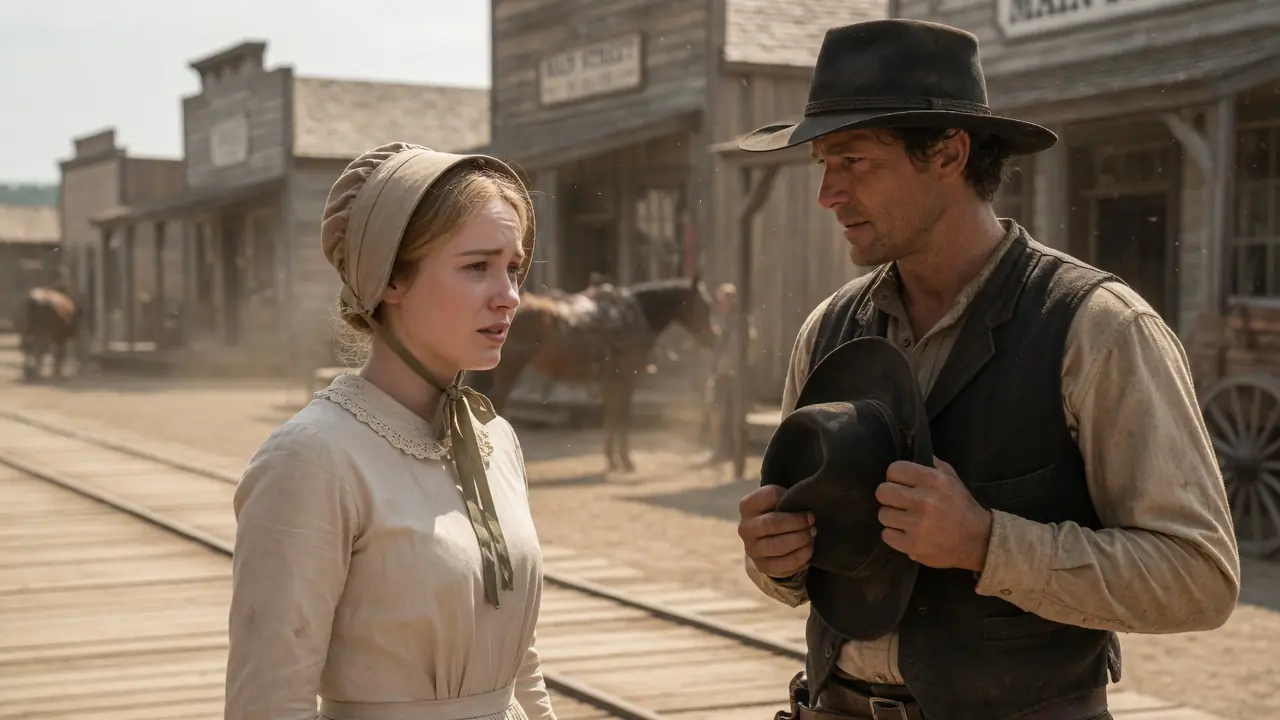
“Hot work,” she said.
He looked up.
His face changed when he saw her.
It had always changed a little.
Today she noticed that he noticed.
“Yes,” he said. “But leather complains less than people.”
“Then you’ve bought the wrong leather.”
He smiled, but not fully.
Something in him was tense.
Rose saw it and felt her own heart answer with nervousness.
“Something wrong?” she asked.
“No.”
A pause.
“Yes.”
She stepped closer to the shade of the livery awning.
“Which is it?”
Will set down the harness leather.
His hands rested on the workbench for a moment, as if he needed the wood to steady him.
“I heard about Marsh.”
Rose went still.
The street seemed to narrow around them.
“I have no right to say anything about it,” he continued. “I know that. I have had no right for a long time because I never said what I should have said.”
Rose’s breath caught.
Will looked at his hands, then back at her.
“But I need to tell you something before you make any decisions. I should have told you a long time ago, and I did not because I convinced myself it was impossible. I was wrong about that.”
Someone hammered down the block.
A wagon creaked past.
The town went on living while Rose stood beneath the awning and felt the world tilt.
“Will,” she said softly.
“If you tell me to stop, I will.”
“Do not stop.”
He swallowed.
“I love you.”
There it was.
Plain.
Late.
True.
Rose’s eyes filled before she could stop them.
Will kept going, because if he stopped now he feared courage would desert him.
“I think I have for years without knowing it. Or maybe I knew and was too cowardly to call it by its name. I told myself you were beyond me. That you deserved better. That being your friend was enough.”
He gave a humorless little laugh.
“It was not enough. I only pretended it was because pretending felt safer than asking.”
Rose did not move.
“I know this might not change anything,” he said. “I know Marsh is a good man, and I know I am late. But I could not let you think nobody saw you. Because I see you. I just was slow to know what I was looking at.”
Rose looked at him for a long moment.
Years moved through her.
All the Wednesday mornings.
All the dances he had not asked for.
All the small kindnesses.
All the waiting.
All the almosts.
Then she took one step closer and said, low enough for only him, “Will, I have been saving my heart for you for years. I just needed you to show up.”
The words struck him harder than any blow.
His face changed completely.
Wonder.
Regret.
Relief so fierce it looked like pain.
“Rose…”
She held his gaze long enough for the words to land, not long enough for her courage to fail.
Then she said, quieter still, “Do not make me wait anymore.”
Will Hadley, who had never once thought he could walk toward the mountains, took a step forward.
Not enough to touch her.
Enough to answer.
“I won’t.”
From across the street, George Alcott, who had been pretending to examine horseshoes outside the blacksmith’s, turned around and smiled to himself.
Some things, he thought, required a nudge.
Other things required a shove.
Will still had some things to do.
He did not sleep much that night.
Not because he doubted what he felt, but because now that he knew it, he saw clearly how much he had risked through silence.
By dawn, he had washed, shaved carefully, combed his hair, and put on his good shirt.
It was a white shirt, though Will owned nothing that stayed truly white for long.
He stood before the small mirror in his room above the livery and looked at himself.
“Do not make a fool of this,” he said.
The mirror offered no promises.
He went to the general store just after opening.
Daniel Callahan was behind the counter, entering figures into the ledger.
He looked up, took in the good shirt, combed hair, and particular expression of a man who had made a decision and was done deliberating.
Daniel said nothing for a moment.
Then he called toward the back, “Rose, Will Hadley is here.”
Footsteps.
Rose came through the back doorway wiping her hands on an apron.
She stopped when she saw him.
The look she gave him was clear and direct and without any of the careful patience she had been carrying for years.
Just, you are here.
Will removed his hat.
“I would like to come calling on you properly,” he said, “starting today. And I would like your father’s permission.”
Daniel found something extremely interesting to examine on the shelf behind him.
“You have it,” he said to the shelf.
Rose’s mouth twitched.
Will looked at her.
“I should have asked sooner.”
“Yes.”
“I was a fool.”
“Yes.”
Daniel coughed into his fist.
Will did not look away.
“I intend to do better.”
Rose considered him.
Then she said, “You know, most men who come calling bring flowers.”
Will looked at his empty hands.
“I will bring them tomorrow.”
“Is there going to be a tomorrow?”
“Every day,” he said, “for as long as you will have me.”
The store went very quiet.
Daniel, still facing the shelf, blinked several times.
Rose looked at Will for one moment more.
Then she smiled.
The real one.
His one.
The one he understood now had always been waiting for him to recognize it.
“Then you had better not be late,” she said.
What followed was the most discussed courtship in Crestfall’s recent history.
People who claimed not to gossip found urgent reasons to pass the general store at unusual hours.
Mrs. Adler saw Will bring flowers the next morning and reported that they were wildflowers, not bought, which she judged more meaningful.
Mr. Fergus said he had known all along.
No one believed him.
George Alcott accepted congratulations for his role in the matter, though no one had offered any.
Edward Marsh heard the news before making his formal offer.
He came into the general store the following Monday.
Rose was alone at the counter.
For one moment, she feared the conversation that might follow.
Edward removed his hat.
“Miss Callahan.”
“Mr. Marsh.”
“I understand Mr. Hadley has begun calling on you.”
“He has.”
Edward nodded slowly.
“I had intended to speak with your father.”
“I know.”
“I suspected you did.”
Rose did not apologize.
That mattered.
Edward looked toward the shelves, then back at her.
“Hadley is a good man.”
“He is.”
“And you are attached to him.”
“I am.”
Edward studied her face.
Then he gave one brief nod, the kind of nod a man gives when acknowledging a fact that changes the terms of business.
“I wish you happiness, Miss Callahan.”
The sincerity surprised her.
“Thank you.”
He placed an order for coffee, salt, and cartridges, paid in full, and left.
Later, Rose told Will.
He was quieter than expected.
“Marsh handled it well,” he said.
“He did.”
“He is a better man than I wanted him to be.”
Rose laughed.
“Does that trouble you?”
“A little. It is easier to be jealous of a scoundrel.”
“You are jealous?”
He looked at her.
“Yes.”
The honesty warmed her.
“Good.”
“Good?”
“You were late. A little jealousy may be educational.”
Will laughed then.
It became easier after that.
Not effortless.
No courtship ever is, no matter what songs claim.
They had known each other all their lives, but courtship changed the arrangement of their knowing.
Suddenly, things that had once been casual carried weight.
A hand offered to help her down from a wagon.
A walk after Sunday service.
A cup of coffee shared behind the store.
A look across a crowded room.
Will had to learn how to speak what he had spent years not saying.
Rose had to learn how to trust that he truly had arrived, that she did not need to keep one hand around her own heart in case he wandered back into ignorance.
There were awkward moments.
At Tuesday supper with the Callahans, Will knocked over a glass of water reaching for bread at the same time Rose reached for it.
Clara laughed until Daniel told her to behave.
Rose handed Will a towel.
“You are very composed around horses,” she said.
“Horses do not wear cream dresses and look at me like that.”
“Like what?”
“Like I have spilled water on the table.”
“You have.”
“That may explain it.”
She smiled.
Daniel watched them with the quiet satisfaction of a father who had spent years seeing what neither of them would name and was now trying very hard not to say anything that might cause a delay.
Will brought wildflowers.
He repaired the back step at the Callahan house.
He walked Rose home after church.
He took her driving in a borrowed buggy on Sunday afternoons, though everyone knew the buggy was from his own livery and therefore not exactly borrowed.
On a Sunday in September, they rode to the ridge above the valley, where the whole county spread below them like a map made of grass, fences, smoke, and sunlight.
The mountains stood beyond, blue and steady.
They tied the horse in shade and sat on a flat rock overlooking the valley.
For a while, they said nothing.
Rose liked that with Will.
His silences did not demand filling.
A hawk circled far overhead.
The wind moved through the grass.
Will finally said, “Why me?”
Rose looked at him.
He seemed genuinely puzzled, not fishing for praise.
“There were better prospects,” he said.
“For what?”
“Money. Land. Position. Words.”
“Words?”
“I know I am not graceful with them.”
“No,” Rose agreed.
He looked at her.
She smiled.
“But I have never found graceful words as useful as honest ones.”
Will picked up a small stone and turned it between his fingers.
“Still.”
Rose looked out at the valley.
“Because you never performed anything,” she said. “Every other man who came was showing me something. His land, his money, his ambition, his manners, his plan for what sort of wife I would make.”
She paused.
“You just showed up, the same every time.”
Will listened carefully.
“I always knew exactly who you were,” she continued. “That is rarer than people think.”
He looked down.
“I nearly missed you.”
“Yes.”
“I am sorry.”
“I know.”
“I do not know how to make up for years.”
Rose turned to him.
“You do not make up for them by mourning them. You make up for them by not wasting the years ahead.”
That sentence remained with him for the rest of his life.
He nodded slowly.
“I can do that.”
“You had better.”
He smiled.
Then his expression sobered.
“Marsh is a good man.”
“He is.”
“You could have had an easier life.”
Rose’s gaze sharpened.
“Do not do that.”
“What?”
“Do not stand beside me after finally showing up and argue on behalf of another man.”
Will opened his mouth, then closed it.
Rose continued.
“I waited for you. Not because I had no other choice. Because you were the choice.”
The wind moved between them.
“Do not make me explain that twice.”
Will looked at her.
At this woman who had held something quietly for years and offered it to him without conditions.
And he felt the specific gratitude of a man who understands fully what almost did not happen.
The valley was gold below them.
The mountains were doing what they always did.
And something that had been patient for a very long time sat down beside him on that ridge and stopped waiting.
October in Wyoming arrived without negotiation.
The cold came fast.
The light sharpened.
The mountains showed their first snow on the high peaks while the valley grass went from gold to brown.
Will asked Rose to marry him on an October evening outside the general store after the harvest social.
He had carried his grandmother’s ring in his breast pocket for two weeks.
It was a simple gold band, carefully cleaned, plain and strong. His mother had given it to him years before, telling him that if he ever found a woman worth becoming braver for, he would know what to do with it.
He had thought then that she was being sentimental.
Now he understood she had been giving instructions.
The harvest social had been lively.
There were pies, songs, children chasing each other between wagons, men discussing grain prices with the seriousness of national policy, and women pretending not to monitor every conversation Rose and Will had.
After it ended, Will walked Rose back to the store because Daniel had gone ahead with Clara.
Main Street was quiet.
The air smelled of cold dust and chimney smoke.
Lantern light glowed in the store windows.
Rose pulled her shawl tighter.
“It will freeze tonight,” she said.
“Yes.”
“You sound distracted.”
“I am.”
“With?”
He stopped at the store steps and turned to her.
His heart was beating so hard he wondered if she could hear it.
“Rose.”
She looked at him.
Her eyes were green tonight in the cold October light.
“I need to say something plainly,” he said, “because I have been unclear for long enough, and you deserve better than unclear.”
She stilled.
“I love you. I think I have for years, which I know is not a point in my favor. But I know it now, clearly, the way I know the things I am most certain of.”
He took the ring from his pocket.
“And I would like very much for you to be my wife.”
A pause.
“If you are willing to take on a man who was slow and is trying to make up for lost time.”
Rose looked at him.
Then at the ring.
Then back at him.
“Will Hadley,” she said, “you are the least romantic man in Wyoming.”
“I know.”
“That proposal was approximately half as poetic as the occasion called for.”
“I know that too.”
“You compared your love to certainty, which is more practical than stirring.”
“I thought certainty was better.”
She took one step closer.
“It is.”
The cold wind moved through the empty street.
Then, after years of patience, Rose said the word that had always been waiting.
“Yes.”
Will exhaled.
“Yes?”
“Yes.”
“I should put the ring on.”
“You should.”
His hands shook as he slid the simple gold band onto her finger.
Rose looked at it the way one looks at something recognized.
Not new.
Finally, completely hers.
Will bowed his head and pressed his lips to her hand.
That was more romantic than anything he had said.
Rose did not mention it aloud.
She simply let him.
They were married in November, before the first hard snow.
The church was full.
Half of Crestfall felt, with some justification, that they had personally invested in this outcome and earned their place at the celebration.
George Alcott sat in the third pew, unusually moved for a man who claimed no feelings about romantic matters.
Edward Marsh came too, which caused considerable whispering.
He gave them a set of fine harness leather as a wedding gift and told Will, “For good work.”
Will understood the offering beneath the words.
“Thank you.”
Edward nodded.
Then, after a pause, he added, “Do not waste her patience.”
“I don’t intend to.”
“Good.”
Rose wore her mother’s wedding dress, taken in at the waist.
Clara cried while fastening the buttons.
May came from two towns over with her baby and cried even harder.
Daniel stood in the hallway outside the church room, looking at Rose as if seeing both his daughter and her mother at once.
“You ready?” he asked.
Rose touched the gold band still warm on her finger.
“Yes.”
Daniel offered his arm.
“Your mother would have liked him.”
Rose smiled.
“She always did.”
“She liked sensible men.”
“He is sensible when not being blind.”
Daniel chuckled.
“That may be the Callahan women’s burden.”
“What is?”
“Teaching good men to see.”
The music began.
Rose walked toward Will with the unhurried certainty of a woman arriving somewhere she had always been headed.
Will stood at the front of the church and watched her come.
In that moment, he felt with sudden, complete clarity how close he had come to missing this.
How a man could stand next to something extraordinary for years and fail to see it.
How Edward Marsh had almost made the offer.
How another week of his own silence might have changed everything.
He was not going to waste another day of it.
They said their vows simply.
They meant every word.
The celebration afterward filled the Callahan house, the store, and half the yard.
There was roast beef, chicken, beans, biscuits, pies, coffee, cider, music, and more advice than any newly married couple required.
George gave a toast.
“I have known Will Hadley for many years,” he began, “and I can say with confidence that he is slow.”
The room laughed.
Will closed his eyes.
George continued.
“But I have also known him to be honest, steady, and capable of learning when instructed plainly by wiser people.”
More laughter.
“And I have known Rose Callahan long enough to say that she is the sort of woman a man may spend years looking at before he understands he is seeing his future. We are all grateful Will came to his senses before the rest of us died of impatience.”
Rose laughed hardest.
Will forgave George eventually.
The years that followed were good ones, built not from grand passion alone, though there was passion enough, but from honest work and the warmth of two people who genuinely liked each other and never stopped being glad to come home.
They lived first in the rooms above the livery.
Rose transformed them within a week.
Not by making them fancy, but by making them livable.
Curtains appeared.
Shelves were organized.
A cracked washbasin was replaced.
Will’s shirts stopped living in uncertain piles.
The accounts were moved from a cigar box to a proper ledger.
The livery grew.
Rose kept the books and discovered within the first year that Will had been undercharging for his work, which she corrected with the brisk efficiency of someone raised in commerce.
He did not argue.
He had learned quickly that on matters of numbers and sense, Rose was simply right.
“You cannot charge Mr. Dalton the same rate for boarding two horses if one of them eats like an army mule,” she said.
“He has been a customer for years.”
“And he will remain one because you are honest. Honesty does not require financial surrender.”
Will leaned against the doorframe.
“I married a merchant.”
“You married the daughter of one. It was warned plainly.”
“I am not complaining.”
“Wise.”
Their son arrived in the second year.
Thomas Daniel Hadley.
He had his mother’s eyes and his father’s patient, deliberate way of moving through the world.
Will held him for the first time as if the baby were both porcelain and dynamite.
“He is very small,” Will said.
Rose, exhausted in bed, gave him a look.
“He did not feel small.”
Will immediately looked guilty.
“I apologize.”
“You should.”
Then she smiled, and he sat beside her with the child in his arms, overwhelmed by the strange expansion of love.
Their daughter came in the fourth year.
Eliza Ruth Hadley.
Quick and bright and funny in the dry way Rose had always been, which made the house considerably louder and considerably more alive.
Eliza learned to talk early and argue immediately afterward.
Thomas watched the world before entering it.
Eliza entered first and asked questions later.
Will often looked at his children, then at Rose, and wondered how one man had come so close to living without this.
The thought humbled him.
On difficult days, it frightened him.
Marriage did not make life easy.
The livery had bad seasons.
Horses got sick.
Customers failed to pay.
A roof collapsed under snow one winter and cost more to repair than expected.
Rose lost a pregnancy between Thomas and Eliza and spent three days saying she was fine because that was what capable women often say when they are not.
Will found her one night sitting in the small kitchen, one hand pressed to her middle, staring at the cold stove.
He did not ask if she was all right.
He had learned better.
He sat beside her and said, “I am here.”
Rose looked at him.
For once, her composure failed.
“I wanted that child too.”
Will’s face broke.
“So did I.”
She cried then.
Not loudly.
But fully.
Will held her.
He did not tell her they could try again.
He did not tell her God had a plan.
He did not tell her time would ease it.
He only stayed.
Later, she said, “You have gotten better at showing up.”
“I had a good teacher.”
She closed her eyes against his shoulder.
“You were slow.”
“I know.”
“But you learned.”
“I am still learning.”
“That will do.”
Years passed in work, weather, children, seasons, losses, repairs, laughter, and the steady accumulation of ordinary happiness.
On a summer evening in their sixth year, Rose was hanging laundry in the yard when Will came home from the livery still dusty.
He stopped at the gate to watch her.
She was humming.
She always hummed during repetitive work.
The Wyoming evening light was gold the way it gets in July.
The mountains were doing what they always did.
And Will Hadley stood at his own gate and looked at his wife.
Not vaguely.
Not as one looks at a landscape taken for granted.
Fully.
Rose noticed him and turned.
“You are staring,” she said.
“I know.”
“You used to never stare.”
“I used to not know what I was looking at.”
She clipped a sheet to the line.
“And now?”
“I have corrected that.”
She smiled.
The real one.
His.
He came through the gate, crossed the yard, took the laundry basket from her hands, and set it down.
Then he held her in the gold evening light.
She rested her head against his chest.
Inside the house, Thomas and Eliza argued over something with the passionate conviction of children who had inherited stubbornness from both sides.
Will pressed his lips to the top of Rose’s head.
“I see you,” he said quietly.
She did not ask what he meant.
She already knew.
She had always known.
Years later, when Eliza was old enough to ask, she asked her mother how she had known.
They were in the kitchen, Rose teaching Eliza to make the pie that had become something of a family institution.
The question came sideways in the middle of rolling dough.
“How did you know Papa was the one before he knew?”
Rose paused.
Flour dusted her hands.
Outside, Will and Thomas were arguing over a wagon wheel.
Rose listened for a moment, smiling faintly.
“He never performed anything,” she said finally. “Every man who came along was showing me something. Your father just showed up the same every time.”
Eliza frowned.
“That sounds dull.”
“It was not. It was rare.”
Rose pressed the dough gently.
“I always knew exactly who he was. Kind. Honest. Stubborn. Slow.”
Eliza giggled.
“He is slow.”
“He is careful. There is a difference, though sometimes it is difficult to detect.”
“But you almost married Mr. Marsh?”
Rose looked at her daughter.
“No. But I almost had to stop waiting for your father.”
Eliza’s expression grew serious.
“Because he was too slow?”
“Yes.”
Rose handed her the rolling pin.
“That is the part I want you to remember. Not only the happy ending. The almost.”
“The almost?”
“Yes. Life is full of almosts. Almost said. Almost chosen. Almost brave. Almost too late.”
She covered Eliza’s hands with hers on the rolling pin.
“Know what you want. Do not perform for anyone. Do not shrink yourself to be chosen. And if the person you are waiting for is slow, give him time, but not forever.”
“What happens after not forever?”
“At some point, you say the true thing. You give him the chance to show up.”
“What if he does not?”
Rose was quiet for a moment.
“Then you know, and you move forward.”
Eliza considered this with the solemn seriousness of a child collecting rules for adulthood.
“But Papa did show up.”
Rose smiled.
“Yes. In my experience, when you say the true thing to the right person, they show up.”
In later years, Crestfall told the story of Rose and Will as if it had always been inevitable.
People like inevitable stories.
They smooth the sharp edges.
They remove the danger.
They make love look like a river that could only have flowed one way.
But Rose remembered the truth.
It had not been inevitable.
It had been fragile.
It had depended on George Alcott saying something uncomfortable.
On Edward Marsh arriving at the right wrong time.
On Will finding courage before Rose’s patience ran out.
On Rose saying the true thing on a dusty street and trusting that if Will was the man she believed him to be, he would not let the truth fall between them unanswered.
That was not small.
That took more courage than anything Will did.
Will was not a villain.
He was something more recognizable.
A man so convinced that something wonderful was beyond his reach that he never reached.
A man who mistook humility for helplessness.
A man who loved without naming it because naming it would have required risk.
Until the morning George Alcott told him about Edward Marsh.
Until the clock that had been running quietly became suddenly undeniable.
Sometimes people need that.
Sometimes the thing that finally moves us is not the presence of love.
We already had that.
It is the understanding that love, like everything worth having, is not guaranteed to wait forever.
Rose and Will chose each other deliberately at the last possible moment, but still in time.
That is the part worth holding on to.
Not that waiting always works.
It does not.
Not that love should be silent.
It should not be silent forever.
But that truth, spoken plainly, can change the shape of a life.
That courage sometimes looks like a woman saying, “I have been saving my heart for you.”
And sometimes it looks like a man admitting, “I was slow to know what I was looking at.”
The mountains outside Crestfall stood there long before Rose and Will were born and long after their children grew old.
They watched the town rise, suffer, laugh, marry, bury, and begin again.
For years, Will had looked at those mountains and at Rose in the same way.
Aware of beauty.
Grateful.
Still.
Then one summer, under the pressure of time and the threat of losing what he had never dared claim, he finally walked toward what had been in front of him all along.
And Rose, who had waited but not forever, was there.
Not because fate promised it.
Because both of them, at last, chose to show up.