The cashier looked him up and down as if he had walked in from a trash pile and expected the room to belong to him.
"Order or get out," she said loudly, chin raised, and lips curled.
"A cortado, please."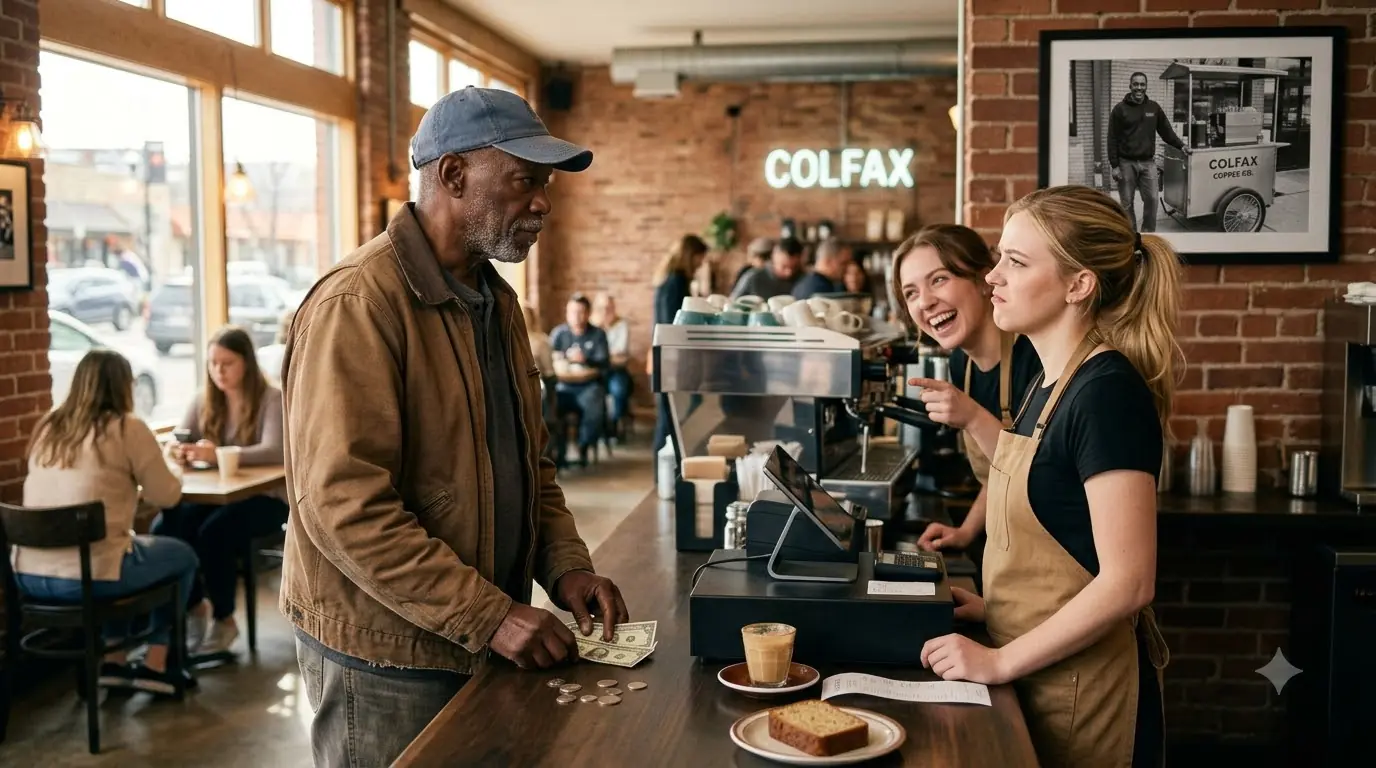
The first cashier barked a laugh. "A cortado? You do not even know what that is. Get your black coffee and go sit on the curb where you belong."
She turned toward the other cashier. "Tiff, look at him. The man looks like he crawled out of a trash can. I bet that card is stolen."
Six people stood in line, and not one of them opened their mouth. The man paid cash, sat down, bit into a slice of banana bread, and froze mid-bite. It was not because of what they had said. He had heard worse his whole life simply for existing in rooms where some people had already decided he did not belong.
He froze because of what they said next, when they thought nobody was listening.
Harold Coleman had built Iron Brew Coffee with his own hands, and that was not a metaphor. Twenty-three years earlier, he had welded a steel coffee cart together in his mother's garage in Englewood, Denver. It was the kind of neighborhood where coffee shops did not exist because nobody believed the people there deserved one.
He had been twenty-nine, broke, and stubborn enough to believe that a Black man with a cart and a dream could build something that lasted. He did. One cart became a storefront, one storefront became five, and five became forty.
Iron Brew Coffee now stretched across Colorado, Utah, and New Mexico. The specialty chain was known for seasonal drinks, hand-roasted beans, and the motto printed on every cup: Everyone deserves a seat.
Harold had written that line himself the year he opened his first permanent store. He had been thinking about his mother, who used to take him to a downtown cafe when he was a boy. The waitress always seated them near the kitchen door, never by the window.
He promised himself that if he ever built a place of his own, everyone would get the window seat.
Now Harold sat in a corner office on the fourteenth floor of a glass building in downtown Denver. A photograph of the original cart hung on the wall behind his desk, faded with age, the wood still stained with espresso. He had not touched an espresso machine in three years and had not walked into one of his own stores as anything other than a name on a letterhead.
He had not thought he needed to. The numbers were good. Revenue was up eleven percent, new stores were opening in Albuquerque and Salt Lake City, and the board and investors were satisfied.
Then his assistant, Lisa, walked in on a Tuesday morning and dropped a folder on his desk.
"You need to read these," she said. "Today."
Inside were thirty-one printed customer reviews for the Denver flagship, his original store. It was the first real location, built with his own money before any investor had said yes. The reviews had all been posted within the previous six months.
Harold read the first three, and his stomach dropped.
"The cashiers looked at me like I was trespassing in my own city."
"I am a fifty-eight-year-old woman. The girl at the register spoke to me like I was a stray dog. I will never go back."
"Hostile and humiliating. I left my coffee on the table and walked out. I did not even want it anymore."
He kept reading. Of the thirty-one reviews, twenty-two mentioned the same problem. The complaints were not about the coffee, prices, or food. They were about the staff and the way certain customers were treated differently.
The same words appeared repeatedly: unwelcome, ignored, disrespected, embarrassed.
Harold opened the internal dashboard on his computer. The flagship store's customer satisfaction score was dead last among all forty locations. The store he had built first was now the worst.
He picked up the phone and called the flagship manager, Craig. Craig had been there for two years and seemed competent on paper.
"Craig, I am looking at the customer satisfaction numbers for your store. Walk me through what is happening."
Craig's voice was calm and practiced. "Mr. Coleman, with all due respect, people leave bad reviews when they do not get free refills. It is noise. My team is solid, and we are hitting our sales targets."
"Your customer satisfaction score is dead last."
"Sir, satisfaction surveys are subjective. We cannot control how people feel."
Harold paused. He recognized the smooth, deflective tone of someone who had rehearsed the answer before the question was asked.
"I hear you, Craig," he said. "I appreciate your time."
He hung up and stared at the phone for a long moment.
That night, Harold drove to the flagship alone and parked across the street with the engine off. It was 9:15, near closing time. Through the glass, he could see two young women behind the counter.
One was wiping down the espresso machine. The other leaned against the register, looking at her phone. A customer walked in, a man in work boots and a paint-stained shirt.
Harold watched. The cashier on her phone did not look up or greet him. The man stood at the counter for almost a full minute before anyone acknowledged he existed.
Harold tightened his grip on the steering wheel. He owned forty locations and employed thousands of people, yet the one store that was supposed to represent everything he believed in was rotting from the inside.
He opened the employee schedule on his phone. Fourteen names appeared. Two kept showing up on every high-traffic shift: Tiffany Grant and Jenna Moore.
Harold stared at her name, then started the car. Something was very wrong inside his own house, and he intended to find out what.
The next morning, Harold Coleman did something he had not done in three years. He dressed like a nobody.
He put on a worn jacket from the back of his closet, an old baseball cap, and no watch. He left his Omega on the bathroom counter. Instead of taking a car service, he rode the bus fourteen stops to Colfax Avenue and walked two blocks to the Denver flagship of Iron Brew Coffee.
This was the store he had built with money borrowed from his mother's retirement fund. It was the store where he had poured the first cup himself and handed it to a stranger for free.
He pushed open the door. The bell above it chimed. Nobody looked up.
Tiffany Grant stood behind the register with a phone in one hand and the other resting flat on the counter as if she were guarding it. Jenna Moore stood at the espresso machine, scrolling on her own screen, a towel draped over her shoulder that she clearly had not used.
Harold stepped to the counter and waited. Five seconds passed, then ten, then fifteen.
A young white couple entered behind him. Tiffany's head snapped up instantly, and her face brightened.
"Hey, guys. Welcome to Iron Brew. What can I get started for you?"
She took their order around Harold as if he were a pillar or a piece of furniture. The couple received their drinks and sat down. Tiffany returned to her phone.
Harold cleared his throat. "Excuse me. I would like to order."
Tiffany looked up. Her eyes moved from his cap to his jacket to his shoes, slow and deliberate, the way someone scans something they have already decided to throw away.
"What do you want?" she asked. It was not really a question. It was a verdict.
"A cortado, please, and a slice of banana bread."
Tiffany tilted her head and turned to Jenna. "He wants a cortado."
Jenna snorted without looking up. Tiffany turned back to Harold and spoke slowly, the way adults sometimes speak to children who are not theirs.
"Sir, do you know what a cortado is, or do you just want a regular black coffee? Keep it simple."
Harold felt heat climb his neck, but he kept his voice level. "I know what a cortado is. I would like one, please."
Tiffany shrugged, punched in the order, and did not ask his name. She scribbled the letters B.C. on the cup. Harold did not ask what they meant. He already understood.
He paid cash. Tiffany took the bills with two fingers as if she were lifting something off a wet floor, then dropped his change on the counter instead of placing it in his hand. Three coins rolled away.
Harold picked them up one by one. He took his drink and banana bread to a corner table and sat down.
The cortado was lukewarm. The banana bread was excellent, the best thing on the menu, and he had not even known it existed.
He took a bite, and that was when he heard them.
Jenna leaned across the register toward Tiffany. She did not lower her voice or glance in Harold's direction, as if he were not worth the effort of discretion.
"Did you see him counting those coins off the counter? That was painful."
Tiffany laughed. "I do not know why people like that come in here. This is not a shelter. Go to McDonald's."
"He is just going to sit there all day, take up a table, buy one coffee, and never tip. They never do."
"At least he did not bring his whole family. Last week, that woman brought three kids and let them run around like animals. I told Craig that if we do not start filtering, this place is going to look like a bus station."
Jenna nodded. "For real. We need to protect the vibe. Some people just do not fit the brand."
Harold set down the banana bread. His hand was steady, but his jaw was locked.
He stared at the table. A coffee ring stained the wood, probably there for weeks because nobody had wiped it. He pulled out his phone, opened the notes app, and typed one word: rot.
Then he stayed another forty-five minutes. He watched and listened.
Tiffany greeted every young, well-dressed white customer with a bright smile and a cheerful "Hey, babe." She handed a middle-aged Black man his drink without a word or eye contact. Jenna turned away from an elderly woman to take a selfie.
Harold finished his cortado, left the cup on the table, and walked out. Nobody said goodbye, nobody thanked him, and nobody noticed he had left.
He stood on the sidewalk outside his own store, beneath the motto printed on every cup: Everyone deserves a seat.
He called his vice president of operations. "Ray, clear my schedule for next week. All of it."
"Harold, you have the investor lunch on Thursday."
"All of it, Ray. I am going back in. Not as corporate, not as the founder, as nobody. Make sure not one person in that building knows."
That night, Harold did not sleep. He sat in his modest two-bedroom apartment in Capitol Hill and replayed every moment. The eye roll, the two-finger bill grab, the coins on the counter, the letters B.C. on the cup, the word filtering, and the laughter that had not been meant to be funny.
It had been meant to be a wall.
Harold had spent fifty-two years on the other side of walls like that. He had believed he built a company without them. He had been wrong.
At 6:00 the next morning, he called Ray.
"I need a cover. New hire, transfer trainee from the Colorado Springs location. Put the name Henry Williams in the system. Can you do that?"
Ray exhaled. "Harold, legal and HR can handle this in forty-eight hours. We pull the camera footage, fire the two cashiers, and it is done."
"If I fire two cashiers, I fix one store. I want to know whether the whole house is sick, Ray."
Silence followed.
"How long?" Ray asked.
"Four days."
"What if someone recognizes you?"
Harold almost laughed. "I spent an hour in my own store. The woman behind the register looked me in the eye and told me to sit on the curb. Trust me, nobody in that building has ever looked at the company about page."
He spent the next two hours preparing. He trimmed his beard shorter and uneven, the way a man might look if he did not own a mirror he liked. He went to Goodwill and bought a gray polo shirt, dark jeans, and scuffed work shoes.
Then he printed the employee handbook and read all forty pages for the first time in two years.
What he found made him sit down. The customer experience protocol was detailed and specific, covering greeting standards, service timelines, and complaint resolution. Yet there was no enforcement mechanism, no audit system, and no anonymous reporting channel.
The whole protocol rested on one assumption: that people would follow it simply because it was right.
Harold closed the handbook. He remembered something his mother used to say: "Good intentions do not survive bad management."
She had always been right.
He opened the flagship schedule again. Tiffany Grant and Jenna Moore held every peak shift from Tuesday through Saturday, 10:00 a.m. to 6:00 p.m., the most profitable hours.
Emma Sullivan was scheduled for 5:00 a.m. openings and late closing shifts every week for four straight months. She received no peak hours, no visibility, and almost no tips worth counting. That was not bad luck. It was a pattern.
Harold put on the gray polo and laced the scuffed shoes. The man in the bathroom mirror did not look like the owner of a forty-store chain. He looked exactly like the kind of person Tiffany Grant would tell to sit on the curb.
Good.
He drove to the flagship and parked in the alley. The employee entrance was a narrow metal door with chipped paint and no camera. The contrast between the picture-perfect storefront and this neglected entrance told him everything about where the company's attention had gone.
The break room smelled of stale coffee and microwave popcorn. A corkboard was cluttered with shift notices. On a shelf in the corner, between napkins and sanitizer, sat a hand-painted ceramic tip jar.
Sunflowers covered one side. The Iron Brew logo appeared on the other. It had been painted carefully, with real affection.
The jar was nearly empty.
A sticky note was taped to the front in bubbly handwriting: All tips go through Tiffany. See her before adding to jar.
Harold photographed the note and the jar, then set it back gently. He clocked in as Henry Williams and walked onto the floor.
On the first morning, Harold was assigned to shadow the opening crew. The shift lead was Emma Sullivan, twenty-eight, Latina, with her hair pulled tightly back and an apron already stained by 5:15 a.m.
She moved behind the counter the way musicians move on a stage. There was no wasted motion. She pulled shots, steamed milk, restocked cups, and wiped the bar in one continuous loop.
To her, Harold was Henry, a transfer who did not know where the lids were.
"Lids are under the second sink, not the first," she said without looking up. "The first sink is sanitizer. Mix those up and you will taste bleach in your espresso for a week."
At 6:40 a.m., an elderly Black man entered. He was tall, slow-moving, and wore a wool coat too heavy for the season.
Emma's face softened. "Walter, oat milk cortado, extra warm?"
Walter smiled as if she had returned something he thought he had lost. "You remember."
"Every day for three years. Sit down. I will bring it over."
She carried the drink to his table with both hands. Walter looked up at her.
"Emma, you are the only reason I still come here."
Emma smiled, but it did not reach her eyes. She returned to work.
Harold waited for a gap between customers. "How long have you been here?"
"Four years."
"Do you like it?"
A long pause followed. Her hands kept moving, wiping and sorting. She did not look at him.
"I like the coffee."
That pause told Harold more than any review.
At 10:00 a.m., the shift changed. Tiffany and Jenna entered, and the air in the store tightened as if someone had turned a dial.
Emma went quiet. Without being told, she moved to the back and began restocking shelves that did not need restocking.
Tiffany did not greet her. "Did you pre-stock the oat milk? I am not doing it again."
"It is done."
"It better be."
Then Tiffany flipped a switch and became a different person. A young white couple entered, and she lit up.
"Hey, guys. Have you tried the Autumn Maple Cortado? It is literally the best thing we have ever made."
Harold blinked. The Autumn Maple Cortado had been Iron Brew's third-highest-selling drink the previous quarter. He did not know who had created it.
A middle-aged woman in a cleaning uniform approached next. Tiffany's smile vanished.
"What do you want?"
She made the drink without another word and set it down. She did not ask the customer's name or wish her a good day.
Harold opened the register drawer to get change. Wedged between the receipt paper and the bill tray was a folded index card.
It had two columns. One was marked with hearts. The other was marked with Xs.
On the second day, Harold waited until Tiffany took a break before pulling the card out.
Under the hearts were notes: Tech guy Jake, always tips five dollars. Instagram girl Molly Brew, tags us, free extra shot. Blond couple, good vibe.
Under the Xs were different notes: Old guy Walter, just sits, nurses one drink. Lady with three kids, messy, do not encourage. Flannel man, does not fit.
Flannel man. That was Harold.
On the back, in Tiffany's handwriting, were instructions: If they are not brand fit, slow service. They will leave on their own. Do not make a scene. Just make it clear they are not welcome.
Harold returned the card exactly where he found it. His hands were steady. His jaw was not.
This was not two young women having a bad day. It was a system.
Later that day, Harold sat with Emma in the break room. She opened a small notebook filled with recipes, seasonal drink ideas, pastry variations, and flavor notes in the margins.
Needs more cinnamon. Try brown sugar syrup.
She stopped on a page labeled Autumn Maple Cortado.
"You created this?" Harold asked.
Emma nodded. "I gave it to Ron last fall. He said he would submit it through regional."
"It went on the menu and sold everywhere. Is your name on it?"
"No. Ron listed it as his initiative."
She turned more pages. Summer Berry Cold Brew, Holiday Spice Latte, Banana Pecan Bread. All were hers. All had been credited to Ron.
"I stopped writing my name on them," she said, closing the notebook. "What was the point?"
Under the table, Harold typed a note on his phone: Emma Sullivan. Four recipes confirmed. Zero credit. Zero raise.
On the third day, Ron Hadley visited. Harold smelled his cologne before he saw him. It was sharp, expensive, and far too strong.
Employees stiffened, and conversations stopped. Ron was forty-eight, tall, tan, and perfectly groomed. He walked into the store as if he owned it, which was ironic because the actual owner stood three feet away in a gray polo.
Ron high-fived Tiffany. "Hey, superstar. The place looks great."
He walked past Emma without a glance. She was restocking cups only six feet away. Invisible.
Ron noticed Harold. "You are new?"
"Yes, sir. Transfer trainee."
"Stick with Tiffany. She is the heartbeat of this store."
Emma was still within earshot. Her hands never stopped moving. She did not flinch because she had heard it before.
Harold pushed gently. "What about the seasonal menu? Who created the maple cortado?"
Ron grinned with pride. "That was mine. Regional initiative, third quarter last year."
Harold nodded slowly without blinking. Emma's hands paused for one second. A cup tilted, but she caught it and continued.
At the end of the day, Harold offered to count the tips.
Tiffany shut him down immediately. "I handle tips."
"Store policy says equal split, right?"
"Policy is policy. Real life is real life. People up front earn the tips. Emma is support staff. She gets the support staff share."
When Tiffany stepped away, Harold checked the point-of-sale system. Tiffany and Jenna received eighty percent of pooled tips. Emma and two other employees shared the remaining twenty percent despite working the same hours.
He photographed the screen.
On the fourth day, a Black woman in her mid-fifties entered around 2:00 p.m. She wore hospital scrubs and a hospital lanyard. Her name was Patricia.
She ordered a vanilla latte and a muffin. Tiffany served her the way she served everyone without a heart beside their name, with dead eyes, a flat voice, and the wrong name on the cup.
The cup said Pat.
"Excuse me," the woman said. "My name is Patricia, not Pat."
Tiffany did not look up. "Same thing."
Patricia took the coffee, sat down, took one sip, then stood and walked out.
Harold followed her. She sat on the bench outside, holding the cup and staring at it. He sat beside her.
"Are you all right?"
She looked at him with eyes that were tired not from one bad experience, but from a lifetime of them.
"I just wanted a cup of coffee in a nice place. That is all."
Harold's chest tightened. "You deserve that."
Patricia almost smiled, but could not quite get there. She threw the cup away and walked off.
Harold remained on the bench for a long time. Then he texted Ray.
It is worse than I thought. One more day. Then legal, HR, and the conference room. Friday morning. Every employee present.
Ray replied within seconds. What are you going to do?
Harold typed back: My job.
On Thursday, before dawn, Harold arrived at 4:30 a.m. The store did not open until 5:30. He had one hour alone in the back office.
Using his corporate login, masked through the IT system as a routine audit, he accessed the store records. Ray had set it up the night before. There were no alerts and no visible trace, only access.
The manager's office was cramped and windowless, barely large enough for a desk, filing cabinet, and an old printer. The chair squeaked when Harold sat down. The room smelled like stale coffee and dust.
He started with twelve months of tip-distribution records. Every weekly payout had been logged digitally through the point-of-sale system.
Harold moved the numbers into a spreadsheet on his phone and ran the calculations. Tiffany and Jenna's combined weekly tips averaged four hundred ten dollars. Across the entire Iron Brew chain, the average weekly two-person front-of-house share was ninety-five dollars.
Theirs was more than four times higher.
Emma Sullivan's weekly share had fallen every month for nine consecutive months, from sixty-two dollars to eleven. The decline began when Tiffany joined the store.
Harold captured every page.
Next, he opened Ron Hadley's quarterly innovation reports. Four regional menu initiatives had been submitted over the previous fourteen months, each credited to Ron as the originator.
Autumn Maple Cortado had been submitted in October. Summer Berry Cold Brew in June. Holiday Spice Latte in December. Banana Pecan Bread in March.
Harold compared the reports with photographs of Emma's notebook. Her Autumn Maple Cortado entry was dated August, two months before Ron's submission. Her Summer Berry Cold Brew appeared in April, again two months earlier.
The Holiday Spice Latte was in Emma's notebook in October, and the Banana Pecan Bread in January. Every recipe had been created by Emma and submitted by Ron exactly two months later.
The delay was long enough to make the reports look independent, yet short enough for Ron to ride her creativity in real time.
Harold sat back in the squeaking chair and stared at the screen. Four ideas. Four best sellers. All hers. All stolen.
He opened the internal complaint log. Emma had filed three formal complaints over eighteen months.
The first concerned scheduling fairness. She had requested rotation into peak shifts. The response stated: Reviewed. No adjustment needed. Current scheduling reflects operational needs. Signed, Ron Hadley.
The second concerned tip distribution. Emma had reported unequal allocation and requested a transparent audit. The response stated: Reviewed. Tip policy is at store-level discretion. No action required. Signed, Ron Hadley.
The third concerned credit for menu contributions. Emma had requested formal recognition for the Autumn Maple Cortado and three other recipes she created.
The response stated: Reviewed. Menu development is a regional function. Individual contributions are noted internally. No further action. Signed, Ron Hadley.
Three complaints. Three dismissals. The same signature and the same dead end.
Harold opened one final file: Tiffany Grant's employee record. He scrolled past her hire date, tax forms, and direct-deposit information, then stopped at the emergency contact section.
Emergency contact: Ron Hadley. Relationship: Uncle.
Harold exhaled slowly and carefully, the way a man breathes when the last piece of something ugly clicks into place.
Ron was Tiffany's uncle. Ron protected Tiffany. Tiffany controlled the floor. Jenna followed Tiffany. Emma filed complaints, and Ron buried them. Ron stole Emma's recipes, leaving her no one above him to report to.
It was a closed loop, a machine built to protect itself.
Harold closed the laptop and walked into the break room. The ceramic tip jar still sat on the shelf, covered in painted sunflowers and the Iron Brew logo.
He picked it up and turned it over. On the bottom, in small faded handwriting, were the words: For the team. E.S.
Emma Sullivan had painted the jar herself for the team. That same team had emptied it, pushed it onto a shelf, and taped a note to it directing every tip through the person who was stealing them.
Harold returned the jar gently. It was evidence now.
He called Ray. "Are legal and HR confirmed for tomorrow?"
"Confirmed. The conference room is booked. Every flagship employee will be there at 8:00 a.m."
"One more thing. Set up the large screen. I am going to show them something."
"What are you going to show them?"
"The truth."
Harold ended the call. He stood alone in the break room among bags of coffee beans and the faint smell of bleach. He looked at the tip jar one more time, then switched off the light and left.
Tomorrow, he would return through the front door.
Friday morning arrived. At 8:00 a.m., the flagship was closed to customers, and every employee sat in the windowless conference room behind the store floor.
Fourteen plastic chairs were arranged in rows beneath buzzing fluorescent lights. The faint hum of the espresso machine came through the wall. Tiffany sat in the second row with her phone in her hand, visibly annoyed by the mandatory meeting.
Jenna sat beside her, chewing gum and whispering something that made Tiffany smirk. Ron Hadley occupied the front row with his legs crossed and one arm stretched across the empty chair beside him, the posture of a man who assumed he was the most important person in any room.
His cologne filled the space before anyone had spoken.
Emma Sullivan sat in the back row with her hands folded and her shoulders slightly forward. She did not know why she had been called in. She expected nothing because nothing was what the company had given her for four years.
At 8:02, the door opened.
Harold Coleman entered wearing the same worn jacket, baseball cap, and scuffed shoes he had worn as the customer they had mocked. He walked to the front of the room without notes or a laptop.
Tiffany narrowed her eyes. Recognition struggled against disbelief. Jenna tilted her head, and her gum stopped moving.
Harold allowed the silence to hold for seven seconds.
"Four days ago, I walked into this store and ordered a cortado and a slice of banana bread," he began. "The two cashiers behind the counter looked at me, a Black man in a worn jacket, and decided I did not belong. One of them told me to get black coffee and sit on the curb where I belonged."
Tiffany's smile froze between performance and panic.
"The other said I looked like I crawled out of a trash can and suggested my payment card was stolen."
The room went silent in an entirely different way.
"My name is Harold Coleman. I founded this company. I built this store. Twenty-three years ago, I welded the first Iron Brew coffee cart in my mother's garage."
The color drained from Tiffany's face, from her cheeks to her lips. Jenna's mouth opened, but nothing came out. Ron uncrossed his legs.
Harold pulled the index card from his jacket pocket and held it up.
"This was inside the register drawer. Hearts and Xs. Hearts for customers considered brand fit. Xs for people you decided were not."
He read aloud. "Old guy Walter, just sits. Lady with three kids, messy. Flannel man, does not fit."
He placed the card on the table.
"The flannel man was me. You put an X beside the man who built everything you are standing in."
Someone in the back row inhaled sharply. Two employees exchanged a look that said they had known something was wrong, even if they had not known how much.
Harold turned to the large screen. The first display showed twelve months of point-of-sale tip data.
"Tiffany Grant and Jenna Moore received eighty percent of all pooled tips. Emma Sullivan and two back-of-house employees shared twenty percent. They worked the same hours and received one-fifth of the money."
The next display placed Ron's quarterly innovation reports beside photographs of Emma's notebook. Dates were circled in red.
"Four recipes: Autumn Maple Cortado, Summer Berry Cold Brew, Holiday Spice Latte, and Banana Pecan Bread. Every one was created by Emma Sullivan. Every one was later submitted by Ron Hadley as his own. Emma's notebook entries predate Ron's reports by two months each time."
Ron's jaw tightened. His fingers closed around his knee.
"I can explain," he began.
"I am not finished."
Harold did not raise his voice. He lowered it, and that was worse.
The final display showed three employee complaints. All had been filed by Emma, marked resolved without action, and signed by Ron Hadley.
"Schedule fairness. Tip distribution. Recipe credit. Emma raised every problem through the process this company gave her. Every complaint died on the same desk."
Harold looked directly at Ron.
"That desk belonged to the same Ron Hadley listed as Tiffany Grant's emergency contact. Relationship: uncle."
Ron's face did not empty the way Tiffany's had. It hardened. His eyes moved toward the exits, calculating rather than confessing, like a man running out of doors and checking for windows.
Harold turned toward Emma. She sat in the back row, where they always put her. The back of the room, the back of the schedule, and the back of the line.
Her hands remained folded, but her back had straightened. Her eyes were wide, not with shock, but with the look of someone witnessing something she had stopped believing would ever happen.
"Emma, you created the Autumn Maple Cortado," Harold said. His voice softened by one degree. "You created the Summer Berry Cold Brew, the Holiday Spice Latte, and the Banana Pecan Bread. It was the same banana bread I was eating while your coworkers told me I did not belong in this store."
No one moved.
"I owe you an apology. Not for what they did, but for not being here to see it. I was fourteen floors above the company while this was happening fourteen feet from the counter. That failure belongs to me."
Emma pressed her lips together. Her eyes were bright, but she did not cry or perform her pain. She nodded once, slowly.
It was not agreement. It was acknowledgment. She had always known what she was worth. She had simply been waiting for someone with authority to see it.
Tiffany stared at the table. Jenna remained still. Ron fixed his eyes on the wall.
Harold straightened. "Now I will tell you what happens next."
He did not raise his voice. Everyone in the room was already holding their breath.
He picked up three plain manila folders from the table beside him. He had prepared one for each person whose name was about to change meaning inside Iron Brew Coffee.
He opened the first folder and placed it in front of Tiffany.
"Tiffany Grant, your employment is terminated effective immediately. This is not merely because you were rude to a customer, though that alone would justify action. You maintained a documented system of discriminatory customer profiling."
He tapped the index card.
"You manipulated the tip pool to divert eighty percent of shared gratuities to yourself and one other employee. You also created a hostile work environment for colleagues who did not look like you, speak like you, or fit the private brand you attempted to build inside a company that was never yours to reshape."
Tiffany did not look up. Her fingers locked together, and her knuckles turned white. Her lips moved slightly, but no sound came out.
The woman who always had something to say had nothing left.
Harold set the second folder in front of Jenna.
"Jenna Moore, the same terms apply. You are terminated for participating in the profiling system, helping maintain the list, and taking part in the manipulation of pooled tips. You also stood behind that counter and treated a paying customer as a suspected thief because of the color of his skin. That customer was me."
Jenna's eyes reddened, and her chin trembled. She reached for the folder but did not open it. She held it because she did not know what else to do with her hands.
Harold turned to Ron.
Ron sat perfectly still, jaw set, eyes fixed above Harold's head. It was the posture of a man who had decided that if he did not look directly at the fire, it was not truly burning.
Harold placed the third folder on the table. He did not slide it. He set it down with finality.
"Ron Hadley, your employment is terminated for falsifying intellectual property claims. You submitted four original recipes created by Emma Sullivan under your own name in quarterly reports to corporate."
He paused.
"You are also terminated for suppressing three formal complaints. Each reached your desk and died there because the employee accused of wrongdoing was your niece. Finally, you built a protection system around an employee who was actively discriminating against customers in a store founded on the principle that everyone deserves a seat."
Ron's nostrils flared. His hand twitched on his knee. For a moment, Harold thought he might explain, deflect, or minimize, just as he had minimized every complaint Emma ever brought to him.
Then Ron looked around. Every employee was watching him, including people he had charmed, praised, joked with, and ignored. Not one person looked away.
He picked up the folder, stood, and walked out without speaking. The door clicked shut behind him. His cologne remained for another thirty seconds, then even that was gone.
Harold faced the eleven employees who remained. Some had worked at the flagship for years. Some had seen what happened and stayed silent. Others had not seen it because the system was designed to remain invisible to anyone who did not watch carefully.
"What happened in this store was not only about three people," Harold said. "It was about a system that allowed them to operate. It was a system I built, or one I failed to build well enough. That changes today."
He changed the screen. Four simple points appeared.
"First, transparent digital tip pooling. Every employee will see every dollar in real time. No single person will control distribution. The system will calculate equal shares automatically according to hours worked. If you work the hours, you earn the tips."
He moved to the second point.
"Second, recipe and innovation credit. Any employee who contributes a menu item will have their name attached to it on the menu board, the application, and marketing materials. The employee will receive a royalty percentage on sales for the first twelve months and priority consideration for promotion. Your ideas belong to you. Nobody takes them."
The third point appeared.
"Third, an independent reporting channel. Complaints will no longer stop at the regional manager. They will go to an outside human resources firm that reports directly to me. Not to Craig, not to the next Ron, but to me. If your voice was buried before, it now has a direct line to the top."
The fourth point appeared.
"Fourth, quarterly undercover audits. Every ninety days, someone from this company, whether me, Ray, a vice president, or another person you will not recognize, will enter a store as a customer. There will be no announcement and no warning. We will see what customers see and feel what they feel. If the experience reflects our values, good. If it does not, we will know and act."
Harold allowed the screen to remain visible. Then he turned to Emma.
She was still seated in the back row, but something had changed. Her chin was slightly higher, like a window cracked open after years of being sealed.
"Emma," Harold said, his tone warmer, "I am offering you the position of Regional Innovation Lead. You will oversee seasonal menu development for all forty locations. Your recipes will carry your name retroactively, and your salary will reflect your contribution, backdated to the date of your first recipe submission."
He slid a fourth folder across the table. It was thicker and heavier than the others.
Emma rose and walked to the front. She did not rush. Every step was deliberate, the same way she moved behind the counter, with no wasted motion and no performance.
She opened the folder. Inside was a formal offer letter, a back-pay check covering eighteen months of stolen tips calculated to the cent, and a new name badge.
Emma Sullivan. Regional Innovation Lead.
She ran her thumb over the badge slowly, touching something she had imagined many times but had never expected to hold.
Her eyes remained bright. It was the brightness of someone finally seen after years of deliberate concealment.
She looked at Harold but did not speak immediately. Then she closed the folder, held it against her chest, and turned toward the room.
"Thank you," she said.
Two quiet, steady words. She did not sound grateful for a gift. She sounded like someone acknowledging the return of something that had always belonged to her.
Nobody clapped. Nobody needed to. The silence said more than applause could have.
Emma walked to the break room and returned thirty seconds later carrying the ceramic tip jar. The sunflowers had faded, and her initials were still visible on the bottom.
She passed through the conference-room door onto the store floor and set the jar on the counter beside the register, where customers could see it. Then she peeled off the sticky note that read, All tips go through Tiffany, and dropped it into the trash.
Emma looked at the empty store. The chairs were stacked, the lights were on, and the espresso machine hummed softly.
She straightened her apron and waited for the doors to open.
Three months later, the Denver flagship of Iron Brew Coffee looked the same from outside. It had the same brick facade, glass front, and logo above the door. Inside, nearly everything had changed.
A hand-lettered chalkboard stood near the entrance and was updated every week in Emma Sullivan's handwriting.
This season's menu, created by our team.
Four recipes were listed, each with a person's name rather than a corporate code.
Autumn Maple Cortado, Emma Sullivan, Denver Flagship.
Winter Cinnamon Cold Brew, Maria Torres, Salt Lake City.
Spring Honey Lavender Latte, Deshawn Williams, Albuquerque.
Summer Peach Iced Tea, Emma Sullivan, Denver Flagship.
Two of the four were Emma's. Nobody needed to steal them anymore. They came from a woman with a notebook and a talent that four years of silence had not managed to kill.
Harold had not gutted the staff. He removed the rot and allowed the rest to grow. Three new employees filled the vacancies, and Emma participated in every hiring decision.
Her only requirement was simple. "They have to actually like people. All people, not only the ones who look good on social media."
One of the new hires was Patricia Davis, the hospital worker who had sat on the bench outside after Tiffany called her Pat and made her feel unwelcome.
Harold had found Patricia through the customer feedback form she filled out, the form nobody had answered. He called her personally, explained what had changed, then asked a question she did not expect.
"Would you ever consider working here?"
Patricia laughed in the way people sometimes laugh when they are close to crying. "Are you serious?"
"You told me all you wanted was a nice place where nobody looked at you as if you did not deserve to be there. I want to build that place, and I think you would be better at it than anyone I could find on a job board."
Patricia started the following Monday. She worked the front register, the position Tiffany had guarded like a throne.
She greeted every customer the way Emma taught her: eye contact, the full name on the cup, and the drink handed over with both hands.
Walter came back. He had stopped visiting after Tiffany repeatedly delayed his order and ignored him, hoping he would leave. He had once told Emma that perhaps he needed to find another place.
Then, one Tuesday at 6:45 a.m., Walter walked through the door in his wool coat, moving slowly. He stood at the counter and looked around as if checking whether the room was safe.
A new barista smiled. "Oat milk cortado, extra warm? Walter, right?"
Walter stared. "How do you know my name?"
"Emma told us about our VIPs. You are at the top of the list."
Walter laughed, short and surprised. It was the sound of a man who had forgotten what it felt like to be expected somewhere.
He sat at the window table, the one Tiffany's index card had implied he did not deserve. When he left, he placed a five-dollar bill in the ceramic tip jar.
Emma had repainted the sunflowers the week after the meeting. The jar now sat front and center, exactly where she had placed it.
Walter tapped the rim twice, the way someone knocks on a door they are glad is open.
"See you tomorrow, Emma."
"See you tomorrow, Walter."
Harold visited the flagship once a month now. He always entered through the front door and always arrived as a customer first.
On one visit, he noticed a framed black-and-white photograph on the wall beside the chalkboard. It showed a young man in his twenties standing beside a steel coffee cart in a garage, grinning like he had just built something that mattered.
A small plaque beneath it read: Everyone deserves a seat. Harold Coleman, Founder.
Harold asked Emma about it. "Who put that up?"
She gave him a small shrug, lighter than the ones she used to give. "The team. They thought customers should know where this place came from."
Harold ordered banana bread and sat at the same corner table where he had frozen mid-bite three months earlier. Patricia handed him his cortado with both hands. Walter sat at the window table, and Emma worked in the back, where Harold could smell cardamom.
He bit into the banana bread. This time, he finished it.
The Denver flagship closed at 9:00 p.m. on a Friday, the same day of the week Harold had entered the conference room and changed the direction of the company.
The store was quiet. Chairs were stacked on tables, and the espresso machine cooled with the soft ticking sound of an engine after a long drive.
The last customer had left twenty minutes earlier, a college student who stayed past closing to finish a paper. Emma had not rushed her. She wiped the surrounding tables and said, "Take your time. We are not going anywhere."
The chalkboard by the entrance still read: This season's menu, created by our team.
The photograph of Harold's original cart hung beside it. The plaque below caught the last overhead light: Everyone deserves a seat.
On the counter, the ceramic tip jar sat in its rightful place. The repainted sunflowers were bright, and the jar was full, not merely with spare coins, but with folded five- and ten-dollar bills from customers who knew the people behind the counter by name.
Emma locked the register, untied her apron, and hung it on the hook in the break room. It was the same hook where her old badge had once hung with a title that did not reflect her value.
Her new badge was pinned to the apron now: Emma Sullivan, Regional Innovation Lead.
She traced the words with one finger, as she had the first time. They were still real.
Emma switched off the lights and walked to the front door. She paused in the dim store, lit only by the street outside.
Through the glass, she could see the bench where Patricia had sat three months earlier, holding a coffee she did not want and wondering why a nice place could not simply be nice to her.
Patricia would open the store the next morning. Walter would arrive at 6:45. His cortado would be ready before he sat down.
Emma locked the door, placed the keys in her bag, and walked home.
Harold returned to the corner table another morning, ordering the same cortado and banana bread. He thought about the six customers who had watched Tiffany and Jenna humiliate him and had said nothing. He thought about Emma filing three complaints that died on the desk of the man taking credit for her work.
For four years, Emma had created recipes worth millions without seeing her name on one of them. They had taken money from her, buried her name, and confined her to the least profitable shifts. Yet they had never gained control over her worth.
She still arrived at 5:00 a.m. She still cared for Walter. She still painted sunflowers on a cheap ceramic jar for a team that did not deserve her faith in them.
The people who abused the system had power over her schedule, but never over her talent or character. The moment someone finally looked closely, the entire structure they created fell apart.
Truth can be buried, but it cannot be destroyed.
Harold looked around the store he had built. Patricia was greeting a customer by name. Walter sat by the window. Emma was explaining a new recipe to a young barista who listened with genuine attention.
The words on the wall no longer sounded like a slogan.
Everyone deserves a seat.
Iron Brew Coffee had finally begun living up to them again.