Sophie Miller worked as a mail carrier for the Ashford postal office, driving a white delivery van through quiet neighborhoods, brick apartment blocks, small businesses, tree-lined streets, and long country roads where mailboxes leaned at odd angles beside gravel driveways. She knew which houses had barking dogs, which porches had loose steps, which customers waited by the window for medicine deliveries, and which elderly residents had not received visitors in too long.
Her job looked simple from the outside.
Drive. Stop. Sort. Deliver. Repeat.
But Sophie had learned that mail was never just mail.
A birthday card could make an old woman cry on her porch. A college acceptance letter could make a teenager scream loud enough for the whole block to hear. A medical bill could make a father sit down heavily on his front steps. A handwritten envelope from far away could put light back into a lonely house.
Sophie noticed those things.
Her mother used to say she had the kind of heart that slowed down when the world rushed past. It was meant as a compliment, though sometimes it felt like a burden. Sophie saw too much. The empty rocking chair. The overgrown walkway. The mailbox untouched for three days. The curtain moving when someone lonely watched but did not wave.
She had become a mail carrier partly because of her grandfather.
Henry Miller had walked a mail route for thirty-two years before retiring. He believed the job was about trust, not envelopes.
“You don’t just deliver paper,” he told Sophie when she was a girl. “You remind people the world still knows where they live.”
After Henry died, Sophie applied for the postal service. The pay was steady, though not generous. The hours were long. The winters were brutal. Her back ached from lifting packages, and her hands cracked from cold air. But she loved the rhythm of the route, the quiet responsibility of it, the way she became part of people’s days without asking for much in return.
Sophie had dreams too.
One day, she wanted to open a small community navigation service for seniors called Home Again. Not a taxi company exactly, and not a medical service. She imagined a network that helped elderly residents with safe rides, appointment reminders, grocery check-ins, address cards, emergency contacts, and simple neighborhood support. She had seen too many older people become trapped between independence and danger.
But dreams required money, training, permits, insurance, and time.
Sophie had very little of any of those.
So she delivered mail.
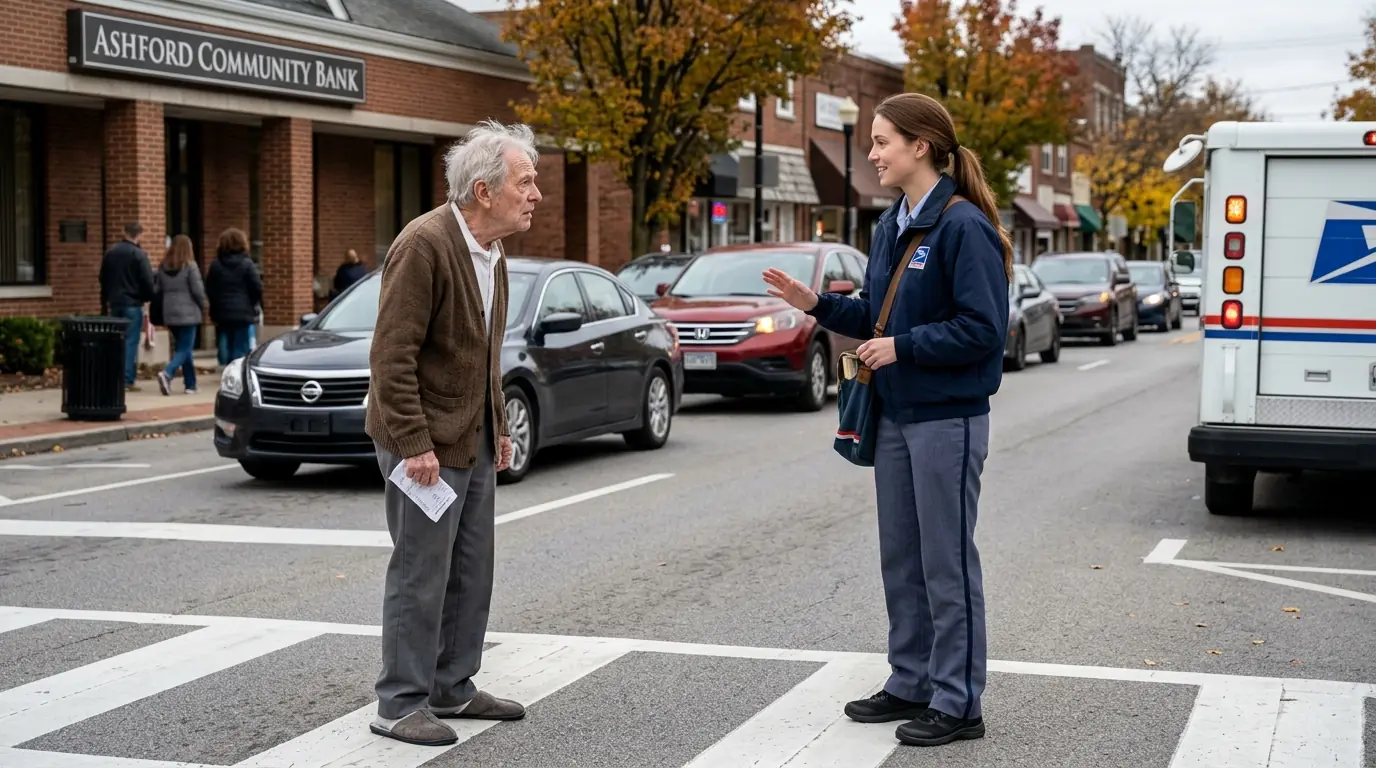
On a cold Tuesday afternoon in late October, Sophie was finishing the Oak Street section of her route when traffic slowed near the intersection by Ashford Community Bank.
At first, she thought there had been an accident.
Cars were stopping awkwardly. Someone honked. A woman in a red SUV rolled down her window and shouted something Sophie could not hear. A delivery truck swerved around the crosswalk.
Then Sophie saw him.
An elderly man stood in the middle of the intersection, confused and trembling.
He wore a brown cardigan over a white shirt, gray trousers, and house slippers. No coat. No hat. No phone. His silver hair was messy from the wind, and one hand clutched a folded paper so tightly it had crumpled in his fist. His other hand was raised slightly, as if he were trying to stop invisible traffic or ask for help but had forgotten how.
The light changed.
Cars began moving again.
The old man did not.
Sophie’s heart jumped.
She pulled the mail van to the curb, turned on the hazard lights, and ran toward the intersection.
“Sir!” she called. “Sir, stay right there!”
A pickup driver shouted, “Get him out of the road!”
Sophie ignored him.
She stepped into the crosswalk, raised one hand toward the waiting cars, and approached the old man slowly. She kept her voice calm.
“Hi. My name is Sophie. I’m going to help you get out of the street, okay?”
The man looked at her with frightened blue eyes.
“I’m not supposed to be here,” he whispered.
“That’s okay. We’ll figure it out.”
“I was going to the pharmacy.”
“All right.”
“But this isn’t the pharmacy.”
“No, sir. This is Oak Street.”
He looked around as if the buildings had moved while he was not watching.
“Oak Street,” he repeated, lost.
Sophie gently guided him toward the curb without touching too hard. He moved slowly, shuffling in slippers across the cold pavement. A few drivers looked annoyed. One woman watched with concern. Most people simply drove around them once the lane cleared.
Sophie brought the old man to the sidewalk near her mail van.
“I need to go home.”
“We’ll get you home.”
“I don’t remember where home is.”
The sentence landed quietly but heavily.
Sophie saw his hands shaking. His cardigan was too thin for the wind. His slippers were damp. His lips had begun to pale from the cold.
She opened the passenger door of the mail van.
“Sit here for a minute. It’s warmer.”
“I shouldn’t.”
“You should. The van isn’t fancy, but it beats standing in traffic.”
That made him blink, then give the smallest confused smile.
She helped him sit, then grabbed her spare fleece jacket from behind the seat and placed it around his shoulders. She kept the door open so he would not feel trapped and crouched beside him.
“What’s your name?”
He stared down at the paper in his hand.
“Walter.”
“Walter what?”
His forehead tightened.
“I know it.”
“That’s okay. No rush.”
He looked ashamed.
“I know my own name.”
“I believe you.”
The shame in his face hurt her more than the confusion.
Sophie had seen older residents struggle before. She knew the difference between someone being difficult and someone being scared. Walter was not being difficult. He was trying to hold onto himself in a moment when the world had slipped out of place.
“May I look at that paper?” she asked.
Walter opened his hand.
The paper was a pharmacy receipt. The name at the top read: Walter Greene. There was no address, but there was a prescription number and the name of Ashford Family Pharmacy three blocks away.
Sophie looked at Walter’s wrist and noticed a medical ID bracelet partly hidden beneath his sleeve.
“Walter, can I check your bracelet?”
He looked at it as if surprised to find it there.
“My daughter made me wear it.”
“She sounds smart.”
“She is bossy.”
“That often overlaps.”
Walter gave another faint smile.
The bracelet had his name, a phone number, and a line that read: Memory impairment. Please call daughter, Emily Greene.
Sophie pulled out her phone and called the number.
A woman answered on the second ring, breathless.
“Hello?”
“Hi, is this Emily Greene?”
“Yes. Who is this?”
“My name is Sophie Miller. I’m a mail carrier in Ashford. I’m with your father, Walter Greene. He’s safe, but he was confused near Oak Street and Main.”
There was a sharp silence.
Then Emily’s voice cracked.
“Oh my God. Dad? Is he hurt?”
“He doesn’t seem injured, but he’s cold and shaken. He says he was going to the pharmacy.”
“He left the house? He was supposed to be with my brother. I’m at work twenty minutes away.” Emily’s breathing quickened. “Can you keep him there? I’m coming right now.”
Sophie looked at Walter, who was staring out the windshield, lost and embarrassed.
“I can do better,” Sophie said. “What’s his address? If it’s on or near my route, I can drive him home and wait until you arrive.”
“You don’t have to do that.”
“He’s cold. He needs to be somewhere familiar.”
Emily gave the address.
14 Maple Ridge Drive.
Sophie knew it. A small blue house with white shutters, seven minutes away.
“I know the house,” Sophie said. “I deliver there.”
Emily began crying.
“Please don’t leave him alone.”
“I won’t.”
Sophie hung up and looked at Walter.
“Your daughter Emily is on her way. I’m going to take you home now.”
Walter’s eyes filled with tears.
“She’ll be angry.”
“She’s scared. That can sound like angry.”
He looked down.
“I didn’t mean to get lost.”
“I know.”
“I had the pharmacy in my head.”
“That happens.”
“My wife used to handle directions.”
“What was her name?”
“Margaret.”
His voice softened around the name.
“She always knew where we were.”
Sophie closed the van door gently and drove toward Maple Ridge Drive.
The drive was quiet except for the heater rattling and Walter’s uneven breathing. Sophie kept her voice calm, pointing out familiar places.
“There’s the library. There’s Miller’s Bakery. There’s the little park with the red benches.”
Walter looked out the window, sometimes nodding, sometimes frowning.
When they turned onto Maple Ridge Drive, his shoulders loosened.
“I know this street.”
“That’s good.”
“The maple tree. The mailbox leans.”
Sophie smiled. “It does. I’ve been meaning to judge it silently.”
Walter laughed once, softly.
The blue house came into view.
The front door was wide open.
A younger man, probably in his thirties, stood on the porch with a phone in his hand, face pale and panicked. When he saw the mail van, he ran down the steps.
“Dad!”
Walter flinched.
Sophie parked and stepped out quickly.
“Slow,” she said to the man. “He’s scared.”
The man stopped himself, breathing hard.
“I’m sorry. I’m sorry.” He looked at Walter. “Dad, I was in the bathroom for five minutes. I thought you were watching TV.”
Walter looked crushed.
“I wanted to get the medicine.”
The man pressed both hands to his face.
Sophie helped Walter out of the van. His son took one arm, gentler this time.
Inside, the house was warm but tense. A half-folded blanket lay on the couch. A television played silently. Family photographs covered the mantel: Walter with a smiling woman, Walter with two children, Walter holding a baby, Walter in a baseball cap beside a lake.
Sophie saw the life around him and understood something painful.
Walter was not alone because nobody loved him.
He was alone because care had become complicated.
Emily arrived ten minutes later, rushing through the door in a navy work blazer, eyes red with fear. She hugged her father, then pulled back to check his face.
“Dad, you scared me.”
Walter lowered his head.
“I’m sorry.”
Emily’s anger melted instantly.
“No. No, I’m sorry. I’m just glad you’re safe.”
Sophie stood near the doorway, ready to leave.
Emily turned to her.
“You found him?”
“In the intersection.”
Emily closed her eyes. “Oh God.”
“He’s okay,” Sophie said. “But he needs warming up, and maybe you should call his doctor if this is new or worse than usual.”
Emily nodded quickly.
Walter’s son, Mark, looked ashamed.
“I only turned away for a few minutes.”
Sophie spoke carefully.
“It only takes a few minutes. That doesn’t mean you don’t care.”
Mark looked at her with gratitude and guilt mixed together.
Emily took a deep breath.
“How can we thank you?”
“No thanks needed.”
“You stopped traffic for him.”
“He needed help.”
“You brought him home.”
“He needed home.”
Walter looked up then.
“You knew where I lived.”
Sophie smiled softly.
“I deliver your mail.”
His eyes filled.
“So the world still knows where I live.”
Sophie froze.
It was almost exactly what her grandfather used to say.
For a moment, she could not answer.
Then she said, “Yes, Walter. It does.”
Before leaving, Sophie noticed the front table near the door. It was cluttered with mail, appointment cards, medication instructions, sticky notes, and two different calendars with different dates circled. A pharmacy bag sat on a chair. A handwritten note on the door said: Do not leave alone. But the note was small, easy to miss, and placed too high.
Sophie hesitated.
Then she said, “Can I suggest something?”
Emily nodded.
“Make a simple station by the door. Big sign at eye level. Emergency numbers. Address card. Pharmacy info. A note that says wait for Emily or Mark. Maybe put a photo of the house and a reminder: This is home. It helps some people when they panic.”
Emily stared at her.
“That’s… actually helpful.”
“Also, sew or tape an address card inside his cardigan, not just the bracelet. If someone doesn’t think to check the bracelet, they might check pockets.”
Mark nodded. “We can do that.”
“And maybe call the pharmacy to arrange delivery instead of pickup.”
Emily looked embarrassed. “I didn’t know they offered that.”
“Some do. I can ask when I’m near there tomorrow.”
“You’ve already done enough.”
Sophie smiled.
“Maybe. But I’m still on the route.”
That night, Sophie finished her deliveries late.
Her supervisor was annoyed, but when she explained what had happened, he only sighed and told her to file a delay report. Sophie drove home exhausted, fingers cold, heart heavy.
She kept thinking about Walter in the intersection.
The fear in his eyes.
The shame when he forgot his full name.
The relief when he recognized his street.
She thought about Emily and Mark, overwhelmed but loving, trying to care for their father without knowing what systems could help. She thought about the door table full of confusion, the open front door, the pharmacy receipt, the tiny bracelet that had saved precious time only because Sophie had known to look.
That night, she opened the old notebook where she kept ideas for Home Again.
She wrote:
Not just rides.
Not just reminders.
Home safety for memory loss.
Door signs. Address cards. Route maps. Emergency contact kits. Pharmacy delivery help. Neighbor check-in network.
People need practical help before crisis.
Then she underlined one sentence.
A person can be loved and still get lost.
The next morning, Sophie stopped by Ashford Family Pharmacy during her lunch break.
She asked about prescription delivery. The pharmacist confirmed they offered it for a small monthly fee and sometimes waived it for older residents with mobility or memory problems. Sophie picked up a pamphlet and brought it to Emily after her route.
Emily met her on the porch.
“You didn’t have to do this,” she said.
“I know.”
Inside, Walter sat at the kitchen table eating soup. He looked tired but steadier.
“Mail girl,” he said.
Sophie smiled. “Sophie.”
“I knew that.”
“I figured.”
Emily laughed softly, relieved.
Over the next week, Sophie helped the Greene family set up simple systems.
A large sign by the door that read: Walter, please wait. Call Emily or Mark before leaving.
A laminated card in Walter’s cardigan pocket with his name, address, daughter’s number, and son’s number.
A neighborhood contact list taped inside a kitchen cabinet.
A pharmacy delivery arrangement.
A simple map with three familiar places: home, library, pharmacy. Not for him to travel alone, but to help him recognize where he was if confused.
A small basket by the door labeled: Mail, medicine, keys, phone.
Sophie was careful not to make the house feel like a hospital. She used calm colors, clear words, and family photos. Walter helped choose the photo of the house for the reminder card.
“That one,” he said, pointing. “Margaret planted those tulips.”
Emily looked at the picture and began to cry.
Walter touched her hand.
“She liked yellow.”
“I know, Dad.”
Sophie looked away to give them privacy.
After that, Walter became one of the people Sophie checked on during her route.
Not officially. Not as part of her job description.
But whenever she delivered mail to 14 Maple Ridge Drive, she slowed down. If Walter was on the porch, she waved. If the mailbox went untouched for more than a day, she knocked. If Emily left a note asking for a pharmacy envelope to be placed inside the storm door, Sophie followed it carefully.
Sometimes Walter was clear.
Sometimes he asked Sophie the same question three times.
“Do I know you?”
“Yes. I bring the mail.”
“Did Margaret send you?”
“No. But I think she would’ve liked me.”
Walter smiled every time.
“I think so too.”
As winter deepened, Sophie began noticing other elderly residents who needed more than mail.
Mrs. Patel on Cedar Avenue had three days of newspapers piling near her door because she had slipped in the kitchen and was too embarrassed to call anyone.
Mr. Donnelly on Ash Street kept missing medical appointment cards because they were mixed with grocery flyers.
A widower named Carl Jenkins forgot to bring in his medication delivery twice because he could not hear the doorbell.
Sophie started carrying extra sticky notes, large-print labels, and a small notebook of phone numbers people gave her voluntarily.
She knew the line between helping and overstepping mattered. She was careful. She asked permission. She never entered homes unless invited. She never handled medication directly. But she could connect people. She could notice. She could slow down.
One afternoon, Emily Greene called her.
“I told my support group about what you did for Dad,” Emily said. “Three people asked whether you do home setup consultations.”
Sophie laughed. “I deliver mail.”
“I know. But you also helped us more than half the pamphlets we got.”
“I’m not certified for anything.”
“You don’t need a certificate to label a door basket and make emergency cards.”
“That sounds like something that would get complicated.”
“It probably would.” Emily paused. “But people need it.”
Sophie looked at the mail trays in her van.
People need it.
The words followed her for weeks.
In March, Walter went missing again.
This time, Sophie was not the one who found him.
A grocery store employee saw him sitting near the automatic doors, confused and unable to remember how he had arrived. But this time, the address card was in his coat pocket. The employee called Emily immediately. Walter was safe within twenty minutes.
Emily called Sophie that evening, crying.
“Your card worked,” she said.
Sophie sat down on her kitchen floor.
“He’s okay?”
“He’s okay. Scared, but okay. The card worked.”
Sophie closed her eyes.
That was the moment Home Again stopped feeling like a dream and started feeling like a responsibility.
By spring, Sophie began offering free Saturday workshops at the public library.
The first one was called Simple Home Systems For Seniors Who Wander Or Forget.
She expected five people.
Thirty came.
Adult children. Elderly spouses. Neighbors. Church volunteers. A retired nurse. A librarian. Two firefighters. Even the pharmacist from Ashford Family Pharmacy attended.
Sophie stood at the front of the small meeting room wearing jeans, a navy sweater, and her postal jacket folded over a chair. On the table beside her were examples: laminated address cards, large-print door signs, contact sheets, appointment calendars, medication delivery pamphlets, mailbox check-in forms, and simple neighborhood maps.
She began with Walter’s story, without using his full name.
“One afternoon,” Sophie said, “I found an elderly man standing in traffic. He was cold, confused, and ashamed. He had a family who loved him, but in that moment, love needed a system.”
People listened.
She showed them how to make a pocket card. How to create a door reminder. How to arrange pharmacy delivery. How to set up a mail check-in with a trusted neighbor. How to write emergency information clearly. How to speak calmly to someone who was confused without humiliating them.
Afterward, people lined up to ask questions.
By the third workshop, the library director asked if Sophie would lead a monthly series.
By the fifth, a local senior center invited her to speak.
By the seventh, the town paper wrote an article.
Mail Carrier Turns Route Lessons Into Safety Workshops For Seniors
Sophie taped the article into her Home Again notebook.
She was proud, but she was also overwhelmed.
She still worked full-time. She still had bills. She still did not know how to turn the idea into something official. She could not charge much because the people who needed help most often had little money. Grants confused her. Insurance frightened her. Forms seemed endless.
Walter, however, believed in her with absolute certainty.
“You should make maps,” he told her one summer afternoon from his porch.
“I do make maps.”
“No. Bigger maps.”
Sophie sat on the porch steps while Emily watered the tulips.
“What kind of bigger maps?”
“Maps home.” Walter tapped his chest. “Not street maps. People maps.”
Sophie looked at Emily, who smiled sadly.
Walter continued, searching for words.
“When I forget, I need someone to point to where I belong.”
Sophie wrote that down later.
People maps.
In August, Walter’s health declined.
His memory worsened. He became quieter, more easily tired. Emily reduced her work hours. Mark moved back to Ashford to help. The family decided Walter could no longer be left alone, even briefly. It was painful, but they made the decision together.
Sophie still visited when she could.
One evening, Walter was sitting at the kitchen table with a shoebox of old photographs. He seemed clearer than usual.
“Sophie,” he said.
She smiled. “You got it right today.”
“I get things right.”
“Yes, you do.”
He pushed a photograph toward her.
It showed a younger Walter standing in front of a small building with a painted sign: Greene’s Maps & Drafting.
“You made maps?” Sophie asked.
Walter nodded.
“For forty years. Road maps. Property maps. Trail maps. Tourist maps. Before phones told everyone where to go.”
Emily looked surprised. “Dad, I forgot about that sign.”
Walter touched the photograph.
“My father started it. I drew streets by hand. Margaret said I made confusing places look kind.”
Sophie held the photograph carefully.
“That’s beautiful.”
Walter looked at her.
“I still have the shop.”
Emily turned sharply. “Dad?”
“The building.” Walter frowned, concentrating. “On Pine Street.”
Emily’s eyes widened.
“The old map shop?”
He nodded.
“I thought you sold it years ago,” Emily said.
“No. Rented it. Then empty. Papers in cabinet.”
Emily looked at Sophie.
“I honestly forgot we still had it. It’s been vacant for years.”
Walter tapped the photograph again.
“She needs it.”
Sophie froze.
“Who?”
Walter looked directly at her.
“Mail girl.”
Emily’s eyes filled.
“Dad.”
Walter’s voice became soft but firm.
“She brought me home.”
No one spoke.
The old man’s clarity faded a little after that, but the sentence remained in the room like a candle.
She brought me home.
Walter passed away the following winter.
He died peacefully, with Emily and Mark beside him, and a yellow tulip photo on the nightstand. Sophie attended the funeral in her postal uniform because Emily said Walter would have liked that.
The church was full.
People knew Walter as a father, neighbor, mapmaker, husband, and quiet man who sometimes got lost near the end of his life but never stopped wanting to return home.
Emily spoke during the service.
“In his final year,” she said, “my father taught us that memory is fragile, but dignity can be protected. He also taught us that sometimes a stranger notices what everyone else is too busy to see.”
Sophie cried silently in the pew.
After the funeral, Emily handed Sophie an envelope.
“Dad wanted you to have this.”
Sophie opened it with trembling hands.
Inside was a letter written in Walter’s shaky handwriting, with some words uneven but clear enough.
Dear Sophie,
I do not know what I will remember when you read this. Maybe not your name. Maybe not my street. But I know this.
You found me when I was lost and did not make me feel foolish.
You took me home.
That is not a small thing.
I spent my life drawing maps for strangers. Roads, rivers, towns, trails. I thought maps showed people where to go. Near the end, you showed me a better kind of map. A way back to dignity. A way back to family. A way back to being safe.
Emily will explain the rest.
Use the map shop.
Help people remember where home is.
Walter Greene
Sophie looked up through tears.
Emily placed a key in her hand.
“The Pine Street building is yours to use,” Emily said. “Legally, we’re setting it up as a long-term community lease for one dollar a year. Dad also left a small fund from his map business savings. It’s not huge, but it’s enough to renovate the front room, print materials, and help you start Home Again properly.”
Sophie shook her head.
“I can’t accept that.”
Emily smiled through tears.
“You can. Dad was very stubborn, and he wrote it into three different notes in case we forgot.”
Sophie laughed and cried at the same time.
Mark stepped forward.
“He said you gave him the map home. He wanted to give you one back.”
The old map shop on Pine Street had been empty for nearly a decade.
When Sophie first unlocked it, dust floated in the sunlight. The front windows were cloudy. Old map drawers lined one wall. A drafting table stood near the back. Shelves held rolled papers, faded atlases, empty frames, and wooden boxes full of labels, pins, rulers, and careful tools from another time.
On the wall behind the counter hung a sign in Walter’s handwriting.
Every road matters to someone.
Sophie stood beneath it and cried.
Then she began.
Emily helped with paperwork. Mark repaired shelves. The library donated chairs. The pharmacy provided updated delivery information. A local printer discounted emergency cards. The fire department helped review safety materials. Volunteers painted the walls a soft blue. Sophie’s postal coworkers donated a coffee maker, a filing cabinet, and several terrible chairs that were comfortable anyway.
Three months later, Home Again opened.
The front window displayed simple words:
Home Again
Senior Safety, Memory Support, Ride Coordination, Address Cards, Family Check-In Plans
No one was charged for basic emergency cards. Families paid what they could for home organization visits. Grants and donations covered those who could not pay. Volunteers helped with transportation sign-ups, pharmacy delivery forms, large-print calendars, and safe walking plans. Sophie hired a part-time coordinator after six months, then another after a year.
She kept her postal job at first.
Then, when Home Again grew too large for evenings and weekends, she made the hardest choice of her life and resigned from the route.
On her last day, she drove the Oak Street section slowly.
She stopped at the intersection where she had found Walter.
For a moment, she sat in the mail van with both hands on the wheel.
The road looked ordinary.
Cars passed. A woman crossed with grocery bags. A man waited for the light. Nothing about the pavement showed what had happened there.
But Sophie remembered.
An old man in slippers.
A folded pharmacy receipt.
Cold wind.
Drivers honking.
A frightened voice saying, I don’t remember where home is.
She whispered, “You made it home, Walter.”
Years passed.
Home Again became one of Ashford’s most trusted community services. The old map shop filled with life. Families came in scared and left with plans. Elderly residents came for address cards and stayed for coffee. Volunteers created walking maps with safe rest points. The pharmacy partnered with Home Again for delivery coordination. The library hosted memory-friendly events. The fire department referred families who needed emergency contact systems.
Sophie became known not just as the former mail carrier, but as the young woman who helped people stay connected to home.
She trained volunteers to speak gently.
She taught families that safety did not have to feel like punishment.
She reminded everyone that confusion should not be met with anger, and aging should not erase dignity.
In the main room of Home Again, Sophie framed Walter’s letter beside an old hand-drawn map of Ashford.
Under it, she placed one sentence from him.
Help people remember where home is.
Every year, on the anniversary of the day she found Walter, Sophie walked to the Oak Street intersection. She never stayed long. Just long enough to remember the beginning.
Then she returned to Pine Street, unlocked the old map shop, turned on the lights, and opened the door for whoever needed help finding their way back.
When people asked what Walter Greene had given her, Sophie always smiled softly.
“He gave me a building,” she said. “He gave me a key. He gave me the first true home for my dream.”
Then she would pause.
“But before that, he gave me a map.”
Not a paper map.
Not roads, rivers, or street names.
A deeper map.
One that showed her how a single clear act of help could become a calling.
How an old man lost in traffic could lead a young woman to her purpose.
How home was not only a place, but a promise people sometimes needed help remembering.
And Sophie spent the rest of her life keeping that promise.