At twenty-four, Katie Bennett believed small towns were full of doors people walked past without noticing.
She lived in a quiet town in South Carolina called Maple Crossing, where old brick shops stood along Main Street, church bells rang every Sunday morning, and the sidewalks were shaded by oak trees that had been there longer than anyone remembered.
Katie was a young white American woman with fair skin, long light-brown hair usually tied into a loose ponytail, soft blue eyes, and a careful way of watching the world. She noticed cracked steps.
She noticed loose railings. She noticed when elderly people paused before crossing the street because the traffic light changed too fast.
Most people called those things ordinary.
Katie called them problems waiting to hurt someone.
She worked at Maple Crossing Hardware, a small family-owned store that sold paint, tools, gardening supplies, nails, screws, batteries, door handles, tape, and the kind of practical things people only remembered when something broke.
Her job was simple.
She stocked shelves, mixed paint, carried bags of soil to cars, cut keys, helped customers choose light bulbs, and answered questions from people who walked in saying, “I need the thing that fixes the other thing.”
Katie loved that part.
She liked solving practical problems.
Her father had been a handyman before illness made it hard for him to work. When Katie was little, she followed him from house to house, carrying his measuring tape and watching him fix porch steps, cabinet doors, windows, loose hinges, leaking faucets, and broken railings.
“Most people don’t need fancy,” her father used to say. “They need safe, steady, and made with care.”
Katie never forgot that.
Her dream was to start a small home-safety service one day called Safe Porch Project, helping elderly people fix the little hazards around their homes before those hazards became emergencies. Loose rugs. Broken steps. Bad lighting. Wobbly railings. Hard-to-open doors. Slippery porches. Mailboxes too far from the house.
But dreams needed money, tools, insurance, training, transportation, and trust.
Katie had a paycheck, a used toolbox from her father, and a notebook full of ideas.
So she worked at the hardware store and waited for a beginning.
One cold Saturday afternoon in November, Katie finished her shift just as the wind began to pick up. The sky was pale gray, and dry leaves scraped across the sidewalk in front of the shops.
People hurried in and out of the bakery, the pharmacy, and the post office, trying to finish errands before the temperature dropped further.
Katie had just locked the side door of the hardware store when she heard a sharp sound from across the street.
A wooden crack.
Then a man’s startled shout.
Katie turned.
An elderly man was standing on the sidewalk outside the old bank building, frozen in place. He was a white American man in his late seventies, thin but tall, with white hair beneath a dark brown cap, pale blue eyes behind square glasses, and a deeply lined face flushed from the cold.
One hand gripped the handle of a small rolling cart.
The cart had tipped sideways.
The wooden crate on top had broken open.
Inside were small jars of homemade preserves, wrapped carefully in cloth. Several jars had rolled across the sidewalk. One had cracked. Another was heading toward the curb.
But that was not the worst part.
The old man’s cane had snapped.
The lower half lay near the storm drain.
Without it, he stood unsteady, trapped between the tipped cart, the scattered jars, and the busy street only a few steps away.
A car passed too close, spraying dirty water from the curb.
The old man flinched.
Katie ran.
“Sir! Don’t move. I’m coming.”
He looked embarrassed immediately.
“I’m all right.”
“No, you’re not. Your cane broke.”
His eyes dropped to the broken cane as if he had only just understood why his body would not move forward.
“Oh,” he whispered.
Katie reached the curb and grabbed the jar before it rolled into the street. Then she picked up the lower half of the cane and pulled the cart upright.
“Are you hurt?” she asked.
“No. Just foolish.”
“You’re not foolish. That sidewalk is uneven.”
She glanced down and saw the problem clearly. One square of pavement had lifted where an oak root pushed beneath it. The cart wheel had caught the edge, tipped the crate, and when the old man tried to steady himself, his old wooden cane had cracked under the sudden pressure.
“What’s your name?” Katie asked.
“Samuel Turner.”
“I’m Katie Bennett. I work at the hardware store.”
His face changed slightly.
“The hardware store?”
“Yes.”
“I was trying to get there.”
Katie looked at the jars.
“With these?”
He nodded, still breathing unevenly.
“My wife used to make peach preserves every summer. She passed three years ago. I’ve been making them from her recipe since then, badly at first.” A small, sad smile crossed his face. “Today is the church charity supper. I promised I’d bring twelve jars for the raffle table. I thought I could stop at the hardware store for twine and labels first.”
Katie looked at the crate.
Only one jar had cracked.
The rest were intact.
“You still have eleven good jars,” she said.
Samuel looked down.
“But I promised twelve.”
Katie understood the pain in his voice.
It was not about jam.
It was about keeping a promise to a wife who was no longer there to stand beside him at the stove.
She picked up the cracked jar carefully and wrapped it in cloth so no one would cut themselves.
“Come inside the hardware store,” she said. “We’ll fix the cart first. Then we’ll figure out the twine and labels.”
Samuel shook his head.
“I don’t want to trouble you after closing.”
“You were already on your way to us. I’m just improving the delivery method.”
That made him give a weak laugh.
Katie offered her arm.
“Can you lean on me until we get you across?”
“I’m heavier than I look.”
“I lift bags of mulch for people who swear they’re helping. I’ll survive.”
Samuel laughed again, a little stronger this time.
Katie carried the broken cane pieces in one hand and let Samuel hold her arm with the other. Together, they crossed carefully to Maple Crossing Hardware. She brought the cart inside, locked the door behind them, and turned the lights back on.
The store was quiet after closing, smelling faintly of sawdust, paint, and metal tools.
Katie guided Samuel to a stool near the key-cutting counter.
“Sit here.”
“I can stand.”
“You can also sit.”
He studied her.
“You sound like my wife.”
“Was she usually right?”
“Almost always.”
“Then we’ll honor her.”
He sat.
Katie brought him a paper cup of water from the back room, then laid the broken cane on the counter. It was old, made of polished wood, worn smooth where his hand had held it for years. The crack had split through the lower shaft. It could not be safely repaired as a walking cane in five minutes.
But Katie had another idea.
She went to the aisle with mobility supplies and found a strong adjustable cane with a rubber tip and a comfortable handle. Then she took the old cane and carefully removed the small brass nameplate attached near the top.
Samuel leaned forward.
“What are you doing?”
“Your old cane isn’t safe anymore,” Katie said gently. “But this brass plate can be moved to the new one.”
His eyes filled.
“My wife gave me that cane after my hip surgery.”
“What was her name?”
“Eleanor.”
Katie looked at the brass plate.
It was engraved:
Samuel — Walk Steady, Come Home Safe.
E.
Katie swallowed.
“That should stay with you.”
She attached the brass plate to the new cane using small screws and a leather backing strip from the repair drawer. Then she adjusted the cane to the right height and tightened it properly.
“Try this.”
Samuel stood slowly and placed weight on the new cane.
It held.
His shoulders lowered with relief.
“That feels better,” he said softly.
“Good.”
Then Katie moved to the rolling cart. One wheel bracket was bent. The wooden crate had split at the corner. She found a screwdriver, two short screws, a metal corner brace, and a strip of rubber padding. In twenty minutes, she had the cart rolling smoothly again and the crate reinforced.
Samuel watched every movement.
“You’re good with your hands.”
“My father taught me.”
“Still living?”
Katie nodded, though her face softened.
“Yes. But he can’t work much now. His hands shake too badly.”
“Hard thing for a man who fixed things.”
“Yes,” Katie said quietly. “It is.”
Samuel looked at the repaired crate.
“My Eleanor used to say fixing things was a way of refusing to give up.”
Katie smiled.
“I like her.”
“You would have. She liked practical girls.”
Katie found twine, blank labels, and a black marker. She wrote neat labels for the remaining jars:
Eleanor Turner’s Peach Preserves
Then she paused.
“You said you promised twelve jars.”
Samuel looked down.
“I did.”
Katie went to the store’s small staff refrigerator in the back. Earlier that week, her mother had sent her a jar of peach preserves made from a family recipe. Katie had brought it for lunch toast and forgotten it.
She brought it out and placed it on the counter.
“It’s not Eleanor’s recipe,” she said. “But it’s peach preserves. We’ll label it as a bonus jar.”
Samuel shook his head immediately.
“No. I can’t take your food.”
“You can take one jar.”
“I won’t let you give away your lunch.”
“Mr. Turner, I was going to eat it on toast in the break room. You’re trying to honor your wife at a charity supper. I think the preserves found a better job.”
Samuel’s eyes filled again.
“This is too kind.”
“No,” Katie said. “It’s practical kindness. My favorite kind.”
She wrote one more label:
Extra Jar — In Honor Of Eleanor
Samuel held it carefully.
At 5:40, Katie helped Samuel load the repaired cart. Then she walked with him to the church hall three blocks away. The sidewalk was uneven in places, and twice she guided the cart around broken pavement. Samuel used the new cane slowly, testing it with each step.
At the church hall, warm light spilled through the windows. People were setting up folding tables, raffle baskets, trays of food, and donation jars.
A woman near the door called out, “Samuel! We were worried.”
“I had a disagreement with a sidewalk,” he said.
Katie smiled.
The woman hurried over and saw the cart.
“Oh, Eleanor’s preserves.”
Samuel nodded, voice thick.
“Katie helped them arrive.”
Inside, Katie helped place the jars on the raffle table. The labels looked simple but beautiful. When people noticed Eleanor’s name, several came over.
“I remember her preserves,” one woman said.
“She brought them to every supper,” another added.
Samuel stood straighter.
For the first time that evening, he did not look embarrassed. He looked proud.
A young girl pointed to the bonus jar.
“What does ‘In Honor Of Eleanor’ mean?”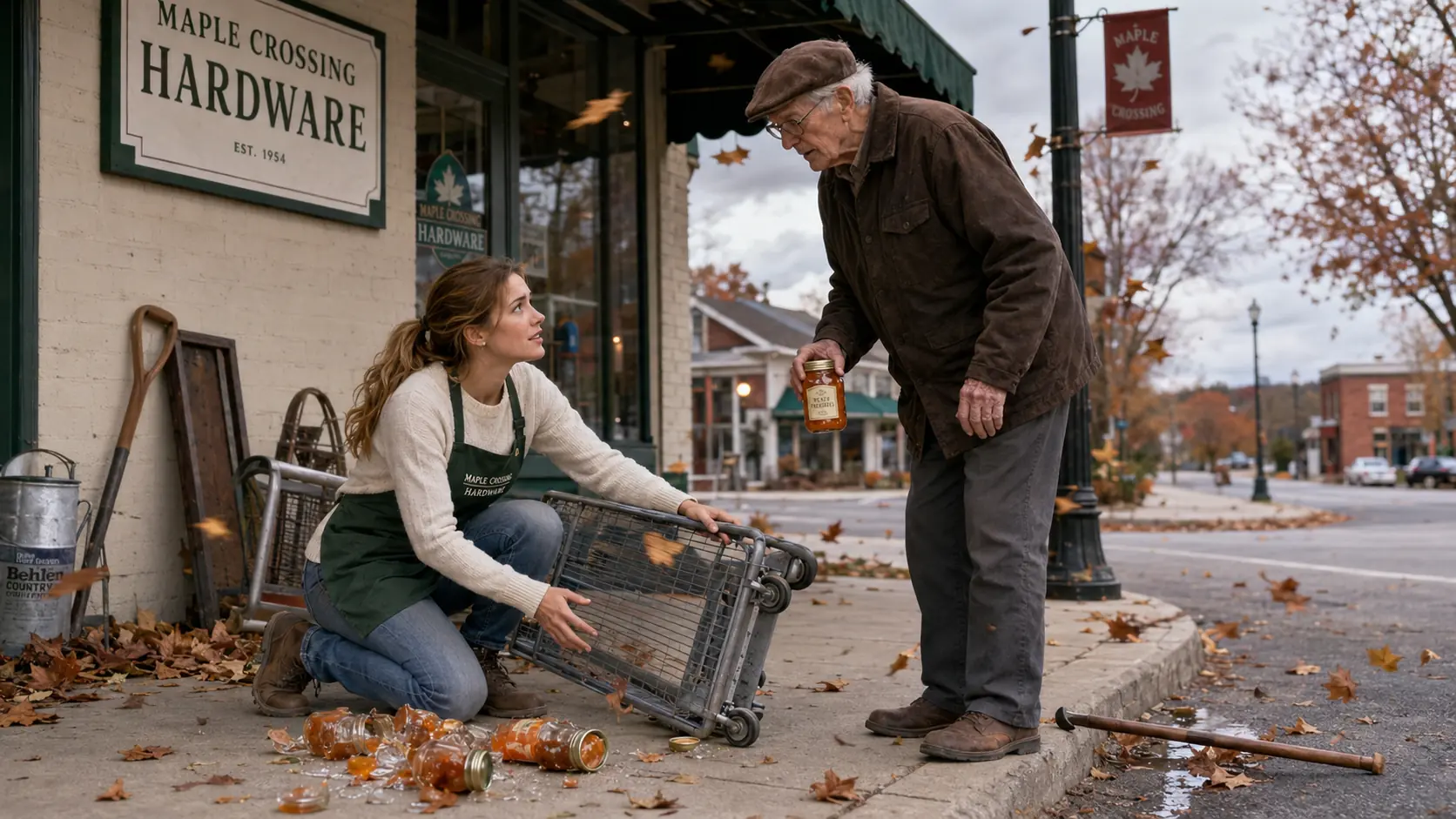
Samuel looked at Katie, then answered softly.
“It means someone remembered that promises sometimes need help getting where they’re going.”
Katie had to look away.
After that night, Samuel began visiting the hardware store every Saturday morning.
At first, he came for ordinary things: screws, labels, jar lids, sandpaper, a better flashlight. Then he began bringing questions from his elderly neighbors.
“Mrs. Bell’s porch rail wiggles.”
“Mr. Adams can’t open his back door when it swells.”
“My neighbor’s steps get slick when it rains.”
“Katie, do you sell brighter bulbs for people who trip over their own shoes?”
Katie realized Samuel had become a messenger for every small hazard in town.
She started writing them down.
Loose railing.
Bad porch light.
High step.
Slippery threshold.
Hard door handle.
Mailbox too far.
No place to sit while unlocking door.
Her notebook for Safe Porch Project began filling faster.
One afternoon, Samuel noticed it.
“What’s that?”
“Just ideas.”
“At my age, just ideas are usually plans waiting for permission.”
Katie smiled.
“I want to help elderly people make their homes safer. Small repairs. Porch rails. Lighting. Steps. Door handles. Things like that.”
Samuel looked at her carefully.
“Then why aren’t you doing it?”
“I don’t have insurance, tools beyond my own, or money to start.”
“Start smaller.”
“How?”
“Come look at my porch.”
So she did.
Samuel’s porch had two loose boards, one weak rail, and a porch light that barely lit the steps. Katie fixed the loose boards with materials Samuel bought from the hardware store. She replaced the bulb with a brighter one and added reflective tape to the step edge. She tightened the railing bracket and made a note that it needed a stronger long-term repair.
Samuel stood at the bottom of the steps and looked at the difference.
“I didn’t realize how nervous I was using those steps until they felt steadier.”
Katie wrote that sentence down.
Then Samuel called Mrs. Bell.
And Mr. Adams.
And two church friends.
Soon Katie was spending Sunday afternoons doing small safety checks for seniors, always careful to stay within what she could legally and safely do. For bigger jobs, she referred them to licensed professionals. But many problems were simple.
A loose screw.
A missing rubber foot.
A dim bulb.
A slippery mat.
A wobbly chair.
Small things.
Important things.
The local church invited Katie to give a short talk after a senior luncheon. She brought examples: a grab bar, brighter bulbs, reflective tape, non-slip pads, lever-style handles, and cane tips.
Samuel sat in the front row wearing his brown cap, nodding as if he had discovered her personally.
Which, in a way, he had.
After the talk, five people asked for home checks.
Then twelve.
Then the senior center called.
Katie began using her evenings and weekends carefully. She did not charge much. Sometimes only materials. Sometimes nothing if someone truly could not pay. The work was exhausting, but it felt right in a way nothing else had.
One morning, Samuel came into the hardware store carrying a flat envelope.
“This is for you,” he said.
Katie grew suspicious.
“What did you do?”
“I became useful.”
“That sounds dangerous.”
He smiled and handed her the envelope.
Inside was a hand-drawn map of Maple Crossing.
But not a regular map.
Samuel had marked homes of elderly residents who needed help, dangerous sidewalks, poorly lit corners, steep church steps, missing benches, and places where curb cuts were blocked or broken.
There were notes in careful handwriting:
Mrs. Bell — rail loose, proud, bring cookies.
Mr. Adams — back step high, bad knees.
Church side door — heavy, sticks in winter.
Post office curb — uneven, where I fell.
Library ramp — slick when wet.
Bench needed between pharmacy and church.
Katie stared at it.
“You made this?”
“Eleanor used to make maps for church deliveries. I borrowed her method.”
“This is incredible.”
“It is practical.”
“It’s more than practical.”
Samuel reached into his coat pocket and pulled out a folded letter.
“I also wrote to the community foundation. They have a small neighborhood safety grant.”
Katie looked up.
“Samuel.”
“You need supplies, insurance help, and permission to become official.”
“I don’t even know if I qualify.”
“You qualify by being the only person already doing the work.”
The letter described the day his cane broke, the repaired cart, the preserves, and every home Katie had helped since. At the end, Samuel wrote:
Katie Bennett understands that safety is not a luxury for elderly people. It is the difference between staying connected and staying trapped.
With Samuel’s letter, her notebook, photos of completed small repairs, and support from the hardware store owner, Katie applied.
She won a modest grant.
Not a fortune.
Not a building.
Not anything grand.
But enough to pay for liability insurance, basic tools, supplies, printed checklists, a small website, and transportation costs.
Safe Porch Project became real.
Katie held her first official safety day at the senior center. She used Samuel’s map to organize volunteer routes. Local teens helped carry supplies. A retired contractor offered advice. The hardware store donated discounted materials.
Samuel sat at the sign-in table with a name tag that read:
Samuel Turner
Map Department
He insisted on the title.
Katie laughed and let him keep it.
Years passed.
Safe Porch Project grew steadily. Katie still worked at the hardware store, but the project became part of the town. Seniors called before winter. Churches hosted safety days. Volunteers checked porch lights and railings. The town council eventually fixed the broken sidewalk where Samuel had fallen.
At the dedication of a new bench halfway between the pharmacy and the church, Samuel sat beside Katie and patted the seat.
“Eleanor would like this,” he said.
“I think so too.”
“She believed people should have places to rest before they had to ask.”
Katie wrote that down too.
Samuel grew older, but he stayed involved as long as he could. He carried his new cane with Eleanor’s brass plate attached to it, polished and shining.
One spring afternoon, he gave Katie one final gift.
It was Eleanor’s old measuring tape.
Soft, faded yellow, rolled inside a little leather case.
“She used this for curtains, quilts, tablecloths, and every church project that needed someone bossy,” Samuel said.
Katie held it carefully.
“I can’t take this.”
“You can.”
“It was hers.”
“Yes. And she would want it used by someone who measures things that matter.”
Katie’s eyes filled.
“I don’t know what to say.”
“Say you’ll keep making safe paths.”
“I will.”
Samuel passed away peacefully that winter.
At his memorial, the church raffle table held jars of peach preserves labeled with Eleanor’s name, made by women from the church using her recipe. Katie placed Samuel’s cane beside his photograph, the brass plate still attached.
Walk Steady, Come Home Safe.
After the service, Samuel’s niece handed Katie a note he had left.
Dear Katie,
The day my cane broke, I thought I had failed Eleanor because I could not even carry her preserves down the street.
You helped me stand.
Then you helped me see that many people in this town were also trying to stand, cross, climb, reach, and keep going with too little help.
Use the map.
Use the tape.
Keep making the small things safer.
Small things are where people live.
With gratitude,
Samuel Turner
Katie framed the map in her office years later.
Safe Porch Project eventually became her full-time work. She never became rich, but she became necessary. She helped elderly people stay in their homes longer, walk to church safely, reach their mailboxes, sit on their porches, and move through their days with less fear.
Whenever someone asked how it began, Katie told the truth.
“It began with an old man on the sidewalk, a broken cane, and peach preserves rolling toward the street.”
Then she would show them Samuel’s map and Eleanor’s measuring tape.
The gifts were small.
A hand-drawn map.
A recommendation letter.
A faded measuring tape.
But inside them was everything Katie needed.
Direction.
Trust.
Purpose.
And every time she fixed a porch rail or measured a step, she remembered what her father had taught her.
People do not always need fancy.
They need safe, steady, and made with care.